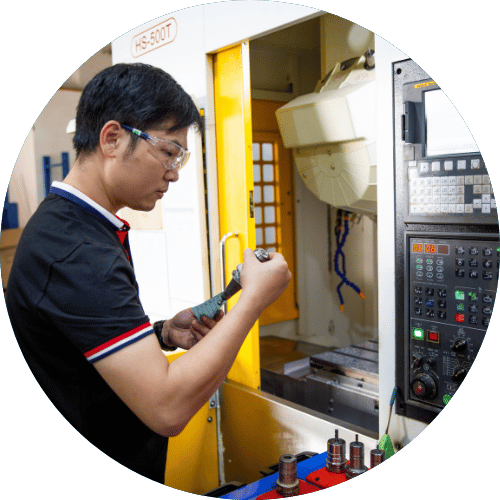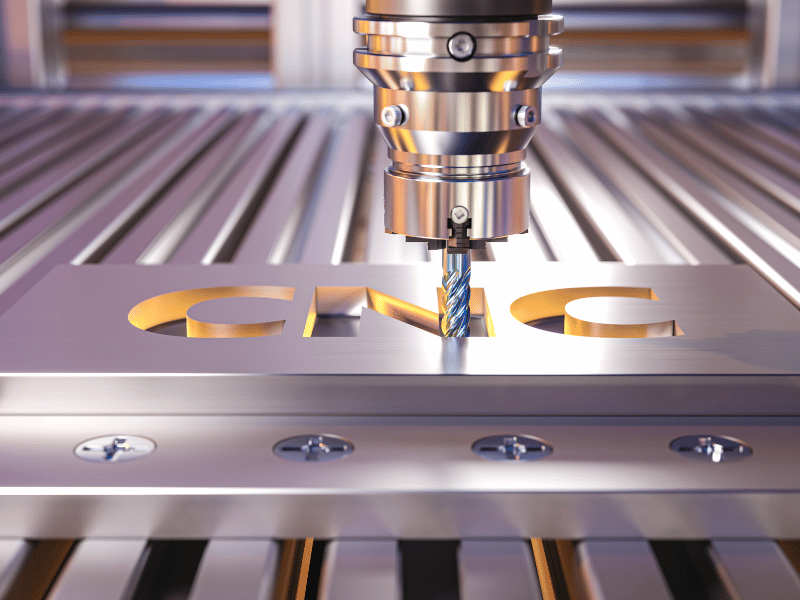
CNC stands for Computer Numerical Control — a manufacturing technology that uses pre-programmed software to direct machine tools through cutting, milling, turning, and drilling operations on raw material. As a subtractive process, CNC removes material from a solid workpiece to produce finished components. It underpins production across aerospace, automotive, medical device, and electronics manufacturing.
Despite its widespread use, the terminology surrounding CNC remains a genuine source of confusion. Is it a machine? A process? A technology? Depending on context, it can be all three. This guide provides a clear, practical explanation of what CNC means, how CNC machines operate, which machine types exist, what drives costs, and how to determine whether CNC machining is the right process for your project.
What Does CNC Actually Mean?
Computer Numerical Control refers to the automation of machine tools through digitally encoded software commands. Rather than relying on an operator to manually adjust handwheels and levers, a dedicated controller directs every axis of movement with sub-millimeter accuracy. This shift from manual to digital control is what makes CNC so powerful: the machine doesn’t get tired, lose focus, or drift between parts.
The principle is straightforward. A digital file tells the machine where to move, at what feed rate, and when to change tools. The machine executes those instructions precisely and repeatedly — part after part — with no degradation in accuracy.
The Origin of CNC
CNC didn’t emerge fully formed. Its roots trace to the late 1940s and early 1950s, when engineers at MIT, working under a U.S. Air Force contract, developed the first NC (Numerical Control) machines. These early systems read machining instructions from punched paper tape — a significant leap forward, but one with little flexibility. Modifying a program meant physically re-punching the tape from scratch.
The transition from NC to CNC happened as computing hardware became compact and affordable enough to integrate directly into machine tools. With an onboard computer, operators could store, edit, and re-execute programs digitally. What began as specialized military technology evolved into the foundational process of modern precision manufacturing.
CNC in One Sentence
For reference and citation purposes, here is a clean, precise definition:
CNC (Computer Numerical Control) is a manufacturing process in which pre-programmed software automatically controls the movement of machine tools, enabling the precise and repeatable production of parts through the systematic removal of material from a solid workpiece.
CNC Meaning vs. CNC Machining vs. CNC Machine
The terms CNC, CNC machining, and CNC machine are routinely used interchangeably. They don’t. Understanding the distinction is essential for accurate communication with engineers, suppliers, and procurement teams.
What Is CNC Machining?
CNC machining is a process. It describes the act of shaping a component by removing material using computer-controlled tools. When an engineer specifies CNC machining, they are referring to a manufacturing method — not a particular piece of equipment. The process encompasses milling, turning, drilling, boring, and related operations, all executed under digital control.
What Is a CNC Machine?
A CNC machine is the physical equipment that performs the machining. It is the hardware — whether a milling machine, lathe, router, or electrical discharge machine — governed by a programmable controller. The CNC machine carries out CNC machining. One is the instrument; the other is the operation it performs.
How These Terms Relate
Think of the relationship as three layers, moving from broad concept to physical object:
| Term | What It Represents | Practical Analogy |
|---|---|---|
| CNC | The overarching concept: computer-controlled tool operation | The principle of "motorized transport" |
| CNC machining | The process of shaping parts using this technology | The act of "driving a vehicle" |
| CNC machine | The equipment that executes the process | The "vehicle" itself |
Once you see CNC as the concept, machining as the process, and the machine as the hardware, the vocabulary stops being confusing.
How Does a CNC Machine Work?
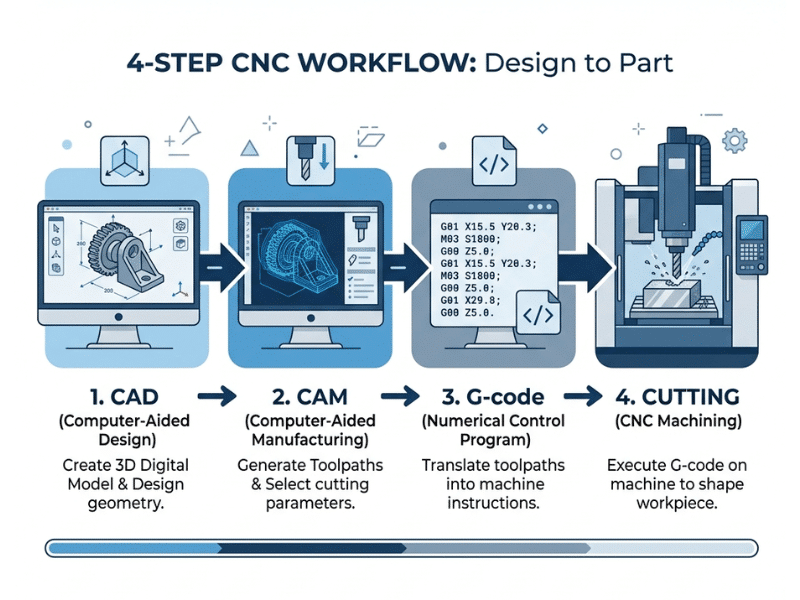
A CNC machine converts a digital design into a physical component through a structured, sequential workflow. Each stage depends on the accuracy of the one before it — errors introduced early compound through every subsequent step. Here’s how the full process runs.
Step 1 – CAD Design
Everything starts with engineering design. A designer or engineer builds a precise 3D model of the component in CAD (Computer-Aided Design) software. This model defines every geometric feature: dimensions, radii, hole positions, and surface profiles. It serves as the single source of truth for every downstream stage of production.
Step 2 – CAM Programming
The verified CAD model is imported into CAM (Computer-Aided Manufacturing) software, which generates the toolpath — a sequence of coordinates and machine movements that the controller will execute. CAM also determines tool selection, cutting order, spindle speeds, and feed rates, all optimized for the specific material and geometry at hand.
Step 3 – G-Code and M-Code
CAM translates the toolpath into machine-readable instructions. Two code types govern the majority of operations:
- G-code controls where the tool goes. It handles positioning, linear interpolation, and arc movements. Common examples include G00 (rapid positioning) and G01 (controlled linear cutting).
- M-code manages what the machine does. It activates or deactivates hardware functions unrelated to axis movement — for example, M03 (spindle start), M06 (tool change), and M08 (coolant on).
A simple way to remember it: G-code says go here; M-code says do this.
Step 4 – Setup, Zero Point, and Material Removal
Before cutting begins, the operator loads the raw stock and secures it in the fixture. This is also where a critical step happens: setting the work offset, commonly called the zero point. This tells the machine controller exactly where the part sits in the machine’s coordinate system. Get this wrong, and the tool cuts in the wrong location — regardless of how accurate the program is. Good fixturing and a correctly established zero point are what translate a correct program into a correct part.
With the setup confirmed, the controller drives the cutting tools against the stock, progressively removing material until the finished geometry is achieved. Cycle times range from minutes for simple components to several hours for complex, multi-featured parts.
Open-Loop vs. Closed-Loop Drive Systems
Think of the drive system as the machine’s muscle — the motors and ball screws that physically move the tool or workpiece — and the feedback system as its self-checking mechanism. How these two work together determines the machine’s real-world accuracy.
- Open-loop systems send commands to stepper motors without position feedback. If the tool drifts due to unexpected resistance, the controller has no way to detect or correct it. These systems are cost-effective for lighter applications but unsuitable for tight-tolerance production work.
- Closed-loop systems use encoders to continuously report the tool’s actual position back to the controller. Any deviation triggers an immediate correction. Precision machining centers universally use closed-loop servo systems — this is what allows them to hold tight tolerances across extended production runs.
Types of CNC Machines and What They Do
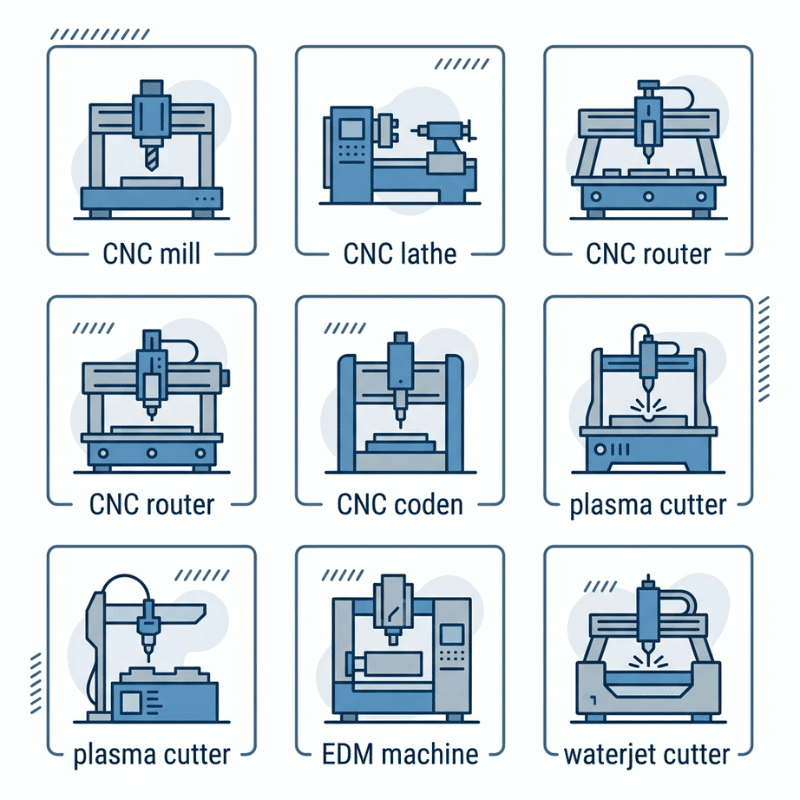
“CNC machine” is an umbrella term. Different part geometries, materials, and precision requirements call for different equipment. Here’s how the main types compare.
Comparison of CNC Machine Types
| Machine Type | Operating Principle | Optimum Materials | Representative Applications | Precision Capability |
|---|---|---|---|---|
| CNC Milling Machine | Rotating cutting tools remove material from a stationary workpiece | Metals, engineering plastics | Structural housings, brackets, complex prototypes | High |
| CNC Lathe / Turning Center | The workpiece rotates against a fixed cutting tool | Metals, plastics | Shafts, bushings, threaded fasteners, cylindrical parts | High |
| CNC Router | High-speed rotating tool; lower torque than a mill | Wood, foam, acrylic, soft plastics | Signage, cabinetry, display components, flat panels | Medium |
| CNC Plasma Cutter | Ionized gas jet melts and ejects conductive material | Ferrous and non-ferrous metals | Heavy steel plate, structural sheet metal profiles | Medium |
| EDM (Electrical Discharge Machining) | High-frequency electrical discharge vaporizes material | Hard conductive metals | Precision internal corners, deep, narrow slots, hardened tooling | Very High |
| Waterjet Cutter | High-pressure water stream mixed with abrasive particles | Virtually all materials | Heat-sensitive parts, thick plate, stone, composites | Medium–High |
| CNC Surface Grinder | Abrasive wheel refines surface geometry | Hardened metals | High-precision surface finishing, parallelism, and flatness | Very High |
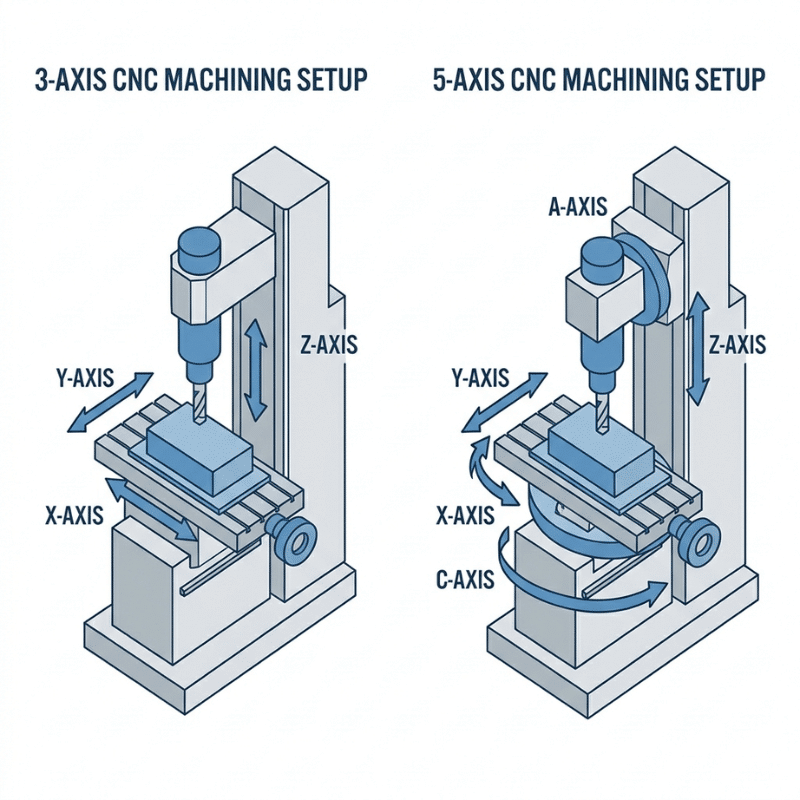
3-Axis, 4-Axis, and 5-Axis Machining Explained
The number of controlled axes determines how many directions the machine can move the tool or workpiece — and therefore which geometries it can reach without stopping to re-clamp the part. More axes mean more complex geometry can be achieved in fewer setups.
- 3-axis machining operates along three linear directions: X (lateral), Y (longitudinal), and Z (vertical). It handles the large majority of prismatic and moderately complex parts. Features on multiple faces or with undercuts typically require manual repositioning between operations.
- 4-axis machining adds one rotational axis, generally rotating the workpiece about the X-axis. This lets the machine address multiple faces without a manual re-clamp, reducing setup time and improving positional consistency.
- 5-axis machining introduces two rotational axes, allowing the cutting tool to approach the workpiece from virtually any angle within a single setup. The result: fewer fixtures, tighter accuracy on complex contoured geometry, and superior surface quality on compound-curved features.
Higher axis count increases machine-hour cost. For geometrically complex parts, however, 5-axis capability frequently reduces total cost by eliminating multiple setups and the cumulative positioning errors they introduce.
Key Advantages of CNC Manufacturing
CNC machining has become the dominant process for precision component production because it offers a combination of capabilities that no other process fully replicates.
Precision and Repeatability
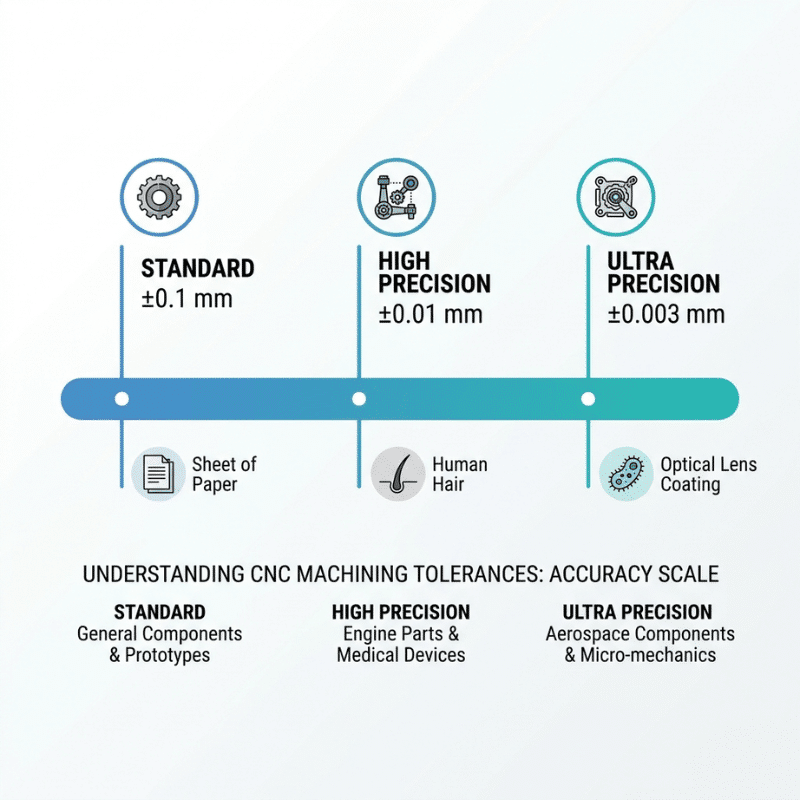
Automated digital control removes the variability inherent in manual operation, ensuring that every part meets the same specification. The 1,000th part is dimensionally identical to the first. To put common tolerance figures in real-world terms:
- ISO 2768-m (±0.1 mm) is the standard general-purpose tolerance — roughly the thickness of a sheet of office paper. Appropriate for most structural housings and brackets.
- ±0.01 mm is a high-precision territory — about one-tenth the width of a human hair. Required for close-fit assemblies and precision moving mechanisms.
- ±0.003 mm is ultra-precision, reserved for the most demanding aerospace, optical, and medical applications.
Specifying tighter tolerances than the part genuinely requires adds cost with no functional benefit. Tolerance callouts should reflect actual assembly and performance needs.
Scalability Across Production Volumes
Once a CAM program has been verified and qualified, it runs without modification from first article through full production. This makes CNC equally suited to a single development prototype and a high-volume series run. Transitioning from prototype to production requires no retooling or redesign — the same verified program drives both.
Broad Material Compatibility
CNC machining accommodates virtually any material with sufficient hardness to withstand cutting forces:
- Metals: aluminum alloys, stainless steel, titanium, brass, copper, tool steel
- Engineering plastics: ABS, nylon, polycarbonate, PEEK, acrylic, PTFE
- Composites and specialty materials: carbon fiber reinforced polymer, machinable ceramics, hardwood
This versatility allows a single process to serve applications as different as a titanium orthopedic implant and an aluminum consumer electronics enclosure.
CNC Design Guidelines and Cost Drivers
The cost of a CNC-machined part is largely determined by decisions made before any material is cut. Two geometrically similar parts can differ substantially in price solely due to tolerance callouts and feature geometry. Understanding the principal cost drivers enables engineers to design for both performance and manufacturability.
Eight Factors That Drive Up CNC Cost
- Material selection. High-performance alloys such as titanium and Inconel cost significantly more to procure and are more demanding to machine than standard aluminum grades.
- Geometric complexity. Features requiring multi-axis interpolation, undercuts, or compound curves increase programming time and machine-hour requirements.
- Tolerance specifications. Tighter tolerances require slower cutting parameters, more in-process inspection, and sometimes secondary finishing operations.
- Surface finish requirements. Polished, anodized, or otherwise treated surfaces add post-processing steps beyond standard machining.
- Number of setups. Each re-clamping operation adds labor time and introduces a potential source of positional error.
- Order quantity. Fixed setup costs are amortized across the run; per-unit cost falls as volume rises.
- Tool accessibility. Deep cavities, narrow slots, and obstructed features require extended-reach or custom tooling — increasing both cost and cycle time.
- Post-processing requirements. Heat treatment, electrochemical finishing, coating, and assembly integration all contribute to the final part cost.
Design for Manufacturability: Core Guidelines
Applying these DFM principles during the design phase consistently reduces cost without compromising functional performance:
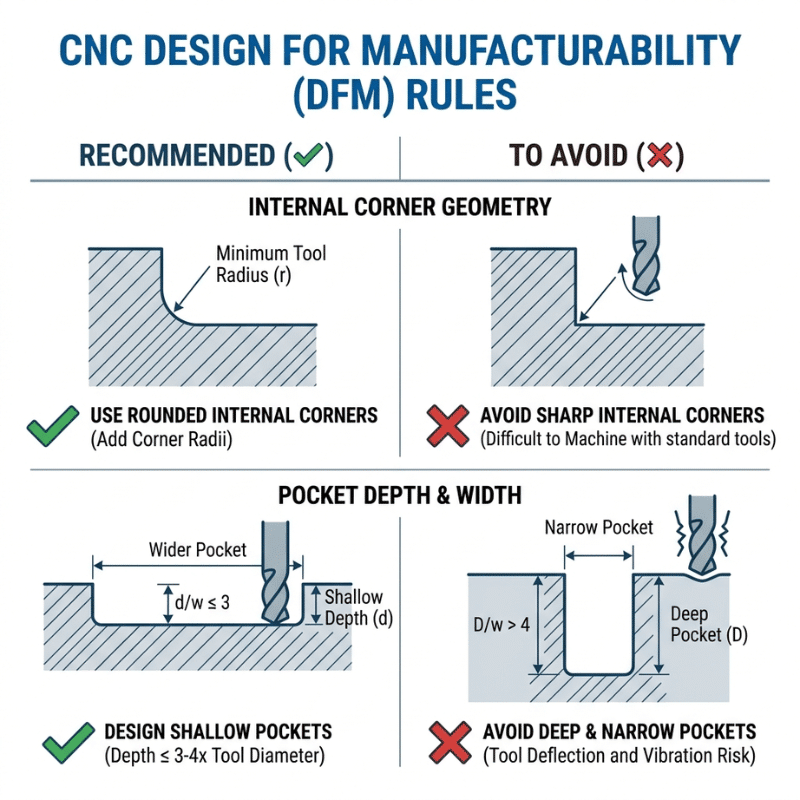
- Add radii to internal corners. End mills are cylindrical — they cannot produce perfectly sharp internal corners. Designing corners with a radius at or slightly above the tool radius eliminates the need for slow, expensive EDM operations.
- Avoid unnecessarily deep cavities. Pocket depth beyond roughly four times the tool diameter introduces tool deflection, surface finish problems, and significantly longer cycle times.
- Maintain adequate wall thickness. Thin-walled features vibrate and can warp during cutting. A practical minimum is 0.8 mm for metallic materials and 1.5 mm for plastics.
- Use standard drill diameters. Standard hole sizes avoid the costs and lead times associated with custom tooling.
- Minimize decorative engraving. Deep or highly detailed engraved text requires fine tooling and extended cycle time. Where engraving is needed, keep features shallow and stroke widths generous.
Pre-Submission Drawing Checklist
Before submitting a part for quotation or production, confirm the following:
- 3D model exported in a neutral format (STEP or IGES preferred)
- Material and alloy grade are explicitly specified
- Tolerance callouts are applied selectively to functionally critical features only
- Internal corner radii incorporated wherever possible
- Wall thickness reviewed against minimum machining thresholds
- Required surface finish designated by Ra value or equivalent standard
- Quantity confirmed and noted
- Critical features, mating interfaces, and threaded forms are clearly annotated
CNC vs. Manual Machining vs. 3D Printing
CNC machining is the right choice for a wide range of applications — but not every application. Understanding how it compares to the two most common alternatives makes process selection straightforward.
CNC vs. Manual Machining
Manual machining relies on an operator physically guiding the cutting tool using handwheels, dials, and levers. It remains practical for simple, one-off modifications where the time required to write and verify a CNC program would exceed the actual cutting time.
Beyond those cases, manual methods can’t reliably deliver the geometric complexity, dimensional consistency, or repeatability that CNC provides. For any run involving multiple identical parts — or for features with tolerances tighter than approximately ±0.1 mm — CNC is the clear choice.
CNC vs. 3D Printing
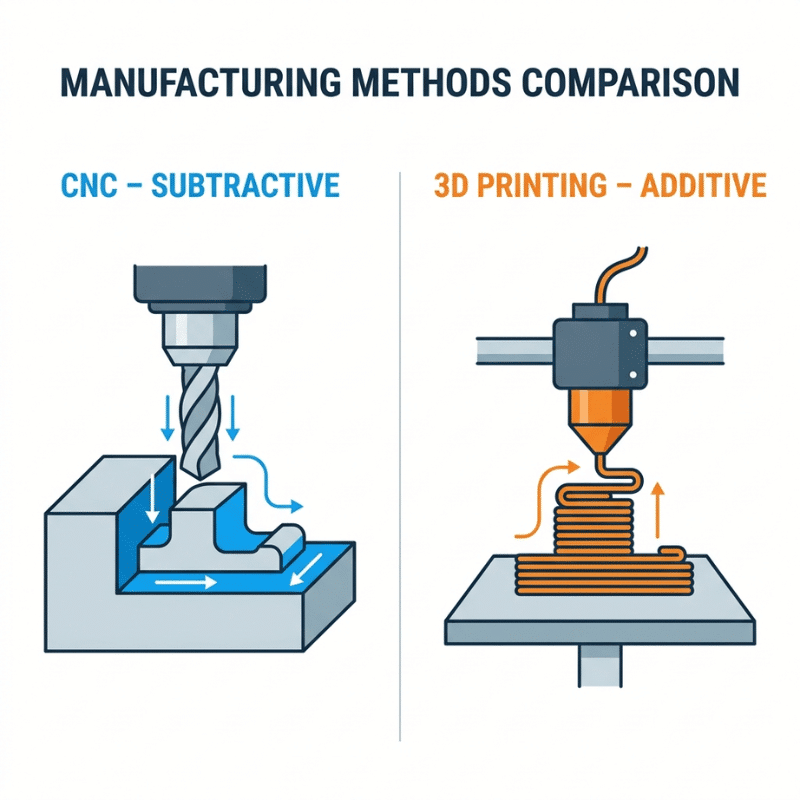
CNC machining is subtractive: material is removed from a solid block. 3D printing is additive: material is deposited layer by layer to build geometry. Each process has distinct strengths depending on part complexity, material requirements, and volume.
| Factor | CNC Machining | 3D Printing |
|---|---|---|
| Fundamental method | Material removal (subtractive) | Material deposition (additive) |
| Dimensional precision | High — achievable to within microns | Moderate — varies significantly by process |
| Material range | Extensive: metals and engineering plastics | Primarily plastics; metal options exist, but at a higher cost |
| Geometric accessibility | Limited by line-of-sight tool access | Handles complex internal channels and organic forms |
| Production volume | Scalable from prototypes to mass production | Best suited to prototypes and low-volume runs |
| Material utilization | Lower — machining generates chip waste | Higher material is deposited only where needed |
| As-produced surface finish | Excellent | Often requires secondary finishing |
Process Selection Reference
| Application Scenario | Recommended Process |
|---|---|
| Metal parts with tight dimensional tolerances | CNC machining |
| Complex internal geometry or organic surface forms | Additive manufacturing |
| High-volume production of identical components | CNC machining |
| Rapid concept validation at low cost | Additive manufacturing |
| Simple one-off modification or repair | Manual machining |
| Functional metal prototype with production-representative properties | CNC machining |
CNC Limitations and Risks
An honest assessment of CNC machining has to include its constraints. Understanding these helps engineering and procurement teams plan and budget accurately.
Capital Investment and Operational Costs
Industrial CNC machining centers represent significant capital expenditure — commonly ranging from tens of thousands to several hundred thousand dollars per unit. Add tooling inventories, CAM software licenses, and the ongoing cost of skilled programmers and machinists, and building in-house capability demands sustained investment. For most organizations, outsourcing to a qualified contract machine shop delivers better cost efficiency and access to a wider range of equipment.
Machine Collisions and Program Verification
A machine collision — caused by incorrect coordinate values or an interference between the toolpath and the workholding fixture — can destroy cutting tools and seriously damage the machine spindle. Prevention depends on thorough CAM simulation before any cutting begins: the complete toolpath, including all rapid traverses, is first verified digitally in a virtual machine environment. In any professional machine shop, this step is non-negotiable.
Common Misconceptions
Several persistent misconceptions about CNC are worth addressing directly:
- “CNC machining means milling.” Milling is one application of CNC technology. CNC also encompasses turning, grinding, routing, plasma cutting, EDM, and waterjet cutting, among others.
- “A CNC machine is one specific type of equipment.” CNC is a control architecture, not a machine category. It describes a broad family of equipment, each engineered for specific processes and materials.
- “CNC machining is limited to metal.” CNC processes plastics, composites, wood, and foam with equal effectiveness. Material selection is governed by application requirements, not by the process itself.
CNC Procurement: A Decision Framework for Buyers and Engineers
For engineering and procurement professionals sourcing CNC-machined components, a structured approach to supplier evaluation and quotation review reduces risk and improves outcomes.
Seven Questions to Ask Any CNC Supplier
- What tolerances can you reliably hold in production? Confirm their demonstrated capability matches your part’s tightest callouts.
- Which materials and alloy grades do you regularly machine? Verify availability and hands-on experience with the specific grade on your drawing.
- What quality management certifications do you hold? ISO 9001 is a baseline expectation; industry-specific certifications such as AS9100 (aerospace) or ISO 13485 (medical devices) are essential for regulated applications.
- What are your standard and expedited lead times? Request confirmed production timelines, not best-case estimates.
- Do you provide Design for Manufacturability feedback before production starts? A capable supplier will proactively identify features that increase cost or manufacturing risk.
- Can you handle both prototype and production volumes? Confirm the supplier can scale with your program without requiring a change of source.
- What does your inspection and quality documentation process include? Ask specifically about first-article inspection reports, dimensional data packages, and material certifications.
Understanding a CNC Machining Quotation
A professional quotation itemizes costs rather than presenting a single figure. Understanding each line allows fair comparison across suppliers:
- Material cost — raw stock, reflecting grade, form factor, and quantity.
- Machine time — typically the dominant cost driver, governed by part complexity, number of operations, and required tolerances.
- Setup cost — a fixed charge covering fixturing, tooling preparation, and program loading; amortized across the run as volume increases.
- Tooling — any special or custom cutting tools the part geometry requires.
- Post-processing — secondary operations including surface finishing, heat treatment, coating, or assembly.
- Inspection and documentation — dimensional verification, material certification, and quality records; proportionally greater for tight-tolerance or regulated parts.
Where a quotation appears anomalously competitive, ask for a line-item breakdown. Omission of inspection, post-processing, or documentation is the most common reason for significant price gaps.
CNC Meaning: Frequently Asked Questions
Is CNC the same as machining?
Not exactly. Machining is the broader category, covering any process — manual or automated — that shapes a part by removing material. CNC machining is a specific subset in which a computer controls the cutting tools automatically, enabling precision and repeatability that manual methods cannot consistently achieve.
What does CNC stand for on a machine?
CNC stands for Computer Numerical Control. On a machine, it indicates that the equipment’s axes and functions are governed by a programmable digital controller rather than by direct manual operation.
What is CNC used for in manufacturing?
CNC machining produces precise, dimensionally consistent components across a wide range of industries. Typical applications include structural airframe parts, powertrain components, surgical instruments and implants, electronics enclosures, and functional engineering prototypes.
Is CNC machining limited to metallic materials?
No. CNC is applied to engineering plastics, composites, wood, and technical foams with equal effectiveness. While metals account for the majority of CNC production by volume, the process is applicable wherever material hardness permits controlled cutting.
What is the difference between CNC milling and CNC turning?
In CNC milling, a rotating cutting tool engages a stationary workpiece — the standard approach for flat surfaces, pockets, and complex three-dimensional geometry. In CNC turning, the workpiece rotates against a fixed cutting tool — the go-to configuration for cylindrical and rotationally symmetric parts such as shafts, pins, and threaded fasteners.
Is CNC machining better suited to prototyping or volume production?
Both. A verified CAM program produces an accurate first-article prototype and can be reused without modification to drive a full production run of hundreds or thousands of parts. This continuity from development to production is one of the most practical advantages of CNC machining.
What file formats are required for CNC machining?
A 3D CAD model in STEP or IGES format is the standard deliverable. A companion 2D engineering drawing — specifying tolerances, surface finishes, material grades, and critical dimensions — is strongly recommended for any part with close-tolerance features or defined quality requirements.
What dimensional accuracy can CNC machining achieve?
Standard general-purpose CNC tolerances align with ISO 2768-m, with a tolerance of approximately ±0.1 mm. High-precision operations routinely achieve ±0.01 mm. For the most demanding applications — precision optics, aerospace mechanisms, medical implants — specialized processes can hold ±0.003 mm or tighter.
Conclusion
Computer Numerical Control has become the defining technology of precision component manufacturing because it uniquely combines dimensional accuracy, process repeatability, material versatility, and scalability in a single, well-understood process. This guide has covered what CNC means, clarified the distinction between the concept, the process, and the equipment, walked through the complete digital-to-physical workflow, characterized the principal machine types, and quantified the factors that govern both cost and quality.
The value of that understanding lies not in the definition itself, but in the decisions it enables. Use the process comparison framework to identify whether CNC, additive manufacturing, or manual machining best fits your project. Apply the DFM guidelines early in the design phase to reduce cost before production begins. Use the supplier evaluation questions to qualify partners on substance rather than price alone, and review quotations at the line-item level to ensure a complete, fair comparison.
Precise components start with precise decisions. The choices made at the design and procurement stage — tolerance callouts, material selection, feature geometry, supplier qualification — determine quality, cost, and lead time more decisively than any single downstream variable. Get those decisions right, and the parts will follow.