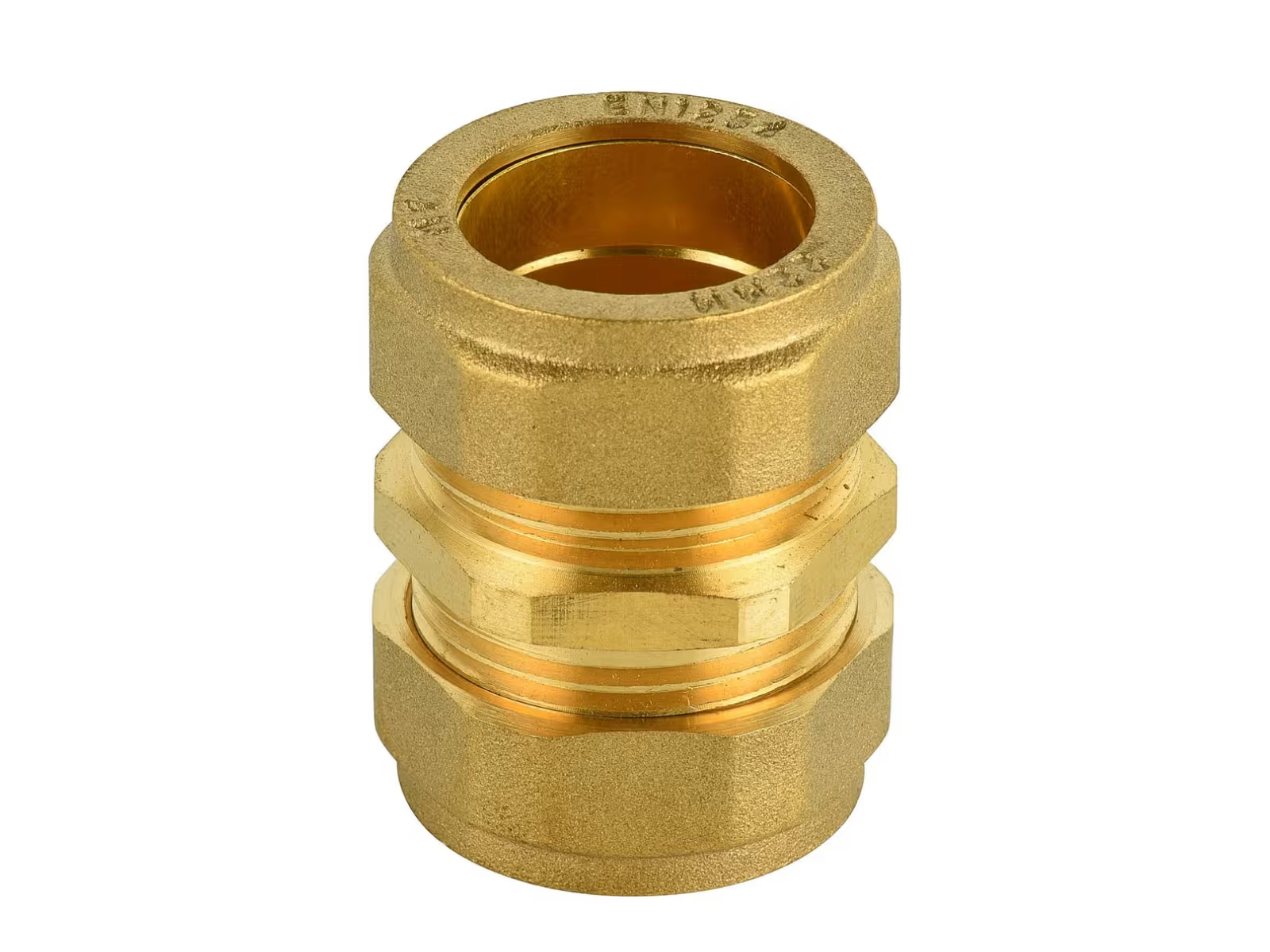
Brass is a copper-zinc alloy. You’ve almost certainly touched some today — the valve body in your kitchen faucet, the terminal crimped onto a power cord, the bell of a trumpet. It’s also one of the most deliberately engineered families of metals in industrial use, which is why the word “brass” covers dozens of alloys that behave very differently from one another on the shop floor.
This guide covers what brass is, where it came from, how it differs from bronze and copper, and why zinc content drives almost every property decision that matters. We’ll go through the main grade families, real applications by industry, and the lead-free regulations now reshaping specifications. By the end, you should be able to move from “we need brass” to a grade choice you can defend.
Brass in Five Facts
- Brass is an alloy of copper and zinc, with zinc typically running from about 5% to 45%. Small additions of lead, tin, aluminum, or silicon tune performance for specific jobs.
- Zinc content controls microstructure. Alpha brasses (below roughly 35–37% zinc) cold-form well; alpha-beta brasses hot-forge and machine well.
- Brass is copper plus zinc. Bronze is primarily copper plus tin. Quite a few alloys named “bronze” are actually brasses.
- Three grades cover a large share of industrial demand: C26000 for forming, C36000 for machining, C46400 for marine hardware.
- Brass is fully recyclable without property loss, and certified lead-free grades satisfy current US and EU drinking-water requirements.
What Is Brass?
Brass is a substitutional alloy — zinc atoms replace copper atoms in the crystal lattice rather than squeezing between them. That’s why copper and zinc mix across such a wide composition range, and why color shifts gradually from reddish copper toward bright yellow as zinc climbs. Brass is a family of alloys, not a single material. A 90/10 brass and a 60/40 brass share a name but handle like different metals once they hit a machine tool.
The alloy exists for practical reasons. Zinc costs less than copper, so each point of zinc brings down the raw-material bill. It also raises strength and hardness, and it lowers the melting point: most brasses melt somewhere between 900°C and 940°C, against 1,085°C for pure copper. That gap matters in a foundry or extrusion shop — lower energy, easier processing, smaller furnace requirements.
What Is Brass Made Of?
Common copper-zinc ratios are 90/10, 85/15, 70/30, and 60/40. The convention always lists copper first, so “70/30 brass” means 70% copper and 30% zinc. In North America, wrought brasses carry UNS designations in the C2xxxx–C4xxxx range, with leaded and specialty alloys running into the C3xxxx, C4xxxx, and C6xxxx series. European buyers will see EN codes — CW617N being one of the most common for forging brass.
Beyond copper and zinc, most commercial brasses include small deliberate additions: lead, tin, aluminum, silicon, arsenic, or bismuth. These rarely exceed 3–4% combined, yet they determine whether a grade machines cleanly, holds up in seawater, or passes a drinking-water certification. We’ll get into what each one actually does in the composition section below.
A Brief History of Brass
The earliest brass objects appear in the Near East, probably produced by accident when early metalworkers smelted copper ores that happened to contain zinc minerals. Deliberate production came later, through what’s known as the cementation process — copper heated with calamine (a zinc carbonate ore) and charcoal in a sealed crucible. Zinc vapor diffused into the copper and produced brass. No one was isolating metallic zinc yet; they were working blind, by result.
The Romans standardized it. They called the alloy orichalcum and, following Augustus’s monetary reforms around 23 BC, began striking the sestertius and dupondius in brass. Those coins represent one of the earliest cases of a copper alloy made to a consistent specification at meaningful scale — the golden color was also a deliberate visual signal, distinguishing them from copper denominations.
The next step required pure zinc. Large-scale zinc smelting by distillation was established at Zawar in Rajasthan, India, well ahead of European practice. When the direct process arrived in Britain — James Emerson’s 1781 patent for combining copper directly with metallic zinc — composition control finally became straightforward. Makers could hit a target ratio reliably, not just approximate it.
Industrialization drove the rest. George Frederick Muntz patented his 60/40 brass in 1832, originally for ship hull sheathing as a cheaper substitute for copper. Drawn cartridge cases created enormous demand for 70/30 brass. Waterbury, Connecticut, became “The Brass City.” Today’s UNS and EN systems are essentially the formal codification of what that industrial history produced.
Brass vs Bronze vs Copper: What’s the Difference?
The distinction is chemical. Brass is copper plus zinc. Bronze is copper plus tin, often with phosphorus, aluminum, or silicon. Commercial copper runs 99.9% copper or better. The confusion is understandable — colors overlap, and several brasses carry “bronze” in their trade names simply because of appearance or historical convention, not chemistry.
The selection logic isn’t complicated once you know the properties. Copper wins when conductivity is what matters most. Bronze wins for wear surfaces, bushings, and long-term seawater service. Brass wins when you need good machinability, decent corrosion resistance, an attractive finish, and a lower cost per kilogram.
|
Property |
Brass |
Bronze |
Copper |
|---|---|---|---|
|
Main composition |
Cu + Zn |
Cu + Sn (± P, Al, Si) |
≥99.9% Cu |
|
Typical color |
Yellow to gold |
Reddish-brown |
Salmon-red |
|
Approx. melting range |
900–940°C |
950–1,050°C |
1,085°C |
|
Electrical conductivity |
~25–45% IACS |
~7–15% IACS (typical) |
~100% IACS |
|
Machinability |
Excellent (leaded grades) |
Moderate |
Poor (gummy) |
|
Seawater resistance |
Moderate (tin grades better) |
Excellent |
Good |
|
Typical uses |
Fittings, connectors, instruments |
Bearings, bushings, marine propellers |
Wiring, busbars, heat exchangers |
Values vary by grade and temper. Confirm against the specific alloy datasheet.
How to Tell Brass and Bronze Apart
Color is the first clue: brass reads yellow or gold, bronze leans reddish-brown. Bronze tends to feel slightly denser, and when struck it rings with a duller note. Aged surfaces are sometimes useful — bronze patinas toward dark brown or green, while brass dulls toward brownish gold. None of that is definitive, though. Plating, lacquer, and high-copper brasses all muddy the visual cues. For anything that actually matters — incoming inspection, scrap sorting, failure investigation — use handheld XRF or lab analysis.
Common Misconception
C22000 “commercial bronze,” C38500 “architectural bronze,” and Muntz metal contain no meaningful tin. All three are brasses. Their names reflect color or tradition, not chemistry. Always specify by UNS or EN designation, never by trade name alone.
If your part could plausibly be either brass or bronze, or you’re weighing whether copper’s conductivity justifies its cost, the short comparison above won’t settle it. Our guide to brass vs. bronze vs. copper differences, properties, and best uses puts the three metals side by side and shows where each one fits best.
How Composition Shapes Brass Properties
Zinc is the master variable. As it rises, strength and hardness climb and color shifts toward yellow. Electrical and thermal conductivity fall steadily. Ductility actually improves up to roughly 30% zinc — which is why 70/30 brass deep-draws so well — then falls as the microstructure transitions. That transition point, around 35–37% zinc, defines the boundary between the two main brass families.
Common Alloying Additions
Small additions let metallurgists fine-tune a copper-zinc base for a specific application:
- Lead: Forms dispersed particles that break chips into short fragments. Makes leaded grades like C36000 the machinability benchmark for high-speed turning and screw-machine work.
- Tin: Boosts seawater corrosion resistance. Defines naval brass (C46400) and admiralty brass (C44300).
- Aluminum: Builds a tough, self-healing oxide film that holds up against erosion in fast-moving water — the reason aluminum brass (C68700) is specified for condenser tubing.
- Arsenic: Added at around 0.02–0.06% to inhibit dezincification in alpha brasses such as admiralty and aluminum brass.
- Silicon and bismuth: Deliver machinability without lead, which is what makes lead-free grades like C69300 viable for drinking-water components.
How Brass Is Made and Formed
Production starts with melting — copper, zinc, and a substantial share of recycled scrap, cast into billets, cakes, or ingots. Mills then extrude rod and tube, roll strip and sheet, or draw wire. Manufacturers convert that feedstock by hot forging, stamping, deep drawing, or CNC machining. Grade and process are linked: alpha brasses are suited to cold rolling and drawing; alpha-beta brasses to hot forging and extrusion. Picking the right grade for the wrong process wastes both material and machining time.
Types of Brass
Brasses are classified by microstructure, which is controlled primarily by zinc content. Knowing which family a grade belongs to tells you how it will form, machine, and corrode before you’ve looked at a single datasheet value.
Alpha Brasses
Alpha brasses sit below roughly 35–37% zinc. Their single-phase, face-centered cubic structure is highly ductile at room temperature, which makes them well suited to deep drawing, stamping, spinning, and cold heading. C23000 red brass and C26000 cartridge brass are the most common. You’ll find them in ammunition cases, springs, radiator cores, lamp bodies, and drawn shells. Hot working is harder than with duplex grades.
Alpha-Beta (Duplex) Brasses
Alpha-beta brasses run roughly 37–45% zinc and have a two-phase structure. The beta phase makes them harder and less cold-ductile, but considerably easier to hot forge and extrude. C28000 Muntz metal, C36000 free-cutting brass, and the European forging brass CW617N all sit here. The trade-off is corrosion: the zinc-rich beta phase is more susceptible to dezincification, which matters in aggressive water applications.
Specialty and Lead-Free Brasses
Specialty brasses add elements to handle specific environments. Naval brass puts in tin for seawater service. Admiralty brass combines tin with arsenic for heat exchanger tubing. Aluminum brass resists high-velocity cooling water. DZR (dezincification-resistant) brasses use controlled composition and sometimes heat treatment to stay stable in aggressive potable water. Lead-free silicon and bismuth brasses came out of the need to maintain machinability while satisfying drinking-water lead limits.
Common Brass Grades at a Glance
North American specifications use UNS numbers, with wrought copper alloys running from C10000 to C79999. International buyers often encounter European EN designations instead. The footnote below gives common cross-references. Treat all compositions as nominal — each standard sets permitted ranges, and actual certification values can vary.
|
UNS No. |
Common Name |
Approx. Composition |
Key Trait |
Typical Uses |
|---|---|---|---|---|
|
C22000 |
Commercial Bronze |
90 Cu / 10 Zn |
Rich bronze color, very ductile |
Jewelry, emblems, architectural trim |
|
C23000 |
Red Brass |
85 Cu / 15 Zn |
Good corrosion resistance, warm tone |
Plumbing pipe, instrument bells, badges |
|
C26000 |
Cartridge Brass |
70 Cu / 30 Zn |
Best cold-forming balance |
Ammunition cases, springs, radiator parts |
|
C27200 |
Yellow Brass |
~63 Cu / 37 Zn |
Lower cost, good formability |
Stampings, hardware, lamp parts |
|
C28000 |
Muntz Metal |
60 Cu / 40 Zn |
Strong, hot-works easily |
Large nuts and bolts, architectural panels |
|
C36000 |
Free-Cutting Brass |
~61.5 Cu / 35.5 Zn / 3 Pb |
Machinability benchmark (100) |
Screw-machine parts, valve stems, fittings |
|
C44300 |
Admiralty Brass |
~71 Cu / 28 Zn / 1 Sn + As |
Inhibited against dezincification |
Condenser and heat exchanger tubes |
|
C46400 |
Naval Brass |
~60 Cu / 39.2 Zn / 0.8 Sn |
Seawater resistance, strength |
Marine shafts, fasteners, fittings |
|
C68700 |
Aluminum Brass |
~77.5 Cu / 20.5 Zn / 2 Al + As |
Erosion resistance |
Power plant and desalination tubing |
|
C69300 |
Lead-Free Silicon Brass |
~75 Cu / 21 Zn / 3 Si |
Machinable without lead |
Potable-water valves and fittings |
Common EN cross-references: CW603N ≈ C36000; CW614N is close to C38500; CW617N is the standard European hot-forging brass. These are approximate — compare element-by-element before substituting.
Work through the table in order: process first (machining, forming, or forging), then service environment (potable water, seawater, outdoor exposure), then compliance requirements. If your part sits between two grades — say, C36000 for machining speed versus C69300 for potable-water compliance — Essengold’s team can compare the options against your drawing and application before you commit.
Key Properties and Benefits of Brass
Every property below connects back to composition. The right way to think about brass isn’t as a list of virtues; it’s as a set of trade-offs that you steer by picking the right grade.
Machinability
C36000 free-cutting brass is the reference point, rated 100 on the standard copper-alloy machinability scale. Its lead particles break chips into short curls instead of long strings, so parts run faster with fewer stoppages. In a high-volume screw-machine shop, that translates to shorter cycle times, longer tool life, and lower cost per piece — often enough to offset a higher material cost compared with steel.
Corrosion Resistance (and Dezincification)
Brass contains no iron, so it can’t rust. In air and fresh water it forms a thin protective oxide and patina. The real corrosion risk is dezincification: in certain water chemistries, zinc selectively leaches out, leaving porous, weakened copper behind. A fitting can look fine externally while it’s lost most of its structural integrity. DZR brasses, arsenic-inhibited alpha grades, and tin-bearing grades all reduce this risk substantially.
Watch Out: Dezincification
Soft, acidic, or high-chloride water — especially when stagnant or warm — raises the risk sharply, particularly for alpha-beta grades. In those environments, specify DZR brass, an inhibited alpha brass like C44300, or a lead-free silicon brass. Standard leaded brass is not the right call.
Electrical and Thermal Conductivity
Brass conducts at roughly 25–45% IACS depending on grade, against about 100% for pure copper. Higher-copper grades sit at the top of that range. For terminals, plug pins, and connectors, that’s workable — and in those applications, you also need spring behavior and formability that copper can’t deliver at the same cost.
Strength, Ductility, and Durability
Temper controls brass strength nearly as much as composition does. Cold-worked C26000 in a spring temper can reach several times the yield strength of the same alloy in the annealed state. That’s why springs, contacts, and clips rely on cold-rolled cartridge brass: it holds force through repeated deflection without cracking.
Acoustic Properties
Brass combines density and stiffness in proportions that support clean resonance — which is why instrument makers have used it for centuries. Bell alloy makes an audible difference: yellow brass (around 70/30) sounds bright and projecting, while gold or red brass (around 85/15) sounds warmer and darker.
Antimicrobial and Low-Sparking Behavior
The US EPA has registered hundreds of copper alloys, including many brasses, as antimicrobial surfaces that kill specified pathogens on contact. Any public claim about this needs to stay inside the specific language of that registration. Separately, brass is a standard material for tools and fittings in environments where a ferrous spark could ignite flammable gases or dust.
Applications of Brass Across Industries
The pattern across industries is consistent: a specific part, a property that makes brass the right call, and a grade that actually delivers it. Generic “brass” specs rarely survive contact with an application requirement.
Plumbing and Water Systems
Valves, fittings, faucet bodies, and meter housings are where brass earns its volume. Machinability keeps complex threaded geometry affordable, and brass handles both hot and cold water without issue. For drinking-water service, specifications have moved firmly toward DZR brass and lead-free grades such as C69300 or bismuth brasses. Essengold supplies material for water-system components with these compliance requirements in mind — confirm the certified grade before releasing the drawing.
Electrical and Electronics
Terminals, plug pins, sockets, battery contacts, and connector housings all rely on brass. C26000 is the common choice for a reason: it balances conductivity, spring properties, and solderability in one alloy. Brass also accepts tin and nickel plating cleanly, which extends contact-surface life.
Automotive, HVAC, and Industrial Equipment
Sensor housings, hydraulic fittings, pneumatic components, and fuel system parts are typical automotive uses. In HVAC and power generation, admiralty and aluminum brass tubes carry cooling water through condensers and heat exchangers, where erosion resistance under high flow is the design constraint. Certain high-strength special brasses also handle synchronizer rings in manual gearboxes, where dimensional stability under wear matters.
Marine Hardware
Naval brass (C46400) is the standard for propeller shafts, fasteners, turnbuckles, and deck fittings. Its tin content puts it ahead of standard brass in seawater. That said, it’s an alpha-beta alloy, and long-term immersion in aggressive seawater can still trigger dezincification — which is why many critical below-waterline parts are bronze rather than brass.
Musical Instruments
Trumpets, trombones, French horns, and tubas are built from brass sheet, spun and hammered and drawn into bells and tubing. The choice of bell alloy — yellow, gold, or red brass — is partly acoustic, partly tradition. Brighter tone from yellow; warmer, darker sound from red.
Architectural and Decorative Hardware
Door handles, locksets, hinges, lighting fixtures, and signage are all common brass applications. Keys are almost always cut from leaded brass because it machines cleanly and holds a sharp thread. Specifiers choose between a living finish that develops patina naturally and a lacquered finish that holds its original color — a choice that often comes down to the building’s maintenance budget as much as aesthetics.
Ammunition
C26000 cartridge brass earns its name here. It deep-draws into a case without cracking at the neck, and on firing it expands to seal the chamber, then springs back enough to extract cleanly. Few materials handle that combination of demands as reliably.
Brass Recycling, Sustainability, and Lead-Free Standards
Brass is one of the most recycled engineering metals in circulation. It remelts without property loss, and machining chips (swarf) are routinely collected and returned to the mill rather than landfilled. Industry figures consistently put recycled content in brass rod feedstock well above three-quarters. In a lot of machining shops, swarf contracts are part of the material economics.
Recycling also cuts energy significantly — remelting brass requires a fraction of what primary copper production consumes. The complication is lead. Mixed scrap streams contain leaded alloys, and that contamination makes it genuinely harder to produce certified lead-free grades from recovered material. Mills producing lead-free brass need segregated scrap streams, which adds cost and makes those grades more sensitive to supply conditions.
Regulation is what’s pushing the industry. In the US, the Reduction of Lead in Drinking Water Act, effective January 2014, defines “lead-free” as a weighted average of no more than 0.25% lead across wetted surfaces. NSF/ANSI/CAN 61 covers health effects from materials in contact with drinking water; NSF/ANSI/CAN 372 verifies lead content. The EU’s recast Drinking Water Directive tightens these requirements further for the European market. When you source through Essengold, request the mill test certificate and compliance documentation for every lot, and match it to the standard your end market requires.
Frequently Asked Questions About Brass
Is brass magnetic?
No. Standard copper-zinc brass is non-magnetic. If a magnet sticks to a part labeled as brass, it’s most likely brass-plated steel, or there’s iron contamination somewhere. Some high-strength manganese and iron brasses can show weak magnetic response, but that’s the exception.
Does brass rust?
No. Rust is iron oxide, and brass contains no iron. Brass tarnishes instead — a brown or dark surface film. In aggressive water, the bigger risk is dezincification, not surface rust.
Why does brass turn green?
Copper in brass reacts with moisture, carbon dioxide, and chlorides to form verdigris — a green copper carbonate or chloride layer. A mild acid paste (vinegar and salt works) removes it. Lacquer or wax slows the return.
Is brass safe for drinking water?
Yes, with the right grade. Use certified lead-free or DZR brass and look for NSF/ANSI/CAN 61 and 372 certification in North America, or compliance with EU drinking-water material rules. Older leaded brass fixtures won’t meet current standards.
Is brass stronger than bronze?
Generally no. Aluminum and phosphor bronzes are harder and more wear-resistant than most brasses. Brass wins on machinability, formability, and cost per part — which is why it dominates fittings and connectors while bronze dominates bearings and bushings.
Is brass cheaper than copper?
Usually, yes — zinc costs considerably less than copper and replaces a large fraction of it in the alloy. But brass prices track the LME copper and zinc markets, so the gap shifts. In practice, fabrication cost often matters more than the base material price.
Sourcing the Right Brass Parts with Essengold
Choosing the right brass is only part of the job. The real challenge is turning that material choice into a part that machines efficiently, holds tolerance, and performs reliably in the end-use environment. A grade that looks acceptable on paper can still create problems in cycle time, tool wear, burr control, or long-term corrosion performance.
Essengold helps customers bridge that gap through CNC machining expertise. Share your drawing, tolerance requirements, service conditions, and production goals, and our team can help you evaluate the most practical brass option for the part and the process. Contact us to discuss your brass machining project or request a quote.