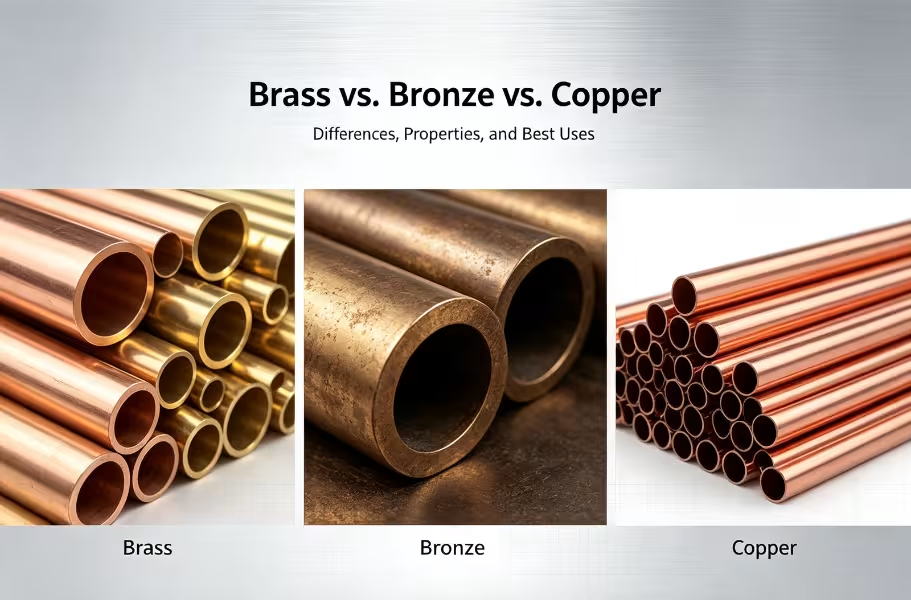
These three metals share the same base, which makes them easy to confuse on a drawing or a quote request. In the field, that confusion gets costly. A standard brass fitting dezincifies in seawater and turns porous from the inside out while still looking fine on the surface. Copper takes two to three times longer to machine than brass for no gain if conductivity isn’t the point. A brass bushing instead of bronze might last months when it should last years.
This guide cuts through the confusion the way a materials engineer would. Brass and bronze aren’t single metals — they’re families of alloys, and “bronze” on a spec sheet means almost nothing without a grade number. Every comparison below names the alloy behind the number, so you can apply it.
Brass vs. Bronze vs. Copper at a Glance
Choose copper when conductivity is the priority. Choose brass when you need economical parts that machine quickly and consistently. Choose bronze when the part will see wear, sliding contact, heavy load, or seawater exposure. All three are copper-based, but small alloying changes make them behave very differently in service: zinc creates brass, while tin, aluminum, silicon, and phosphorus create the main bronze families.
| Property | Copper | Brass | Bronze |
|---|---|---|---|
| Composition | ~99.9% Cu | Cu + 5–40% zinc | Cu + tin, aluminum, silicon, or other alloying elements |
| Color | Pinkish-orange | Bright yellow to yellow-gold | Reddish-brown to darker brown |
| Electrical conductivity | ~100% IACS | ~26–28% IACS | ~7–15% IACS |
| Typical tensile strength | ~220–345 MPa | ~300–525 MPa | ~325–700+ MPa |
| Corrosion resistance | Good in air and fresh water | Good in many environments, but some grades can dezincify | Generally strongest in marine and seawater service |
| Wear/friction behavior | Poor for sliding contact | Moderate | Usually best choice for bearings, bushings, and wear surfaces |
| Machinability | Low; tends to cut gummy | Excellent, especially C36000 | Moderate to low, depending on alloy |
| Relative cost | Mid to high | Usually lowest | Usually highest |
| Best fit applications | Wiring, busbars, heat exchangers, plumbing tube | Fittings, valves, fasteners, turned parts, decorative hardware | Bearings, bushings, gears, marine hardware, propellers |
These figures are representative, not universal. Brass and bronze are alloy families rather than single materials, so exact values can shift substantially by grade and temper. When two options look close on paper, the real decision usually comes down to service environment, manufacturing method, and wear condition—not just the headline strength number.
What Are Copper, Brass, and Bronze?
Copper, brass, and bronze sit in the same metal family, but they are not interchangeable. A small change in alloying can shift strength, machinability, corrosion behavior, and even the cost of making the part. That is why two materials that look similar on the shelf can behave very differently in a machine shop or in service.
Copper: The Base Metal
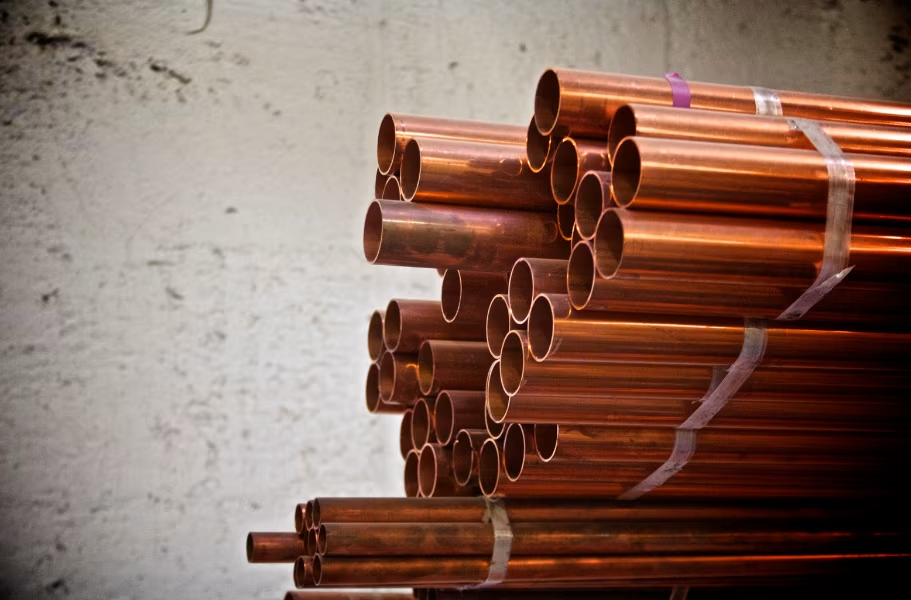
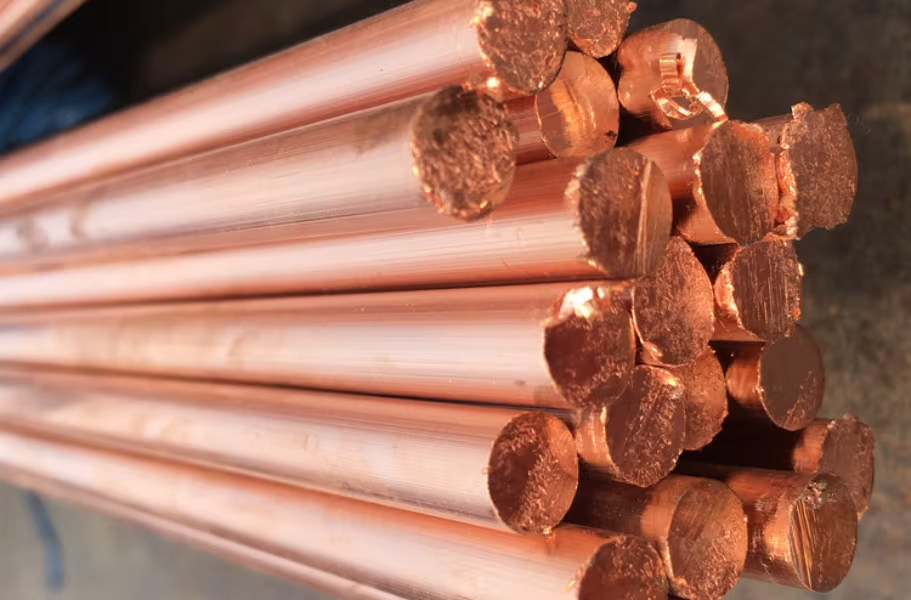
Copper is the starting point for all three. The most common grade, C11000 electrolytic tough pitch copper, is about 99.9% copper. It has the familiar reddish-orange color and the highest electrical conductivity of any non-precious engineering metal. If the job is to move current or heat, copper sets the benchmark.
That same purity creates its main trade-off. Copper is soft, highly ductile, and prone to smearing on cutting tools rather than breaking into clean chips. It forms easily, but it does not machine efficiently. Annealed C11000 is typically around 220 MPa tensile strength, which puts it well below even many common brasses. In practice, copper earns its place when conductivity or formability matters more than strength or machining speed.
Brass: Copper + Zinc
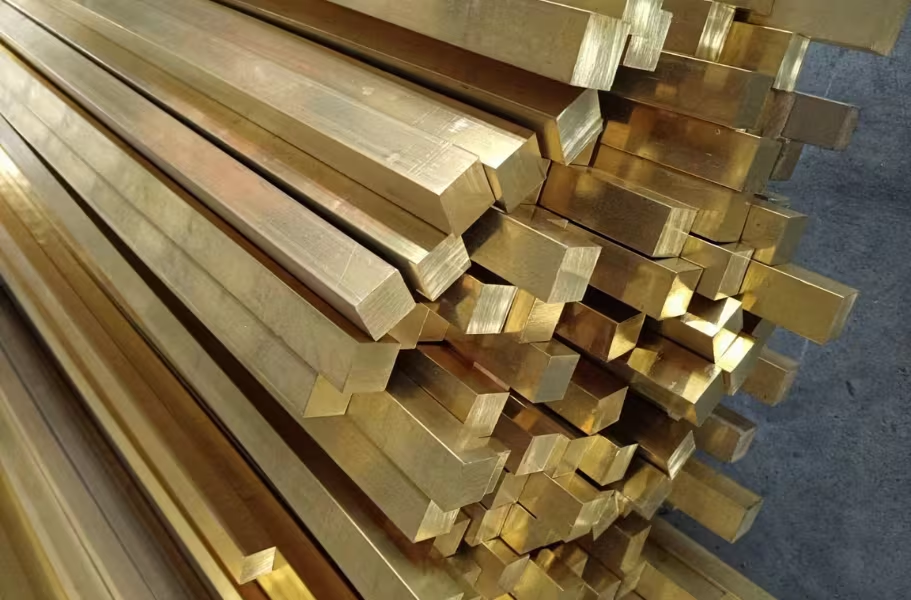
Brass is copper alloyed with zinc, usually somewhere between 5% and 40%. That one addition changes the economics of the material immediately: zinc costs less than copper, improves strength, and makes the alloy much easier to use for many common parts.
Two grades account for a large share of real-world brass applications. C26000 cartridge brass, with roughly 70% copper and 30% zinc, is the standard choice when the part needs to be formed or drawn. C36000 free-machining brass is the opposite kind of workhorse. Its lead addition helps the material break clean chips and reach a machinability rating of 100, which is why it dominates fittings, turned parts, and other high-volume machined components. Lead-free brasses are available for drinking-water service, though they usually do not machine quite as easily.
Brass does come with one important limitation: dezincification. In chloride-rich or otherwise aggressive water, zinc can gradually leach from the alloy and leave behind a weak, porous copper structure. The fitting may still look sound from the outside, but mechanically it is no longer the same material.
Bronze: Copper + Tin, Aluminum, Silicon, or Phosphorus
Bronze is traditionally defined as copper alloyed with tin, but in modern industrial use the term covers a broader family of copper alloys built for harder service conditions. That broader meaning is important, because “bronze” can refer to materials with very different performance profiles.
Phosphor bronze, such as C51000, is chosen when the part needs spring properties, wear resistance, or good fatigue performance. That is why it shows up in springs, electrical contacts, and bearing surfaces. Aluminum bronze, including grades like C95400, moves in a different direction: much higher strength, excellent resistance to marine corrosion, and strong performance under heavy load. Silicon bronze is often selected when joining and appearance matter. It welds and brazes cleanly, casts well, and is widely used in marine hardware, architecture, and art metalwork.
One naming trap is worth keeping in mind. Manganese bronze, such as C86300, is technically a high-strength brass because zinc is its primary alloying element. The name survived from older trade usage, but the metallurgy matters more than the label. When the application is load-bearing, marine, or wear-critical, specifying the alloy number matters far more than relying on a family name alone.
Brass vs. Bronze vs. Copper: Property Comparison
The easiest way to compare these metals is to keep the same order every time: copper, then brass, then bronze. That makes it easier to scan by property without losing the thread. One point up front: for these copper-based alloys, material selection is driven far more by alloy, temper, and work hardening than by heat treatment in the steel sense.
Strength and Hardness
Strength tells you how much load a part can carry before it yields. Hardness tells you how well the surface resists denting and local damage. The two often rise together, but they do not answer the same question.
In practical terms, copper sits at the bottom of this group for strength. Annealed C11000 is typically around 220 MPa tensile strength, rising to roughly 345 MPa in hard-drawn tempers. Common brasses move higher, with C26000 landing around 300–525 MPa depending on temper. Bronze covers the widest range. Annealed C51000 phosphor bronze starts around 325 MPa, cast C95400 aluminum bronze is around 586 MPa, and hard-temper phosphor bronze spring stock can exceed 700 MPa.
That range matters because “bronze” is not one material. If the part is load-bearing, shock-prone, or highly stressed, aluminum bronze is usually the first family to evaluate. If the loads are moderate and cost matters more than maximum strength, hard-temper brass is often enough.
Electrical and Thermal Conductivity
Electrical conductivity in this category is usually expressed as % IACS, with pure copper set at 100. Thermal conductivity follows the same pattern: as alloying goes up, heat flow drops.
Copper remains the benchmark at roughly 100% IACS and about 390 W/m·K. Brass drops sharply from there. C26000 is typically around 26–28% IACS and about 115–120 W/m·K. Most bronzes sit lower still, often in the 7–15% IACS range with thermal conductivity closer to 50–70 W/m·K.
That loss is not subtle. Once you alloy copper for strength, wear, or machinability, conductivity falls quickly. For busbars, motor windings, current-carrying connectors, and heat-transfer components, copper is usually not just the best option but the only realistic one. The common exception is phosphor bronze, which gives up conductivity in exchange for spring performance in electrical contacts.
Corrosion Resistance
All three metals tolerate ordinary atmospheric exposure well and develop a protective surface film over time. The useful comparison starts when the environment becomes specific: fresh water, chlorides, ammonia, marine immersion, or chemical cleaning exposure.
Copper has a long track record in fresh water, soil contact, roofing, and outdoor service. Brass performs well in many indoor and general-service environments, but it comes with two well-known risks: dezincification in chloride-rich or otherwise aggressive waters, and stress-corrosion cracking in the presence of ammonia or related compounds. Switching to DZR brass addresses the first issue, but it does not solve the second.
Bronze is generally the safer family for marine duty. Aluminum bronze, nickel aluminum bronze, and silicon bronze are widely used where seawater, splash exposure, or long-term outdoor service would make standard brass a poor bet. That is why you see bronze in propellers, pump components, seacocks, and other hardware that cannot afford hidden corrosion damage.
A datasheet can call all three “corrosion-resistant” and still tell you almost nothing useful. Corrosion resistance only means something once the environment is defined.
Wear Resistance and Friction
Wear resistance matters when a part has to hold size and surface integrity under repeated contact. This is where copper, brass, and bronze stop looking like near substitutes and separate very quickly.
Copper is a poor wear material. Under load it tends to gall, meaning the contacting surfaces microscopically tear, stick, and tear again. Brass is serviceable in lighter-duty moving parts such as valve stems, small gears, and lightly loaded guide components, but it is not the first choice for sustained sliding contact.
Bronze is built for that job. Bearing bronze such as C93200, along with phosphor bronze grades like C51000, is commonly used for bushings, plain bearings, thrust washers, and worm gear nuts because it wears in a controlled way and runs well against steel. That design logic is deliberate: the bronze component is supposed to be the sacrificial part. Replacing a bushing is cheap. Replacing a scored shaft or damaged housing is not.
Machinability
Machinability is often treated as a shop-floor issue, but in production it becomes a cost issue very quickly. The standard scale uses C36000 free-machining brass as the 100-point baseline.
Copper sits near the bottom at roughly 20. It work-hardens, throws long stringy chips, and tends to build up on the cutting edge. Phosphor bronze behaves similarly. Aluminum bronze is more manageable, often around 60, but it still demands good tooling, proper feeds, and attention to heat. Bearing bronze cuts better, often around 70, and is much less troublesome in practice. C36000 brass remains the benchmark because it breaks short chips, runs fast, and is easy on tools.
That gap shows up immediately in real part cost. A material that looks only slightly worse on paper can be dramatically worse when you are turning thousands of parts. It is one of the main reasons brass dominates plumbing fittings, valve bodies, and high-volume precision turned components, even in cases where another alloy might look stronger or more corrosion-resistant in a catalog.
Formability and Joining
Formability is simply how far a material can be bent, drawn, or reshaped before it cracks. If the part geometry is demanding, this property can eliminate options before strength even enters the conversation.
Copper is the most ductile of the three and handles tight bends and deep draws exceptionally well. Cartridge brass, especially C26000, is close behind and remains a standard forming alloy for exactly that reason. Bronze is less forgiving. Phosphor bronze work-hardens quickly, so heavy forming often requires intermediate annealing rather than one continuous operation.
Joining introduces a different set of trade-offs. Copper’s high thermal conductivity pulls heat away from the weld zone, which makes thick sections harder to weld than many fabricators expect. Brass presents the opposite problem: zinc can volatilize during welding, creating porosity in the joint and fumes that require serious ventilation control. Silicon bronze is the standout here. It welds and brazes cleanly, performs well as a MIG brazing filler, and is often the most practical choice for welded marine fabrication, architectural metalwork, and art applications.
Weight, Cost, and Availability
Weight is usually not the deciding factor in this family, because the densities are fairly close. Copper is about 8.9 g/cm³, brass about 8.5, and phosphor bronze again around 8.9. Aluminum bronze is the main exception at roughly 7.5 g/cm³, which can matter where weight savings justify the cost.
Commercially, cost and availability matter more than density. Brass is usually the lowest-cost option because zinc is cheaper than copper and the alloy is widely produced in standard bar, rod, and sheet forms. Copper typically lands above brass, while bronze often sits highest because tin and other alloying additions carry a premium. Exact pricing moves with the market, so supplier quotes matter more than general rules. Availability follows a similar pattern: if a distributor only has one copper alloy family on the shelf in multiple sizes, it is usually brass.
Best Uses for Copper, Brass, and Bronze
The clearest way to think about these three metals is not by chemistry alone, but by the kind of job each one is built to do. Copper earns its place when the part has to move electricity or heat. Brass earns its place when the part has to be made efficiently and repeatedly. Bronze earns its place when the part has to survive contact, load, or seawater over the long term.
Best Uses for Copper
Copper belongs anywhere conductivity is the job, not just one requirement among many. That is why it remains the standard for building wiring, busbars, motor windings, and other current-carrying components. The same logic applies on the thermal side. Heat exchangers, cold plates, and heat sinks rely on copper because it moves heat faster than most practical engineering metals.
Its ductility also gives it a second life outside electrical work. Copper tube can be bent and formed in the field without much drama, which is one reason it has stayed relevant in plumbing, refrigeration, and roofing for so long. In architectural applications, that same metal also develops a stable, recognizable patina over time. In healthcare settings, copper and certain copper alloys are also used on touch surfaces because of their antimicrobial performance.
Copper starts to lose its case when conductivity is no longer the primary requirement. If the part needs to be machined quickly, carry significant structural load, or survive repeated sliding contact, copper is usually the wrong answer.
Best Uses for Brass
Brass is the default production metal for a reason. It hits a useful middle ground: stronger than copper, far easier to machine, and usually less expensive than either copper or bronze. That combination is why brass shows up so often in valve bodies, fittings, fluid connectors, threaded hardware, lock components, and other precision parts made in volume.
Some brass grades are chosen for forming rather than machining. C26000 cartridge brass remains the classic example, especially in deep-drawn parts such as ammunition cases, where predictable forming behavior matters more than raw strength. Other uses, such as musical instruments and decorative hardware, take advantage of brass for different reasons: it forms well, holds a finish nicely, and carries the bright yellow-gold appearance that copper and bronze do not.
Brass is usually the right starting point when a part must be made cheaply, consistently, and at scale. It becomes a poor choice once the environment turns aggressive. Seawater, chloride-rich water, and ammonia-bearing exposure all create problems that brass is not especially good at solving over the long term.
Best Uses for Bronze
Bronze belongs in harder service. It is the material family you reach for when friction, wear, load, or marine exposure will decide whether the part lasts. Bearing bronzes such as C93200 and phosphor bronzes such as C51000 are widely used for bushings, plain bearings, thrust washers, and worm gear nuts because they wear predictably and run well against harder mating materials.
Marine hardware is another natural fit. Nickel aluminum bronze and related alloys are common in propellers, pump impellers, seacocks, and other components that have to tolerate seawater without quietly degrading from within. Other bronze families solve different problems. Phosphor bronze is widely used in springs and electrical contacts because it combines elasticity with decent corrosion resistance. Silicon bronze is often chosen where welding, brazing, or cast appearance matters, which explains its long presence in architecture, sculpture, and marine fabrication.
Bronze is harder to justify when the environment is mild and cost pressure is high. If the part doesn’t need wear resistance, marine durability, or the specific mechanical behavior of a bronze alloy, brass usually wins on economics, and copper wins on conductivity.
How to Choose the Right Metal for Your Project
Start with the constraint you cannot design around. If the part has to carry current efficiently, that decision comes first. If it has to survive sliding contact in a wet or dirty environment, that comes first. Material selection usually gets simpler once the non-negotiable requirement is clear. Only after that should you optimize for cost, machining speed, or ease of sourcing.
Quick Decision Guide
- Choose copper (C11000) when electrical or thermal conductivity is the primary requirement.
- Choose C36000 brass when the part will be machined in volume and cost per part matters.
- Choose C93200 bearing bronze or C51000 phosphor bronze for bushings, bearings, and other parts that see repeated sliding contact.
- Choose aluminum bronze or nickel aluminum bronze for saltwater and marine service, and silicon bronze when the assembly also needs to be welded.
- Choose copper or C26000 cartridge brass when the part requires deep drawing, tight bends, or aggressive forming.
- Choose brass first when the goal is the lowest material cost with solid all-around manufacturability.
- Choose silicon bronze for welded marine fabrications, architectural metalwork, and art applications where joining quality matters as much as corrosion resistance.
Common Selection Mistakes
Using standard brass in seawater or aggressive water
This is one of the most common and most avoidable mistakes. Dezincification often progresses quietly, and the part can look acceptable until it fails under pressure or after long exposure. If the service environment includes chlorides, use DZR brass only where it is truly appropriate, or move to a bronze alloy designed for marine duty.
Specifying “bronze” without specifying the alloy
This is less a technical error than a purchasing error with technical consequences. C93200 bearing bronze and C95400 aluminum bronze are both called bronze, but they are built for very different jobs and sit far apart in strength. If load, wear conditions, or the corrosion environment matters, the family name is not enough. Specify the alloy number.
Choosing copper for a part that really needs to be machined economically
Copper’s machinability is poor relative to free-machining brass. That difference shows up in cycle time, tool life, burr control, and overall part cost. If the part does not need copper’s conductivity or ductility, machining it from brass is usually the more efficient choice.
If two materials still look close after this first pass, compare the service environment first, the manufacturing route second, and price last. That order prevents most bad material calls.
How to Tell Brass, Bronze, and Copper Apart
Visual identification is useful, but only up to a point. Brass, bronze, and copper can look close enough to confuse buyers, restorers, and even experienced shop personnel—especially once the surface has aged, been coated, or picked up years of dirt and oxidation. That means appearance is good for rough sorting, not for final verification.
Color is still the best first pass. Copper is usually the easiest to spot because of its pinkish-orange tone and warmer, redder appearance. Brass shifts toward yellow-gold, and the more zinc it contains, the lighter and brighter it tends to look. Bronze generally sits closer to copper than to brass, but with a duller, browner cast and less overall visual brightness.
Patina can help when the material is old or weathered. Copper typically darkens to brown before developing the familiar blue-green verdigris. Brass usually dulls toward brown and may show scattered green corrosion products over time. Bronze often develops a more even brown-to-green surface film, especially in outdoor service. These differences are useful, but they are still only clues. Alloy variation, surface finish, lacquer, plating, and corrosion history can all distort the appearance.
A magnet is not a useful way to separate them in practice. All three are generally non-magnetic, so magnetic testing tells you very little about whether the base metal is copper, brass, or bronze. If the answer affects purchasing, fit, corrosion life, compliance, or warranty, do not rely on appearance alone. Use XRF analysis or verify the material against the mill certificate.
FAQs About Brass, Bronze, and Copper
Is bronze stronger than brass?
Usually, yes—but only if you compare the right alloys. Aluminum bronze such as C95400 is stronger than most common brasses, while hard-temper brass can overlap with softer bronze grades. If strength actually matters in the application, compare the alloy and temper, not the family name.
Which is most expensive?
Bronze is usually the most expensive, copper is often next, and brass is usually the least expensive. Tin content is one reason bronze tends to cost more, but raw material price is only part of the decision. In many parts, machining cost, wear life, and replacement interval matter just as much as the price per pound.
Which holds up best in saltwater?
Aluminum bronze, nickel aluminum bronze, and silicon bronze are the usual starting points. Standard brass is a poor long-term choice in seawater because dezincification is a built-in risk, not a rare edge case.
Are they magnetic?
Not in any useful way for identification. Copper, brass, and most bronzes are generally non-magnetic, although some aluminum bronzes can show a faint response because of iron or nickel in the alloy. In practice, a magnet is not a reliable way to separate them.
Can brass be used for drinking water fittings?
Yes, but only if the alloy meets the applicable potable-water standard. In practice, that usually means a lead-free or dezincification-resistant brass approved for the job. Standard free-machining brass such as C36000 is not the right choice for drinking-water contact.
Choosing Between Brass, Bronze, and Copper
Copper makes sense when conductivity is the job. Brass makes sense when the part needs to be produced accurately, repeatedly, and at the lowest practical cost. Bronze makes sense when the part has to survive wear, load, or marine exposure over time.
Before you lock in the material, pull the datasheet for the exact alloy and temper—not just the family name. Then check that datasheet against the actual service environment and the way the part will be made. Those two steps prevent most expensive material mistakes before they turn into field failures, warranty claims, or short service life.