Quick Answer
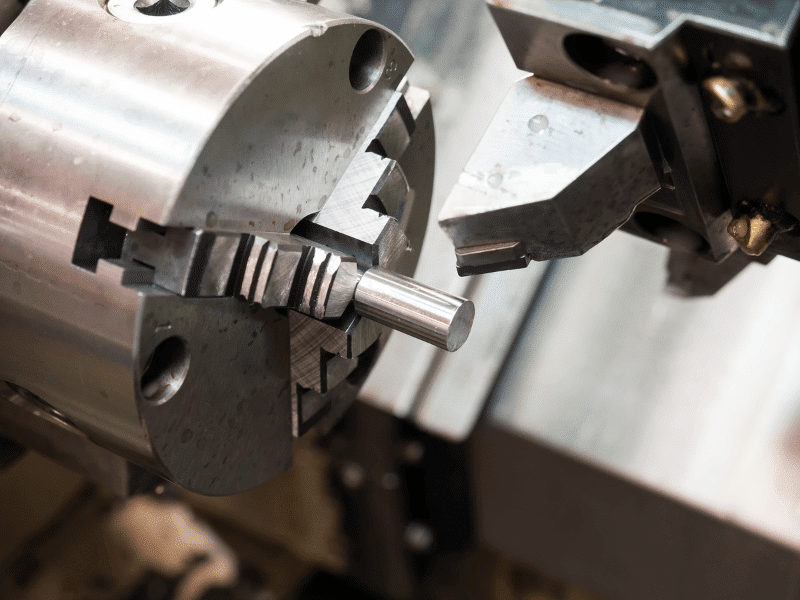
CNC turning is a subtractive machining process where the workpiece spins at high speed while a single-point cutting tool moves along it to remove material. It’s the standard method for producing cylindrical and rotationally symmetric parts. Here are the three things most engineers and buyers need to know upfront:
- What it’s best for: Round parts—shafts, pins, bushings, threaded bodies, fittings—anything built around a central axis.
- How it differs from milling: In turning, the workpiece rotates, and the tool stays put. In milling, the tool rotates while the workpiece remains fixed.
- When to choose it: When your part is dominated by outer diameters, bores, or concentric features, turning is typically faster and cheaper than any alternative.
|
Question |
Fast Answer |
Typical Scenario |
|---|---|---|
|
Best for? |
Cylindrical, rotational parts |
Shafts, bushings, threaded fittings |
|
Turning or milling? |
Turning = part spins, tool fixed |
Round vs. boxy geometry |
|
When to use? |
Diameters and concentricity dominate |
Repeatable, symmetric parts |
Start by checking whether your part is rotationally symmetric. Then match it against process capability and cost. Finally, confirm your tolerance and surface finish callouts are appropriate for the function. This guide walks you through each of those steps.
Introduction
Every machine part starts with a decision that quietly sets its cost and lead time: which process makes it? For round parts, that question usually comes down to turning or milling. Get it wrong and you either end up with a part that can’t be made economically, or you pay for setups and operations you never needed.
Engineers and buyers face the same recurring doubts. Should this part be turned or milled? How tight can I specify a tolerance before the price jumps? Which design details will make a quote balloon? If you’ve ever held a shaft or a threaded fitting and wondered how it got so round and precise, the answer is almost always turning—and understanding exactly how it works is the first step to specifying it well.
This article is a working reference, not a sales pitch. You’ll find a clear definition of CNC turning and the part shapes it suits, side-by-side comparisons against milling and turning centers, a straight-talking section on when to use it, and a step-by-step look at the process. We cover the core operations and parameters; the features that turn handles well versus those that drive costs up; practical design-for-manufacturing rules; realistic tolerances and surface finishes; common materials; and what actually determines price. By the end, you’ll be able to judge a part, design it smarter, and estimate its cost with confidence.
Let’s start with what CNC turning actually is.
What Is CNC Turning?
CNC turning is a computer-controlled machining process that shapes a part by rotating it against a cutting tool. It belongs to the family of subtractive processes—it removes material rather than adding or forming it. The “CNC” part, computer numerical control, is what makes every finished part match the first one: the tool path follows a program rather than an operator’s hand, so the thousandth part comes out the same as the first.
How CNC Turning Removes Material
The workpiece is clamped in a chuck and spun at high speed. A single-point cutting tool then engages the rotating material, shaving off metal to create the desired shape. The tool travels along the length of the part—the Z axis—to cut diameters and contours, and moves in toward the center—the X axis—to face ends or cut grooves. Coolant sprays over the cut, carrying heat away from the tool edge and flushing chips clear before they can cause trouble.
That single detail—the workpiece rotates while the tool stays relatively still—is the defining feature of turning. It’s the opposite of milling, and it’s exactly why turning is so efficient for round shapes. As the part spins, the tool only needs to control depth and travel; the rotation itself generates the cylindrical surface. A CNC program, written in G-code, manages the tool path, spindle speed, and feed rate so that the result repeats part after part without operator intervention.
What Part Shapes Suit CNC Turning
Because the part rotates around a central axis, turning naturally produces shapes built around that axis:
- Cylinders and rods — the most fundamental turned shape.
- Cones and tapers — created by gradually changing the diameter along the length.
- Disks and flanges — short, wide rotational parts.
- Stepped shafts — several diameters along one axis, cut in sequence.
- Threaded parts — bolts, studs, and fittings with internal or external threads.
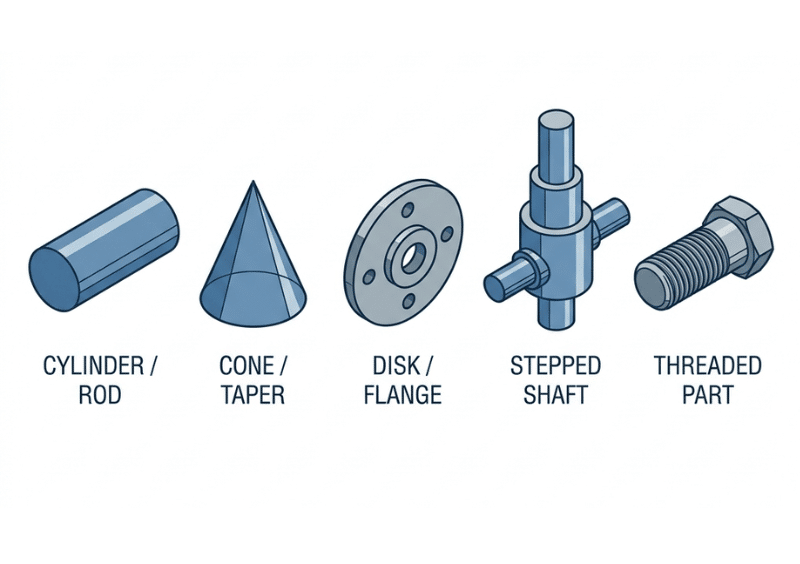
Real-world examples include drive shafts, dowel pins, bushings, spacers, hydraulic fittings, and threaded connectors. With powered live tooling, a turning center can also add off-axis features such as flats, cross-holes, or hexagonal profiles—more on that shortly.
Turning in one sentence: If your part looks like it was made on a potter’s wheel—round, symmetric, built around a center line—it’s a turning job.
CNC Turning vs. Milling vs. Lathe
Two comparisons come up constantly: turning versus milling, and a basic CNC lathe versus a full turning center. Getting these clear early saves a lot of second-guessing downstream.
CNC Turning vs. CNC Milling
The core difference is motion. In turning, the workpiece rotates, and a single-point tool cuts it. In milling, a multi-point rotating tool does the cutting while the workpiece stays fixed to a bed. That difference determines what each process does best.
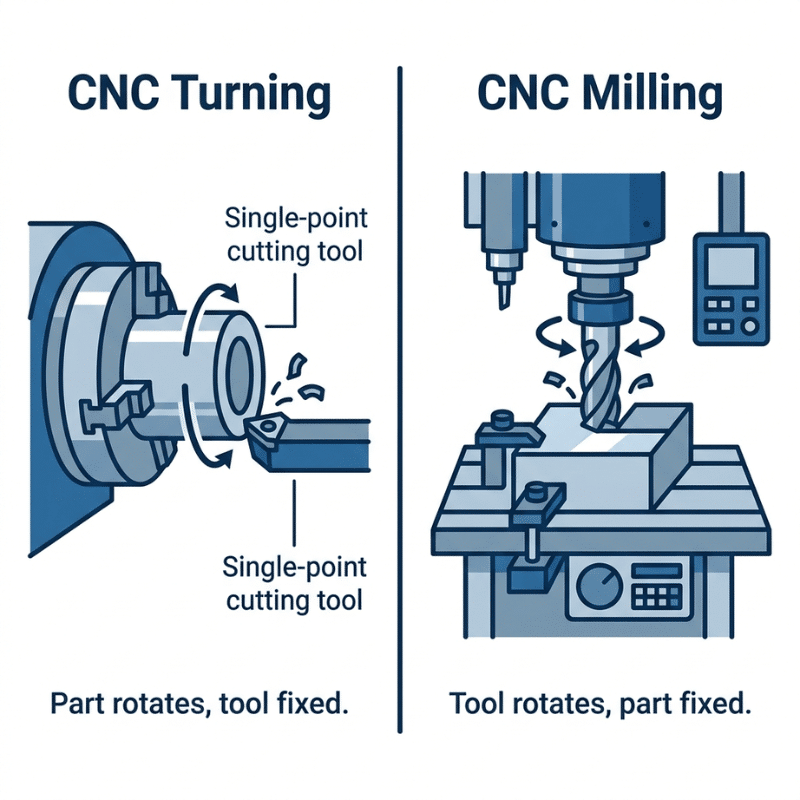
Turning excels on rotational geometry—outer diameters, bores, and concentric features. Milling excels on prismatic and complex shapes—flat faces, pockets, slots, and features that point in many directions. A shaft is a turning part. A bracket is a milling part. Many finished assemblies need both.
|
Topic |
CNC Turning |
CNC Milling |
|---|---|---|
|
Workpiece |
Rotates |
Stays fixed |
|
Cutting tool |
Usually stationary, single-point |
Rotating, multi-point |
|
Best for |
Cylindrical / rotational parts |
Prismatic / complex surfaces |
|
Typical parts |
Shafts, bushings, pins, threads |
Brackets, housings, plates |
|
Setups |
Fewer for round parts |
Fewer for boxy parts |
CNC Lathe vs. CNC Turning Center
A CNC lathe and a CNC turning center do the same fundamental job, but a turning center is the more capable, modern evolution. Turning centers add automatic tool changers, powered live tooling for milling and drilling, slant-bed designs for better chip flow and gravity-assisted chip removal, and higher spindle speeds. A basic CNC lathe handles simpler parts and shorter runs at a lower machine cost—think bushings and pins rather than complex multi-feature shafts.
|
Topic |
CNC Lathe |
CNC Turning Center |
|---|---|---|
|
Tool changing |
Manual / limited |
Automatic tool changer |
|
Live tooling |
Rare |
Common (mill / drill / tap) |
|
Bed type |
Flatbed |
Slant bed |
|
Best for |
Simple parts, short runs |
Complex parts, higher volume |
|
Cost |
Lower |
Higher |
Which Should You Choose?
The decision comes down to three quick rules. If your part is mostly rotational, choose turning. If it’s mostly prismatic or has features pointing in many directions, choose milling. If it’s a round part that also needs a few off-axis features—cross-holes, flats, keyways—choose a turning center with live tooling so you can finish everything in a single setup without re-clamping.
When to Use CNC Turning
Knowing the definition is useful. Knowing whether your specific part belongs on a lathe is what actually saves money. Use these three lenses to make that call.
Use CNC Turning When…
Turning is the right choice when:
- The part is cylindrical or rotationally symmetric around a central axis.
- Outer diameters, bores, or concentricity are the critical features.
- You’re making shafts, pins, bushings, threaded bodies, spacers, or fittings.
- You need high repeatability across many identical parts.
- You’re running medium to high volumes, where turning’s fast cycle times deliver real savings.
For these parts, turning typically requires fewer setups and less machine time than any alternative, keeping both cost and lead time down.
Reconsider or Avoid CNC Turning When…
Turning is the wrong tool when:
- The part is mainly prismatic or box-shaped, with flat faces and square geometry.
- Off-axis features dominate the design rather than appearing as a few minor additions.
- The part needs deep, non-axisymmetric pockets that a rotating workpiece can’t access.
- Milling would reduce the total number of setups and handling steps overall.
Forcing a boxy part onto a lathe typically means extra fixturing and secondary operations that cancel out any apparent savings. If a part mostly wants to sit still while a rotating tool works on it, put it on a mill.
Turning + Live Tooling as a Middle Ground
Many real parts land somewhere in between—mostly round, but with a few off-axis details like a cross-hole, a wrench flat, or a small keyway. This is where a turning center with live tooling earns its place. Powered rotary tools let the machine mill, drill, and tap while the part stays in the chuck, so you complete the whole part in one setup rather than transferring it to a mill. That single-setup approach improves feature-to-feature accuracy and cuts handling time significantly.
|
Part Feature |
CNC Turning Fit |
Notes |
|---|---|---|
|
Round, symmetric body |
Ideal |
Core strength of turning |
|
Outer diameters / bores |
Ideal |
Naturally produced by rotation |
|
Threads (internal / external) |
Ideal |
Standard turning operation |
|
A few cross-holes or flats |
Depends |
Best handled on a turning center with live tooling |
|
Mostly prismatic geometry |
Avoid |
Milling is the better choice |
|
Deep off-axis pockets |
Avoid |
Consider milling instead |
How CNC Turning Works
The path from a 3D model to a finished part follows three clear stages. Understanding them shows you exactly where quality and cost are determined.
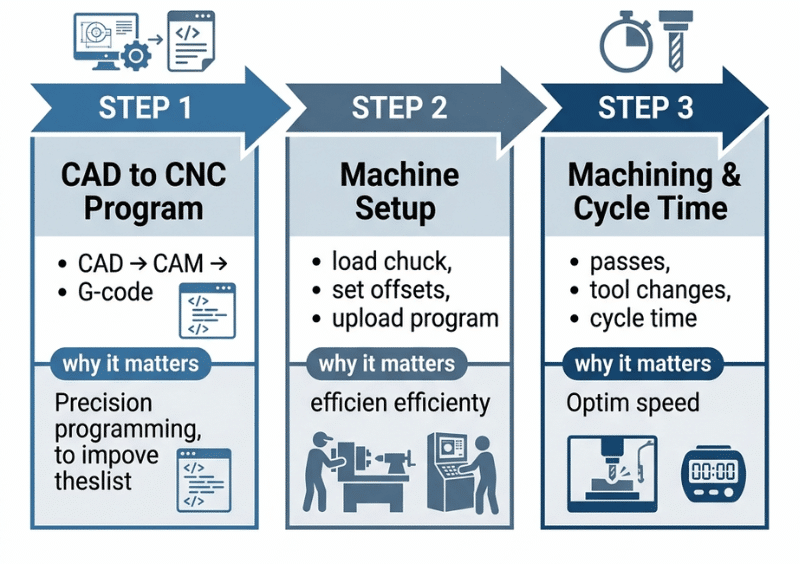
Step 1 – CAD to CNC Program
It starts with a CAD model of the part. That model is imported into CAM (computer-aided manufacturing) software, which generates the tool paths and the G-code the machine reads. G-code tells the lathe exactly where to move, how fast to feed, and how quickly to spin the spindle. A manufacturing engineer also reviews the design for manufacturability at this stage, confirming every feature can be reached and cut on a lathe before the program is sent to the floor.
Why it matters: Errors caught here cost nothing to fix. A tolerance or feature that can’t be turned is far cheaper to redesign in software than to discover mid-production.
Step 2 – Machine Setup
Next, the machine is prepared. The operator loads the workpiece into the chuck—which clamps it tight so it won’t shift when the spindle speeds up—installs and indexes the cutting tools in the turret, sets tool offsets, calibrates zero points, and uploads the program. Two key variables are dialed in here: spindle speed (how fast the part rotates) and feed rate (how fast the tool travels along the workpiece). Get either one wrong for the material and you’ll see it in the finish, the tool life, or the scrap pile.
Why it matters: Setup accuracy directly affects part quality. A poorly gripped workpiece or a wrong offset produces scrap, and every minute of setup is machine time spent not cutting—both of which add to cost.
Step 3 – Machining and Cycle Time
With everything set, the machine runs the program, making the passes needed to reach the final shape. A simple shaft might need just a few passes; a complex part with grooves, threads, and bores requires more tool changes and more time. Total cycle time breaks down into three components: loading time, actual cutting time, and idle time—tool changes and rapid moves between cuts that aren’t removing material.
Why it matters: Cycle time is the single biggest driver of per-part cost. The more passes, tool changes, and idle moves a design requires, the higher the price, which is why simpler geometry is almost always cheaper.
Key CNC Turning Operations
A lathe can perform many distinct operations, grouped by whether they work on the outside or the inside of the part. The specific operation is defined by the cutting tool used and the path it takes.
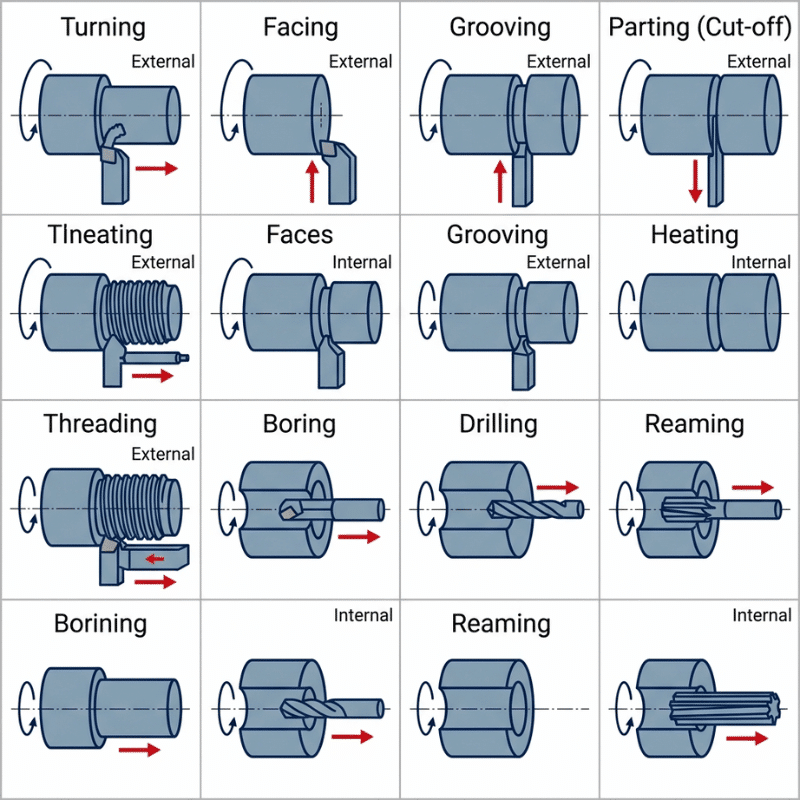
External Operations
These shape the outer surfaces of the part:
- Turning: The core operation. A single-point tool moves along the side of the rotating part to reduce the outer diameter and form tapers, steps, chamfers, and contours—typically in multiple light passes to sneak up on the final dimension.
- Facing: The tool moves radially across the end of the part to create a flat, square face. It’s usually the first cut on a fresh piece of stock to give a clean, square reference surface.
- Grooving: The tool plunges radially into the side to cut a groove—commonly for snap-ring or O-ring seats, where width and depth have to be right.
- Parting: Similar to grooving, but the tool cuts all the way through to separate the finished part from the raw stock bar.
- Threading: A pointed single-point tool moves axially to cut external threads to a set pitch and length, typically in multiple passes coordinated precisely with the spindle rotation.
- Knurling: A special tool presses a serrated diamond or straight pattern into the surface for grip or aesthetics—technically a forming step rather than a cutting operation.
Internal Operations
These shape the inside of the part:
- Boring: A boring tool enlarges and finishes an existing hole to a precise diameter. When drilling alone can’t get the hole tight or smooth enough, boring gets you there.
- Drilling: A stationary drill held in the turret or tailstock creates axial holes along the center line, with the part spinning around it rather than the drill spinning in a fixed workpiece.
- Reaming: A sizing operation that removes a small amount of material from a drilled hole to achieve an exact diameter with a smooth, consistent finish.
- Internal threading: Cuts threads into a bore for fasteners or fittings, using a coordinated single-point tool pass just like external threading.
|
Operation |
Type |
What It Does |
Typical Use |
|---|---|---|---|
|
Turning |
External |
Reduces outer diameter, forms tapers/steps |
Shaft profiles |
|
Facing |
External |
Machines have a flat end face |
Squaring part ends |
|
Grooving |
External |
Cuts a radial groove |
Snap-ring seats |
|
Parting |
External |
Cuts off the finished part |
Separating from stock |
|
Threading |
External / Internal |
Cuts threads |
Fasteners, fittings |
|
Boring |
Internal |
Enlarges / finishes a hole |
Precise bores |
|
Drilling |
Internal |
Creates axial holes |
Starter holes |
|
Reaming |
Internal |
Finishes hole to size |
Tight-tolerance bores |
Key CNC Turning Parameters
The quality, speed, and cost of a turning job come down to four cutting parameters. A machinist sets these based on the material and tooling in use, and small adjustments in any of them ripple through the finished part.
- Cutting speed: The spindle’s rotational speed in RPM, set by the material and tooling. Softer metals like aluminum tolerate high speeds and cut cleanly. Tougher materials, such as stainless steel, require lower speeds to avoid work hardening and protect the tool edge.
- Feed rate: How fast the tool travels along the workpiece, measured in mm/min or IPM. This is the parameter with the most direct influence on surface finish. Slow the feed down, and the surface smooths out; push it up, and you’ll see tool marks. When a part is coming out rougher than expected, the feed rate is usually the first thing to check.
- Depth of cut: How much material a single pass removes. Deeper cuts remove metal quickly but generate more heat, increase cutting forces, and accelerate tool wear—all of which can affect dimensional accuracy.
- Cutting tool: Geometry, material, and coating all affect cutting performance, tool life, and the achievable finish. Matching the right tool to the material and operation makes every other parameter easier to dial in.
Rough vs. finish tip: For roughing—removing bulk material quickly—run a lower spindle speed with a higher feed rate. For finishing—achieving a smooth surface and a tight tolerance—flip it: higher spindle speed, lower feed rate.
|
Parameter |
Controls |
Increase It → |
Decrease It → |
|---|---|---|---|
|
Cutting speed (RPM) |
Rotation rate |
Faster cutting; more heat and wear |
Slower cutting; longer tool life |
|
Feed rate |
Tool travel speed |
Faster stock removal; rougher finish |
Slower removal; smoother finish |
|
Depth of cut |
Material removed per pass |
Fewer passes; higher forces and heat |
More passes; gentler, more controlled cut |
|
Cutting tool |
Cut quality and tool life |
— Match to material |
— Match to operation |
Best Part Features for CNC Turning — and Features That Raise Cost
Thinking in terms of part features rather than machine specifications is the fastest way to judge whether a design is a good fit and where its cost will land.
Features CNC Turning Excels At
Turning produces these features easily and economically, because they all result from a rotating part meeting a straightforward tool path:
- Outer diameters — the natural result of a spinning workpiece and a tool controlling depth.
- Bores and internal diameters — drilled, then bored or reamed to a precise, repeatable size.
- Steps and shoulders — multiple diameters along one axis, all held concentric in a single setup.
- Grooves — cut cleanly and accurately with a plunging tool.
- Threads — internal or external — are a standard operation on any lathe.
- Tapers and chamfers — formed by angling the tool path relative to the axis.
- Concentric features — everything sharing one center line, held true by the rotation itself.
- Parting — cleanly cutting the finished part free from the stock bar in a single pass.
Features That Increase Turning Cost
These features work against Turning’s core strengths and push the price up:
- Tight tolerances on long, slender parts — the part deflects away from the cutting force, demanding slower, lighter passes and more of them to creep toward the final dimension.
- Deep, small-diameter bores — hard to reach with tooling, prone to chatter, and slow to machine accurately without special support.
- Thin walls — flex and vibrate under cutting forces, risking chatter, dimensional error, and scrap.
- Multiple setups — any re-clamping adds handling time and compounds tolerance errors between features across different setups.
- Off-axis features requiring live tooling — cross-holes and flats require a capable turning center and add measurable cycle time.
|
Cost-Raising Feature |
Why It’s Difficult |
Cheaper Alternative |
|---|---|---|
|
Tight tolerance on the slender part |
Deflection forces slow, light passes |
Relax tolerance or add steady rest support |
|
Deep, narrow bore |
Limited reach and chatter risk slow the cut |
Shorten depth or increase bore diameter |
|
Thin walls |
Vibration risks dimensional error and scrap |
Increase wall thickness where possible |
|
Many off-axis features |
Requires live tooling and extra cycle time |
Group features or reconsider milling |
|
Multiple setups |
Adds handling time and tolerance stack-up |
Design for single-setup access |
Design Guidelines for CNC Turned Parts
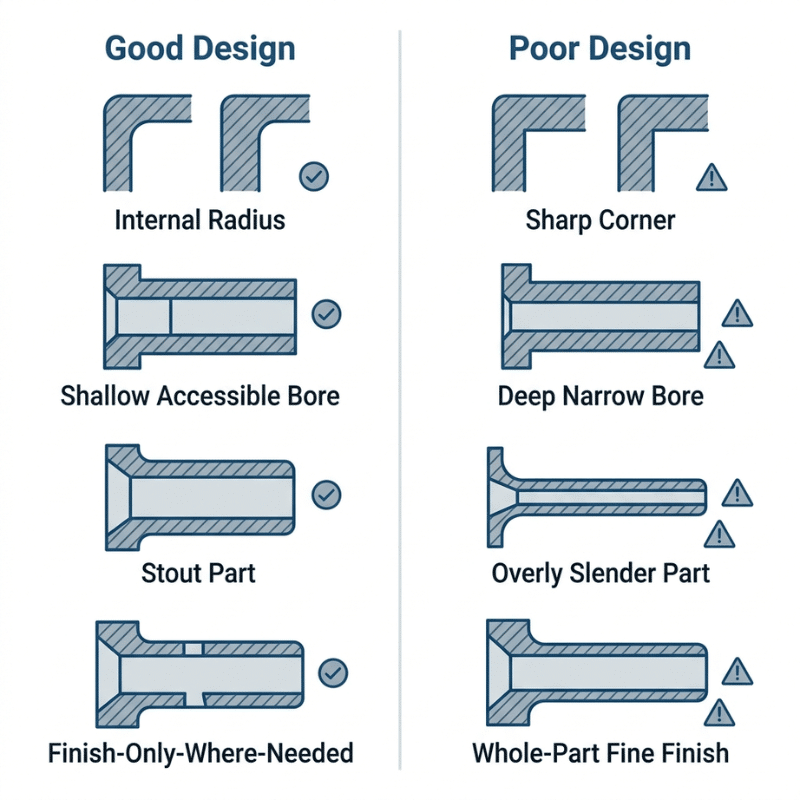
Sound design keeps a turned part both manufacturable and cost-effective. These seven rules translate general advice into concrete decisions you can make at the CAD stage, before a quote is ever requested.
- Specify tight tolerances only on functional surfaces. Use standard tolerances everywhere else and reserve precision callouts for the diameters and faces that actually drive fit, function, or sealing.
- Prefer standard drill and thread sizes. Standard tooling is faster and cheaper than custom tools; specifying an unusual hole diameter when it isn’t needed is one of the quietest ways to inflate a quote.
- Limit deep, narrow bores and control length-to-diameter ratios. Shallow, accessible features cut faster with less risk of chatter and deflection.
- Add generous internal radii and chamfers. Reasonable transitions allow the cutting tool to flow smoothly rather than fight sharp corners, which accelerate wear.
- Keep slender parts within a sensible length-to-diameter ratio. Long, thin parts deflect under cutting forces, which slows the job and increases the risk of scrap. When the ratio gets extreme, a steady rest or tailstock support becomes necessary.
- Call out surface finish only where the function demands it. Don’t apply a fine-finish specification to the entire part when only one sealing face actually needs it—that single callout can add an entire extra operation.
- Separate functional tolerances from cosmetic requirements. Make it clear which callouts affect performance and which affect appearance, so the shop doesn’t over-machine a face that only needs to look clean.
|
DFM Rule |
Why It Matters |
Benefit |
|---|---|---|
|
Tight tolerance only where needed |
Precision requires more time and inspection |
Lower cost, faster runs |
|
Use standard tool sizes |
Eliminates custom tooling orders |
Cheaper setup, shorter lead time |
|
Limit deep, narrow bores |
Reduces chatter and addresses problems |
Fewer defects, faster cycle |
|
Add radii and chamfers |
Eases the tool motion through the cut |
Smoother results, longer tool life |
|
Control length-to-diameter ratio |
Prevents deflection under load |
Better accuracy, less scrap |
|
Finish only where needed |
Fine finishes add operations and inspection |
Reduced per-part cost |
|
Split the function from the cosmetic |
Prevents unnecessary over-machining |
More predictable pricing |
Practical takeaway: Design the simplest part that still performs—precise only where function demands it, and standard everywhere else.
Tolerances and Surface Finish
How accurate and how smooth can CNC turning get—and when does chasing those numbers start costing more than it’s worth?
Typical CNC Turning Tolerances
Standard CNC turning reliably holds tolerances around ±0.01 mm (±0.0005 in) on common features. For most applications, a general tolerance standard such as ISO 2768-m is perfectly adequate and requires no special effort. Turning can go tighter when the application demands it, but every increment tighter requires slower cuts, more capable tooling, and more thorough inspection—all of which add measurable cost.
Achievable Surface Finish
An as-machined turned surface typically falls in the Ra 1.6–3.2 µm range, achievable with standard tooling and feeds. A dedicated finishing pass or fine turning can reach Ra 0.8 µm. Below that, a secondary operation, such as grinding, is usually required. Before adding a secondary operation, remember that slowing the feed rate is your most direct lever for improving finish within the same turning setup—it costs time but not a whole new process step.
Specify Only What You Need
Over-specifying is the most consistent way to inflate the cost on a turned part. A tolerance of ±0.001 mm or a mirror finish on a face that never contacts anything can multiply the price for zero functional benefit. Match the callout to what the part actually needs to do, and let general tolerances cover everything that isn’t functionally critical.
|
Requirement Level |
Typical Range |
Cost Impact |
Notes |
|---|---|---|---|
|
General tolerance |
ISO 2768-m |
Lowest |
Suitable for most non-critical features |
|
Standard precision |
±0.01 mm |
Low |
Routine for CNC turning |
|
Tight tolerance |
±0.005 mm |
Moderate to high |
Requires slower cuts and inspection |
|
Very tight tolerance |
±0.001 mm |
High |
Often requires secondary grinding |
|
As-machined finish |
Ra 1.6–3.2 µm |
Lowest |
Standard as-turned result |
|
Fine finish |
Ra 0.8 µm |
Moderate |
Requires a dedicated finishing pass |
Materials for CNC Turning
Almost any machinable material can be turned, but each behaves differently on the lathe. Material choice affects cutting speed, tool wear, achievable surface finish, and ultimately cost. The same setup that runs smoothly in aluminum can cause real trouble in stainless steel.
- Aluminum (e.g., 6061): Excellent machinability—cuts fast, produces a clean finish, and is forgiving on tooling. Aluminum is a shop favorite for prototypes and production alike, and a sensible default for parts where moderate strength is sufficient.
- Steel (mild and alloy grades): Machines well and offers high strength, though it runs slower than aluminum, generates more heat, and wears tooling faster.
- Stainless steel (e.g., 304, 316): Tough, corrosion-resistant, and demanding to cut. It work-hardens if the tool rubs instead of cuts, so sharp tooling, consistent coolant, and appropriate speeds are essential.
- Brass: One of the best materials to turn. It cuts cleanly at high speed, produces an excellent surface finish, and is easy on tooling—which is why it’s a reliable choice for fittings, connectors, and electrical components.
- Engineering plastics (e.g., Delrin, nylon, PEEK): Turn quickly into lightweight, low-friction parts, but require sharp tools and careful attention to heat management. Letting a plastic get too hot causes melting, smearing, and dimensional problems.
|
Material |
Machinability |
Speed Tendency |
Notes |
|---|---|---|---|
|
Aluminum 6061 |
Excellent |
High |
Fast, clean finish, low machining cost |
|
Mild / alloy steel |
Good |
Moderate |
Strong; generates more heat than aluminum |
|
Stainless steel |
Fair |
Low |
Work-hardened; needs sharp tools and coolant |
|
Brass |
Excellent |
High |
Superb finish; long tool life |
|
Engineering plastics |
Good |
High |
Manage heat and chip control carefully |
CNC Turning Cost
Cost is where every upstream design and process decision ultimately lands. Understanding what drives the price—and what you can do about it—lets you estimate and control it before a single chip is cut.
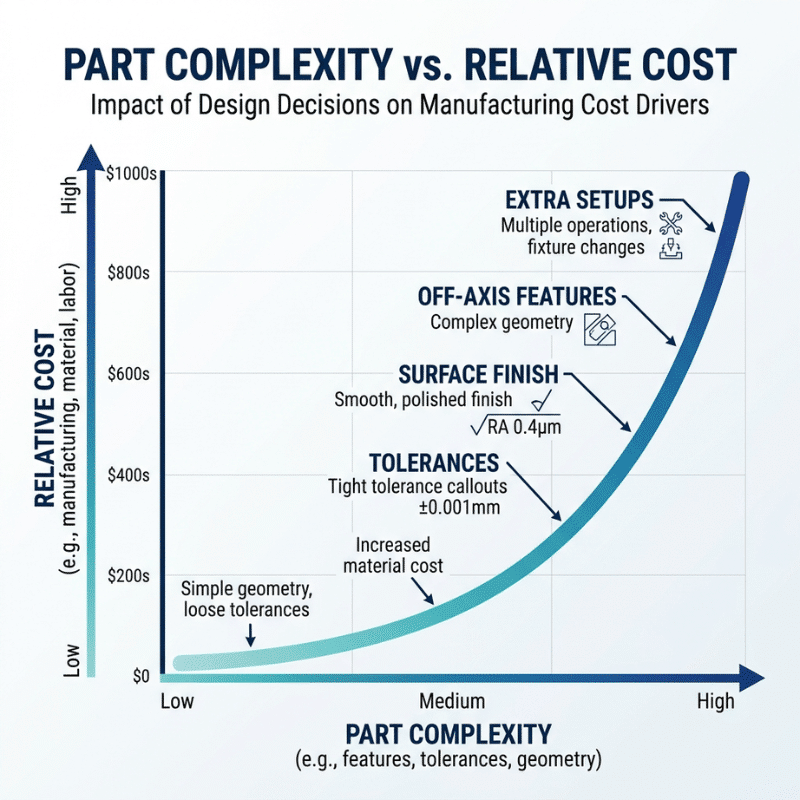
What Drives CNC Turning Cost
Eight factors account for the majority of a turned part’s cost:
- Material — tougher alloys like stainless steel and titanium cost more in raw stock and take longer to machine than aluminum.
- Cycle time — the single biggest driver; every minute on the machine adds cost, and complex geometry multiplies those minutes fast.
- Part diameter and length — larger parts require more stock and longer tool travel.
- Tolerances — tighter callouts force slower cuts, more passes, and more inspection.
- Surface finish — fine finishes may require dedicated finishing passes or secondary operations, such as grinding.
- Complexity and the number of operations — more features and tool changes directly extend cycle time.
- Secondary operations — heat treatment, plating, or additional milling all add steps and handling cost.
- Quantity — setup cost is fixed; it spreads across more parts at higher volumes, significantly reducing per-part cost.
How to Reduce CNC Turning Cost
Six actions consistently lower the price without compromising function:
- Simplify the geometry to reduce passes, tool changes, and total cycle time.
- Relax tolerances wherever the application allows.
- Remove unnecessary surface finish requirements from non-functional faces.
- Use standard stock sizes to minimize material removal and avoid waste.
- Group similar features to reduce the number of tool changes within the program.
- Minimize off-axis features that require live tooling and extend setup time.
|
Cost Driver |
Effect on Cost |
What You Can Do |
|---|---|---|
|
Material choice |
Higher for tough alloys |
Choose the cheapest material that meets the spec |
|
Cycle time |
Directly proportional |
Simplify geometry to reduce passes |
|
Tolerances |
Tighter = higher cost |
Relax wherever function permits |
|
Surface finish |
Finer = higher cost |
Specify only on functional faces |
|
Complexity |
More features = longer cycle |
Reduce operations and tool changes |
|
Quantity |
Higher volume = lower per-part cost |
Batch orders when practical |
CNC Turning Machine Types
Turning machines come in four common configurations. The choice among them is mostly a question of part size, weight, and whether combined milling or drilling operations are needed in the same setup. As a general rule, large or heavy parts favor vertical configurations for stability, while parts requiring combined turning and milling in a single setup favor a turning center with live tooling.
|
Machine Type |
Characteristics |
Best For |
Notes |
|---|---|---|---|
|
Horizontal turning center |
Enclosed, horizontal spindle, live tooling, slant bed for chip flow |
Complex, higher-volume round parts |
The most versatile all-around choice |
|
Vertical turning center |
Vertical spindle; chuck faces up; stable at low RPM |
Large, heavy, wide-diameter parts |
Handles big, unwieldy workpieces |
|
Horizontal lathe |
Conventional lathe under CNC control |
Simple turning and boring, short runs |
Lower capital cost |
|
Vertical lathe |
Holds the workpiece from below and spins it vertically |
Heavy parts; shops with limited floor space |
Good where headroom exceeds floor space |
FAQ
What is CNC turning used for?
CNC turning produces cylindrical and rotationally symmetric parts with high precision and excellent repeatability. Common applications span the automotive, aerospace, medical, and oil and gas industries and include shafts, pins, bushings, fittings, threaded components, and spacers.
What parts are best made by CNC turning?
Parts built around a central axis are ideal candidates—such as shafts, rods, bushings, dowel pins, flanges, threaded bodies, and hydraulic fittings. If a part is round and its critical features are outer diameters, bores, or concentric surfaces, turning is almost always the most efficient and cost-effective way to produce it.
What is the difference between CNC turning and milling?
In CNC turning, the workpiece rotates, and a stationary single-point tool cuts it—best for cylindrical parts. In CNC milling, a rotating multi-point tool cuts a stationary workpiece—best for prismatic and complex shapes. The short version: turning spins the part; milling spins the tool.
What is the difference between a CNC lathe and a turning center?
A CNC lathe is the simpler machine, well-suited to basic turning operations and short production runs. A CNC turning center is the more advanced evolution: it adds automatic tool changing, live tooling for milling and drilling, a slant bed for better chip management, and higher spindle speeds—making it the right choice for complex parts and higher volumes.
How accurate is CNC turning?
Standard CNC turning routinely holds tolerances around ±0.01 mm on typical features. With slower cuts, precision tooling, and dedicated inspection steps, tighter tolerances are achievable. For most applications, a general tolerance standard such as ISO 2768-m is sufficient without any extraordinary effort.
What tolerances can CNC turning hold?
Standard turning reliably achieves ±0.01 mm. Tighter tolerances of ±0.005 mm are possible at added cost. Very tight tolerances near ±0.001 mm typically require a secondary operation such as grinding. Specify tight tolerances only on the features that functionally need them, and let standard tolerances cover everything else.
Is CNC turning cheaper than milling?
For round, rotationally symmetric parts, turning is usually the cheaper process because it requires fewer setups and less machine time. For prismatic or geometrically complex parts, milling is more economical. The cheaper process is always the one that matches the part’s geometry with the fewest setups and operations.
What materials can be CNC turned?
Most machinable materials can be turned, including aluminum alloys, mild and alloy steels, stainless steel, brass, and engineering plastics. Aluminum and brass offer particularly good machinability, while stainless steel requires slower speeds, sharper tooling, and consistent coolant to machine well.
What operations can a CNC turning center perform?
A turning center handles a full range of external operations—turning, facing, grooving, parting, threading, and knurling—as well as internal operations including boring, drilling, reaming, and internal threading. With live tooling installed, it can also mill flats, drill cross-holes, and tap threads without removing the part from the chuck.
How do I design a part for CNC turning?
Design around a central axis. Specify tight tolerances only on features that require them for function. Use standard drill and thread sizes wherever possible. Add appropriate radii and chamfers to internal transitions; avoid deep, narrow bores and thin walls; keep the length-to-diameter ratio within a practical range; and call out fine surface finishes only on the faces that actually need them. These decisions, made early in the design process, have the biggest impact on cost and manufacturability.
How does tool wear affect the accuracy of a turned part?
Tool wear is gradual and easy to miss until a part fails inspection. As an insert dulls, it begins to cut slightly large or leave a rougher surface than intended, pushing dimensions toward the edge of tolerance—or past it. On a tight-tolerance run, a worn tool can mean the difference between a good part and a scrapped one. That’s why monitoring tool life matters: most shops track insert usage and replace or offset tools proactively, before drift becomes a defect. Checking parts at regular intervals during a run and adjusting tool offsets when dimensions start to creep is standard practice for keeping a turned part in spec from the first piece to the last.