Titanium has a strong demand story. Aircraft makers, defense contractors, and medical device companies all depend on it. Yet you can’t buy it the way you buy gold.
Most “titanium investments” work indirectly. Many of them actually track paint pigment, not the metal. I have helped many clients spot this gap before they commit a single dollar.
This guide shows you how to pick the right route, check your real titanium exposure, and avoid overpaying. Each step targets the mistakes I see investors make most often.
Can You Invest in Titanium? The Short Answer
Yes, but mostly indirectly, through mining, pigment, and aerospace stocks or broad funds. There’s no titanium spot market, futures contract, or pure-play ETF.
When clients ask me where to buy titanium, I point them to four realistic routes:
- Stocks: Buy shares in miners, pigment makers, sponge producers, or aerospace forgers.
- ETFs: Hold mining, metals, or aerospace funds that own a few titanium companies.
- Physical metal: Buy bars, plate, or scrap, but expect steep premiums and weak resale.
- Private or royalty deals: Join niche placements or mineral sands royalties, which mostly stay closed to retail buyers.
Each route gives you a different slice of the market. Some barely touch the metal at all.
Titanium doesn’t act like gold. It works as an industrial input, so its fortunes rise and fall with build cycles. When airlines order more jets and builders paint more homes, demand climbs. When those cycles cool, titanium profits cool with them.
Treat titanium as a bet on industry, not a place to park wealth.
Why Titanium Doesn’t Trade Like Gold
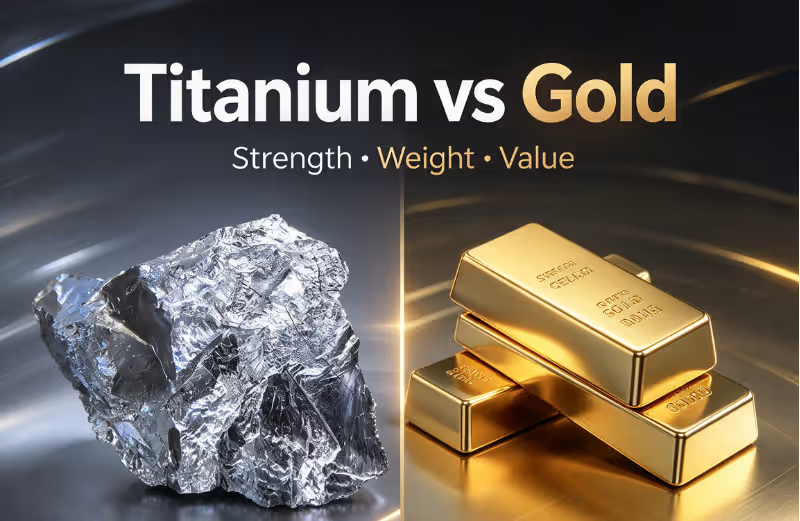
Many new investors picture titanium as “the next gold.” I correct that idea in almost every first conversation. The two metals trade in very different markets.
|
Feature |
Gold |
Titanium |
|---|---|---|
|
Public spot price |
Yes, quoted live worldwide |
No |
|
Futures market |
Yes, on major exchanges |
None |
|
Standard bullion form |
Bars and coins with set purity |
No recognized standard |
|
Resale buyers |
Banks, dealers, other investors |
Fabricators, scrap processors, a few dealers |
|
Main demand driver |
Investment, central banks, jewelry |
Aerospace, defense, pigment, industry |
No public price. You can’t check a titanium price on your phone. No exchange quotes a spot price, and no futures contract exists. Producers and buyers set prices through long-term supply contracts and negotiated deals. Trade publications publish price assessments, but only for paying subscribers.
No standard product. Gold buyers know exactly what a one-ounce bar is worth. Titanium works differently. Grade, form, and certification set its value, not just weight. A certified Grade 5 plate and an untested offcut of the same weight can sell for very different prices. Industrial buyers see this every day when they source bar and plate for production parts.
Thin resale market. When you sell, you meet fabricators, scrap processors, and a handful of dealers. None of them pay retail. They pay what the metal is worth for their next melt or job.
Costly to make. Producers chlorinate titanium ore, then reduce it through the Kroll process into porous “sponge.” That process burns a lot of energy and needs specialized plants. So energy prices and plant capacity drive metal costs far more than investor interest does. Those costs flow all the way downstream, which is one reason finished titanium parts cost far more than similar aluminum or steel parts.
These four points lead to one conclusion I share with every client:
Titanium is an industrial-cycle exposure, not a hedge against inflation or crisis.
Metal or Pigment? Know Which Titanium Market You’re Betting On
Before a client buys any “titanium stock,” I ask one question: which titanium? The answer changes the whole investment.
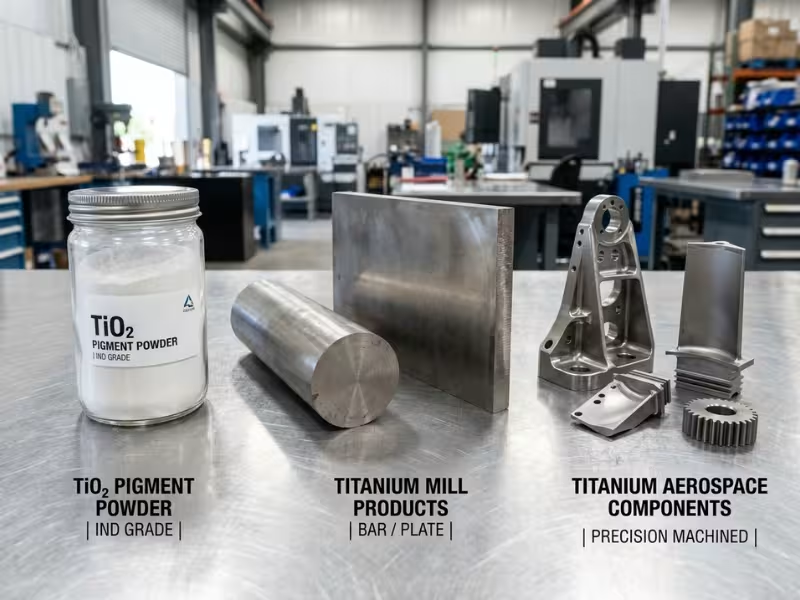
Here’s the fact most articles skip. Roughly 90% of mined titanium minerals become titanium dioxide (TiO2) pigment, according to USGS data. That white powder ends up in paint, plastics, and paper. Only a small slice becomes metal. So many “titanium stocks” are really paint and plastics plays.
Titanium splits into three different bets:
- Feedstock and pigment. This covers ilmenite, rutile, and TiO2. Housing, autos, coatings demand, and Chinese pigment exports drive it.
- Metal and mill products. This covers sponge, ingot, plate, and bar. Aircraft build rates, engine programs, defense budgets, and medical demand drive it.
- Downstream aerospace parts. This covers forgings, castings, and precision-machined titanium metal parts. Titanium is a cost input here, not the profit engine.
Supply clusters in a few places. China dominates sponge output. Japan, Russia, Kazakhstan, and Saudi Arabia hold most of the rest. Russia’s VSMPO-Avisma once supplied a big share of Western aerospace metal, but many buyers cut ties after the 2022 sanctions. Domestic sponge production in the U.S. has become far less significant in recent years.
Scrap plays a quiet role too. Recycled machining scrap feeds a large share of aerospace melt. Every chip and offcut from a titanium job can return to the furnace. That supply cushions price spikes when sponge gets tight.
What Moves Each Market
Once you know your bet, you know which headlines matter. This table shows what I track for each one.
|
Your Bet |
What Drives It |
Example Exposure Types |
Signals to Watch |
|---|---|---|---|
|
Feedstock and pigment |
Housing starts, auto output, coatings demand, Chinese TiO2 exports |
Mineral sands miners, integrated pigment producers |
TiO2 price trends, China export volumes, anti-dumping duties |
|
Metal and mill products |
Aircraft build rates, engine programs, defense budgets, medical implants |
Sponge makers, mill-product producers |
Boeing and Airbus build rates, sponge imports, defense spending bills |
|
Downstream aerospace parts |
Aircraft deliveries, engine orders, contract terms |
Forgers, casting makers |
Order backlogs, price pass-through clauses, supplier margins |
If a stock’s signals don’t match your thesis, you’re holding the wrong stock.
The Main Ways to Invest in Titanium
Every titanium route gives you a different amount of real exposure. Some routes put you close to the metal. Others mostly give you paint pigment. I’ll walk you through each one the way I review it for clients, starting with the route most investors use.
Titanium Stocks
I sort titanium stocks by where each company sits in the value chain. A ticker list hides the real question, which is what part of the business actually earns the money.
The companies below are examples, not recommendations:
- Mineral sands miners: Iluka Resources and Kenmare Resources dig up ilmenite, rutile, and zircon.
- Integrated feedstock-to-pigment producers: Tronox mines feedstock and turns it into TiO2 pigment.
- Pigment-focused producers: Kronos Worldwide and Chemours make TiO2 for paint, plastics, and coatings.
- Sponge and mill-product producers: Osaka Titanium Technologies and Toho Titanium make sponge in Japan. ATI turns titanium into plate, bar, and sheet.
- Aerospace forgers: Howmet Aerospace shapes titanium into engine and airframe parts.
- Diversified miners: Rio Tinto runs a titanium unit, but it makes up only a small slice of group revenue.
Here’s the twist that surprises many clients. Some of the largest Western titanium metal makers aren’t publicly listed on their own. Precision Castparts and TIMET both sit inside Berkshire Hathaway. Pure public exposure to titanium metal is scarcer than most people expect.
How I read a filing in 10 minutes:
- Titanium share of segment revenue. If titanium brings in only 5% of sales, you’re not holding a titanium stock.
- Contract backlog and duration. Long backlogs show demand that’s already locked in.
- Fixed-price vs. pass-through pricing. Pass-through clauses protect margins when sponge or energy costs jump.
- Customer concentration. One big aerospace buyer can make or break a year.
- Feedstock supply agreements. Secure ore or sponge supply reduces shutdown risk.
Titanium ETFs and Funds
Funds feel easier, but they dilute your exposure more than most investors realize.
No pure-play titanium ETF exists. You get exposure through mining, metals, strategic-materials, and aerospace and defense funds. Broad commodity funds don’t hold titanium at all, because no titanium futures contract exists for them to buy.
I run a look-through exposure check before any client buys a fund:
- Open the fund’s full holdings file.
- Flag every company with titanium operations.
- Multiply each holding’s fund weight by its titanium revenue share.
- Add up the results.
Worked example (hypothetical numbers):
- Company A: 3% weight × 60% titanium revenue = 1.8%
- Company B: 2% weight × 30% titanium revenue = 0.6%
- Company C: 4% weight × 10% titanium revenue = 0.4%
Total titanium exposure: 2.8%.
That’s typical. Most funds land in the low single digits. If you hold several funds, check for overlap too. They often share the same handful of names.
Physical Titanium: Bars, Bullion, and Scrap
Some clients want metal they can hold. I understand the appeal, but this route needs the most caution.
Forms you’ll find:
- Novelty or “bullion” bars
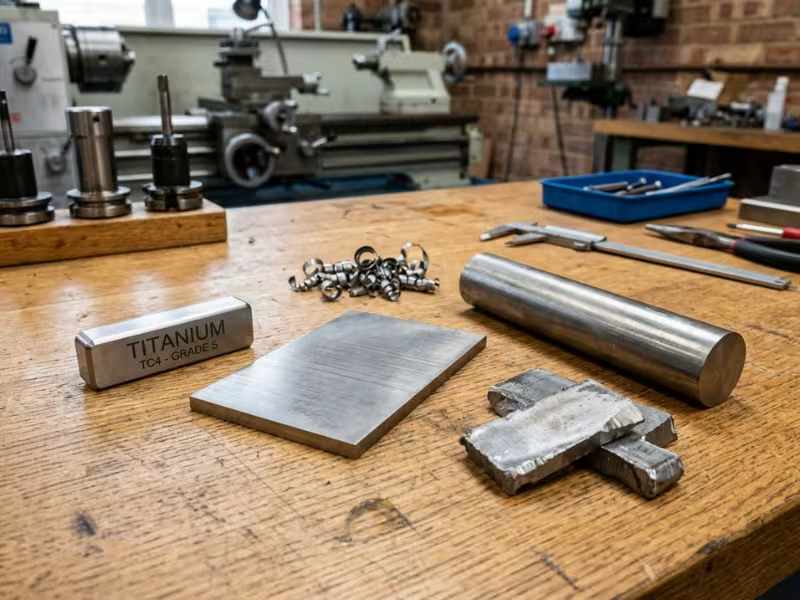
- Industrial bar, rod, and plate
- Sponge, which rarely reaches retail buyers
- Scrap and offcuts
Grade matters more than weight. Grade 2 is commercially pure titanium. Grade 5 (Ti-6Al-4V) is the workhorse aerospace alloy. It’s also the grade buyers request most often in CNC metal machining for aerospace, medical, and high-performance industrial parts. A buyer pays for proven grade, not just pounds.
Watch the premiums. Retail bars often sell for many times their industrial or scrap value. When you sell, you’ll usually get a scrap-level price.
Five questions I ask a dealer before buying:
- What grade is it, and can you provide a mill test report?
- Do you buy back, and on what basis: a percentage of retail or a scrap quote?
- What’s the total cost after shipping and sales tax or VAT?
- Can I verify the grade independently, for example with XRF testing?
- Is this an industrial product or a minted collectible?
Industrial buyers ask these same questions. Any serious CNC machining service checks mill test reports and traceable certification before cutting a single titanium part. If a retail dealer can’t match that standard, walk away.
Storage, tax, and records: Titanium won’t rust or tarnish, so storage is easy. Insurance, though, costs a lot compared with the metal’s value. In the U.S., the IRS may tax physical metal under collectibles rules, so confirm with a tax professional. Keep every receipt, invoice, and certificate.
Futures, Private Deals, and Royalties
These routes sound sophisticated, but they’re mostly not practical for retail investors.
Futures: No titanium futures trade on CME, LME, or SHFE. If a broker offers you “titanium futures,” treat it as a red flag.
Royalties: Royalty and streaming interests tied to mineral sands are niche. They usually come bundled with other commodities.
Private placements and crowdfunding: These deals are illiquid and hard to verify. Most U.S. offerings only accept accredited investors.
Titanium Investment Routes Compared
Here’s how I score each route when clients ask me to line them up.
|
Route |
Liquidity |
Minimum Entry |
Price Transparency |
Storage and Cost Drag |
Income |
Real Titanium Exposure |
Best For |
|---|---|---|---|---|---|---|---|
|
Stocks |
High, trades daily |
One share |
High, live quotes and filings |
Low, trading fees only |
Some pay dividends |
Low to high, varies by company |
Investors with a clear thesis |
|
ETFs |
High, trades daily |
One share |
High, daily holdings data |
Low, annual expense ratio |
Small, pass-through dividends |
Very low, often low single digits |
Hands-off investors |
|
Physical metal |
Low, scrap-level resale |
Small, but steep premiums |
Low, no public price |
High: premiums, insurance, shipping |
None |
Direct metal, but hard to resell |
Collectors and makers |
|
Private and royalty deals |
Very low, often locked up |
High, often accredited only |
Low, limited disclosure |
Medium: fees and due diligence |
Possible royalty payments |
Mixed, often bundled with other minerals |
Experienced accredited investors |
Stocks and ETFs win on liquidity and transparency. You can check prices, read filings, and sell on any trading day.
Physical metal loses on nearly every investment measure, so I steer only collectors and makers toward it. For everyone else, choose stocks for targeted exposure and ETFs if you value convenience over precision.
Which Route Fits Your Goal
The comparison table shows the trade-offs. Your goal decides which trade-off you can live with. Here’s how I match routes to the five goals I hear most often.
“I want low-maintenance exposure to strategic metals.”
Choose a broad mining or aerospace ETF. You buy once, and the fund handles the stock picking. Just accept the trade-off up front. Your real titanium exposure will be diluted, often down to a few percent. You’re buying a sector, not the metal.
“I’m bullish on aircraft production.”
Look at mill-product producers or aerospace forgers. Their revenue climbs when Boeing and Airbus raise build rates. Skip the pigment names here. A TiO2 producer follows paint and housing demand, so it won’t track your jet thesis at all.
“I want dividends from the sector.”
Focus on established pigment or mineral sands producers. These companies have the longest record of paying shareholders. Don’t count on steady checks, though. When pigment prices fall, boards often cut payouts fast. Treat the dividend as a bonus, not a fixed income stream.
“I want something I can hold.”
Make a small physical purchase, and call it what it is: a collectible. A certified Grade 5 bar can look great on your desk. Expect to sell it near scrap value, so spend only what you’d happily pay for a keepsake.
“I want high upside.”
Consider small-cap feedstock developers, and keep the position small. A new mineral sands project can multiply in value if it reaches production. Many never get there. The real risks are permits and financing, not titanium demand. One stalled approval or failed funding round can sink the share price overnight.
If your goal doesn’t fit neatly into one box, split it. Many of my clients pair a core ETF with one targeted stock.
Risks That Matter Most and Mistakes to Avoid
Titanium risk rarely comes from one headline. It builds up in layers. I group it into four clusters so you can see which ones hit your chosen route hardest.
|
Risk Cluster |
What It Looks Like |
Routes Most Exposed |
How to Reduce It |
|---|---|---|---|
|
Market |
Aerospace or housing slowdowns, substitution, Chinese pigment oversupply |
Pigment stocks, mill producers, ETFs |
Match the stock to your thesis and keep positions small |
|
Supply and political |
Country concentration, sanctions, export controls, currency swings |
Miners, sponge makers |
Spread exposure across regions and check supply sources |
|
Company |
One big customer, fixed-price contracts, permit delays, outages |
Individual stocks, small caps |
Read filings for backlog, pricing terms, and customer mix |
|
Buyer-side |
Opaque prices, retail premiums, fake grades, weak resale, fraud |
Physical metal, private deals |
Demand mill test reports and buy only what you can verify |
Where Each Cluster Bites
The table gives you the overview. Here’s what I watch inside each cluster.
Market risks. Titanium follows two cycles. Jet orders drive metal demand, and housing drives pigment demand. When either cycle cools, earnings fall fast. Designers also swap titanium for composites, aluminum, or high-strength steel when prices climb. On the pigment side, cheap Chinese TiO2 exports can crush margins for Western producers.
Supply and political risks. A few countries control most sponge output. Sanctions and export controls can reroute supply almost overnight, as Russia showed in 2022. Currency moves matter too. A stronger Australian dollar, rand, or yen can squeeze producers who sell in U.S. dollars.
Company risks. One aerospace customer can account for a huge share of sales. Fixed-price contracts trap margins when energy or feedstock costs jump. Mines and plants also face permit delays, outages, and rising environmental costs.
Buyer-side risks. With no public price, you can’t easily spot a fair deal. Retail bars carry steep premiums. Some sellers mislabel grades. Resale markets stay thin, and private deals attract fraud.
Five Mistakes I See Again and Again
- Treating titanium as an inflation hedge.
- Buying a pigment stock to play aerospace.
- Ignoring how much revenue actually comes from titanium.
- Paying novelty premiums for “bullion” bars.
- Trading on headlines without checking contract terms.
How to Build a Titanium Position Step by Step
Most titanium mistakes happen before the first trade. Investors buy a ticker first, then search for a reason to own it. I reverse that order with every client. These seven steps give your position a thesis you can actually test.
- Pick your bet first. Decide whether you’re backing pigment, metal, or downstream aerospace parts. Each one follows its own cycle. A housing slump can drag down a pigment producer while a forger keeps growing.
- Choose your route. Match it to your liquidity needs and time horizon. If you might need the cash within a year, stick with stocks or ETFs you can sell on any trading day. Save physical metal and private deals for money you won’t touch.
- Verify your real exposure. For a stock, find titanium’s share of segment revenue in the annual report. For a fund, run the look-through check. A tiny number means you own something else with a titanium label.
- Size it as a satellite. Measure the position against your total industrial and commodity holdings, not your whole portfolio. Many of my clients cap it at a small slice of that bucket, often 5–10%.
- Set your watch list. Track the signals that move your bet:
-
- Boeing and Airbus delivery and build-rate updates
- USGS Mineral Commodity Summaries, released each year
- Chinese sponge and pigment trade data
- Company backlog disclosures in quarterly reports
- Write down your thesis and exit triggers. Use one sentence for why you bought. Then list two or three events that would make you sell, such as shrinking backlog for two straight quarters. Review both every quarter, and rebalance if your exposure drifts past your target.
- Keep clean records. Track tax lots, purchase dates, and cost basis for every security. For physical metal, keep receipts, mill test reports, and certificates together. You’ll need them when you sell.
FAQs
Is there a titanium ETF?
Not a dedicated one. If a fund’s marketing mentions titanium, check its top ten holdings before you buy. You’ll usually find diversified miners, aerospace primes, and defense contractors. Also be careful with search results. Some funds and products use “titanium” as a brand name and have no link to the metal at all.
Can you buy titanium bullion like gold?
You can buy bars labeled “bullion,” but no mint or exchange backs a titanium standard. Dealers don’t post daily buy and sell spreads. U.S. retirement account rules for precious metals cover gold, silver, platinum, and palladium, but not titanium. Treat these bars as desk pieces or craft items. Buy one because you like it, not as a store of value.
What is the price of titanium per pound?
No single number exists, because each form sells in its own market. As rough orders of magnitude:
- Sponge: a few dollars to the low teens per pound, depending on origin and grade.
- Clean scrap: often a few dollars per pound.
- Retail novelty bars: tens or even hundreds of dollars per pound.
Get a current trade quote before you rely on any figure.
Is titanium dioxide the same as titanium metal?
No. Titanium dioxide is a white, chalky compound. You’ll find it in sunscreen, toothpaste, paint, and plastics. Titanium metal is a strong, light material used in jet engines and hip implants. Both start from the same ore, but they end up in different plants and serve different customers. A price jump in one rarely lifts the other.
How does Russia affect the titanium market?
Russia matters mostly on the metal side. Before 2022, Western planemakers bought some of their forgings and mill products from Russia. Since then, many buyers have qualified new suppliers in Japan, the U.S., and Europe. That shift takes years, because aerospace parts need long certification. For investors, this can fill order books at non-Russian mills, but it can also raise input costs.
Is titanium a good investment right now?
I can’t answer that with a forecast, and you should doubt anyone who claims certainty. Use a three-part test instead:
- Where do the aircraft and housing cycles stand today?
- Does the valuation already price in that outlook?
- Does titanium make up enough of the revenue to matter?
When all three line up, the case gets stronger.
Final Thoughts
Titanium is investable, but mostly through companies. The market you pick (pigment, metal, or aerospace parts) matters far more than the metal’s reputation.
I’ve watched investors buy a “titanium stock” for the jet boom, only to see it follow paint demand instead. The label fooled them.
So before you buy, ask two questions. Is this a pigment, metal, or aerospace bet? And how much of its revenue actually comes from titanium? If you can’t answer both, keep your money in your pocket until you can.
Read More: Current Titanium Price per Ounce: 1 oz Bullion Bars & Market Trends