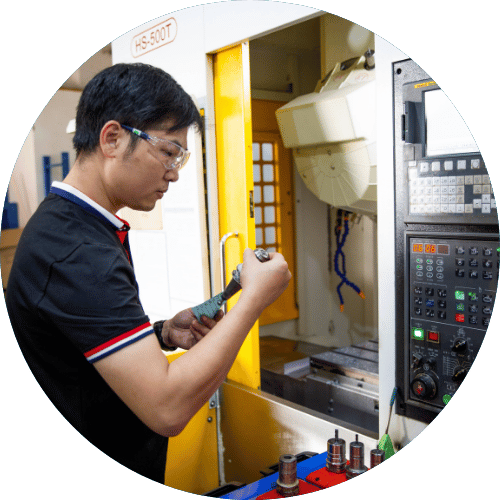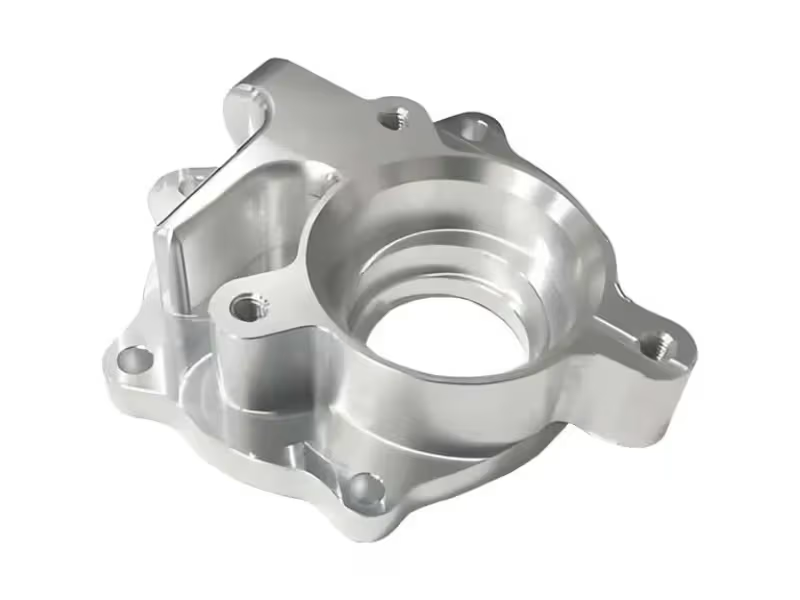
Many buyers see “billet” on a spec sheet or product page and assume they’re getting a stronger, better part. Sometimes they are. Often, they’re just paying for a label.
The word alone tells you very little. The alloy, the temper, the part design, and the job the part has to do matter far more.
This guide explains what billet aluminum is and how it compares with cast and forged aluminum. It also shows when billet is worth its higher price, when casting or forging is the better choice, and how to check whether a “billet” claim holds up.
What Billet Aluminum Actually Means
Most of the confusion about billet aluminum starts with the definition. Get that right, and the comparisons with cast and forged parts become much easier.
Billet Is a Material Form, Not an Alloy
Billet describes the form of the metal before anyone machines it. It does not name a grade. You can buy 6061 billet, 7075 billet, or 2024 billet, and each one behaves very differently.
The word also means different things in different places. At an aluminum mill, “billet” is the large cast log that feeds an extrusion press. In a machine shop, it has a looser meaning: solid wrought stock, usually extruded bar, round rod, or rolled plate cut into blocks.
A good drawing never just says “billet.” It says something like “6061-T6511 bar, 3 in. × 4 in.” That line tells the shop exactly what to order. The word “billet” alone does not.
Billet Stock vs. Billet Part
Buyers often mix up these two terms. Separating them clears away most of the marketing noise.
- Billet stock is the raw material. It arrives as a solid bar, rod, or block with a mill certificate.
- A billet part is the finished component cut from that solid stock, typically through aluminum CNC machining services. Milling, turning, and drilling remove material until only the part remains.
A “billet” bracket or intake manifold simply means someone machined it from a solid piece. Nobody poured it into a mold or pressed it in a die. That tells you how the part was made. It doesn’t tell you how well it will perform.
|
Term |
What It Means |
What It Does Not Mean |
|---|---|---|
|
Billet (mill term) |
Cast log that feeds extrusion or forging |
A finished part or a specific alloy |
|
Billet stock |
Solid wrought bar, rod, or block |
A guarantee of strength or quality |
|
Billet part |
Component CNC-machined from solid stock |
Stronger than every cast or forged part |
|
“Billet aluminum” (marketing) |
Machined from solid aluminum |
Premium alloy, better temper, or tighter QC |
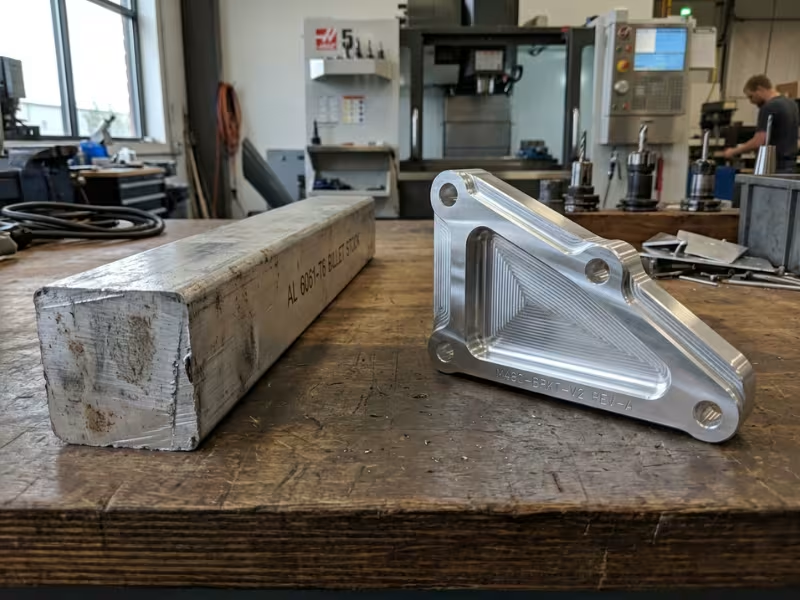
A well-made billet part can be excellent. So can a well-made casting. The label points to the process, not the result.
Why Billet Aluminum Is Often Misunderstood
If billet only describes a starting form, why does it carry so much weight? The answer has more to do with marketing than metallurgy.
“Billet” sounds solid and premium. Aftermarket brands stamp it on intake manifolds, triple clamps, and bike parts because buyers link the word with strength. Over time, it started doing a job it was never meant to do.
The result shows up in quote requests every week. A buyer asks for “billet aluminum” and expects three things at once: a strong alloy, high strength, and top quality. The word promises none of them.
A 6061 billet part and a 7075 billet part share a label but not a strength level. 7075-T6 carries nearly twice the yield strength of 6061-T6, yet both are “billet.” And a billet part with sharp internal corners can crack sooner than a well-designed casting.
What Actually Decides How a Part Performs
When an engineer reviews a drawing, five factors matter. “Billet” isn’t one of them.
- Alloy. Sets the strength ceiling, corrosion behavior, and weldability.
- Temper. 6061-O and 6061-T6 are the same alloy with very different strength. The suffix matters.
- Part geometry. Thin walls, sharp corners, and sudden section changes create stress risers, no matter how the part was made.
- Process control. Toolpaths, fixturing, deburring, and inspection decide whether the part matches the drawing.
- Application load. A static bracket and a part under constant vibration need different answers.
Get these five right, and the process choice becomes a question of cost and volume. Get them wrong, and the word “billet” won’t save the part.
How Billet Parts Are Made
You don’t need to run a CNC machine to buy billet parts wisely. But once you see how a solid block becomes a finished part, most cost and quality questions answer themselves.
From Solid Stock to Finished Part
Every billet part starts as solid wrought stock. Shops use round rod for turned parts and rectangular bar or plate for milled ones. The first step is to saw a blank slightly larger than the finished part.
Then the machines take over. A CNC lathe cuts round features like shafts, bores, and threads. A CNC mill cuts pockets, faces, and holes. A 5-axis machine reaches compound angles in a single setup, and fewer re-clamps mean fewer chances for error.
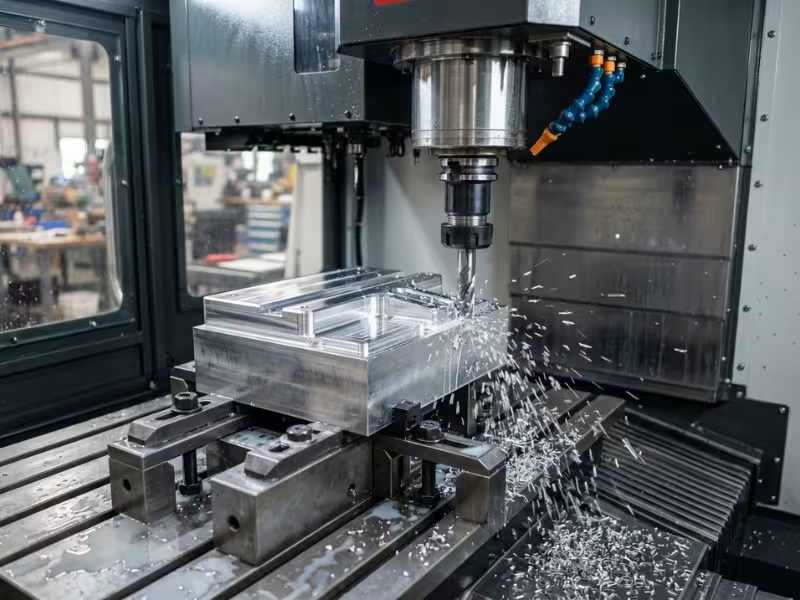
The logic is simple: the machine removes everything that isn’t the part.
|
Step |
What Happens |
Why It Matters |
|---|---|---|
|
Cut blank |
Saw bar or plate to size |
Sets material cost |
|
Rough machining |
Remove bulk material quickly |
Drives most of the cycle time |
|
Finish machining |
Light passes to final size |
Sets tolerance and surface finish |
|
Deburr and inspect |
Break edges, check dimensions |
Confirms the part matches the drawing |
What You Gain, and What You Pay For
This subtractive approach has clear strengths and clear costs. Both matter when you compare quotes.
The gains:
- Precision. A capable shop holds ±0.005 in. as routine work and goes tighter on critical features.
- Clean surfaces. Machined faces come off crisp and anodize evenly.
- Fast design changes. A revision means editing the CAM program. You don’t need a new mold or die, and you don’t wait for one.
The costs:
The biggest cost shows up as chips. On a deeply pocketed bracket, 60–80% of the starting block can end up on the floor of the machine. You pay for that aluminum, and you pay for every minute the spindle spends removing it. Recycling the chips recovers some material value, but not the machine time.
Volume changes the math. From a single part up to a few hundred, billet usually wins because setup stays modest and you need no dedicated tooling. That’s why so many low-volume projects start with a flexible CNC metal machining service. In the thousands, cycle time and waste add cost to every unit, and casting or forging becomes a serious option.
Billet Aluminum vs Cast Aluminum
This is the comparison buyers ask about most. Both routes can produce a good part, but they succeed in different situations. In most cases, volume decides the winner, not strength.
How Cast Parts Are Made
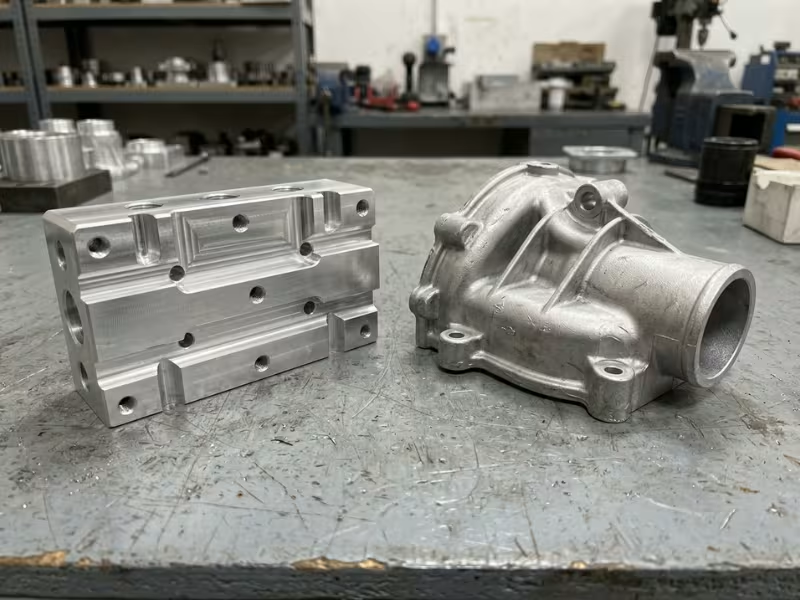
Casting skips the solid block entirely. A foundry melts aluminum and fills a cavity shaped like the part.
- Die casting forces molten metal into a hardened steel die under high pressure. It produces thousands of parts a day with good detail.
- Sand casting pours metal into a sand mold that is broken apart afterward. Tooling costs less, but surfaces are rougher and tolerances looser.
Both produce a near-net shape. Most castings still go to a CNC machine for sealing faces, bores, and threads.
Where Billet Has the Edge
Billet wins when accuracy and consistency matter more than unit price.
- Tighter tolerances. A die casting typically holds about ±0.005 in. over the first inch, and tolerance loosens as the part grows. Sand castings often need ±0.030 in. or more. Machined features hold ±0.005 in. across the whole part.
- Consistent material. Wrought bar arrives fully dense. Castings can trap gas and shrinkage pores that stay hidden until a part leaks under pressure or cracks under load.
- Usable strength. 6061-T6 bar offers about 40 ksi yield strength. A380, the most common die-casting alloy, sits near 23 ksi as cast. Most high-pressure die castings can’t take a full T6 heat treatment, because trapped gas blisters the surface.
- Prototypes and short runs. A billet part can be cut this week. A casting can’t start until the tooling exists.
Some cast alloys narrow the gap. A356-T6 sand or permanent-mold castings are one example. Even then, billet gives you more predictable results from part to part.
Where Casting Pulls Ahead
Casting earns its place once volumes climb or the geometry fights a cutting tool.
- High-volume economics. Once the die is paid off, a die-cast housing might cost a few dollars per part. The machined version could cost $40 or more in spindle time alone.
- Complex internal shapes. Curved coolant passages, hollow housings, and deep ribs are easy in a mold. A cutting tool often can’t reach them.
- Lower waste. A casting uses close to the metal it needs.
- Short machining cycles. Only the critical features need cutting.
Cost, Lead Time, and the Break-Even Point
Tooling creates the biggest gap. Billet needs only stock, fixtures, and a CAM program. A sand-casting pattern typically runs a few thousand dollars. A production die-casting tool commonly costs $20,000 to $100,000 or more and can take 8–12 weeks to build. Billet parts often ship in 1–3 weeks.
To estimate break-even, divide the tooling cost by the savings per part. If a die costs $40,000 and saves $20 per part compared with machining, casting starts paying off at about 2,000 parts. Below that number, billet usually costs less overall. Most projects cross over somewhere between a few hundred and a few thousand units.
Design changes shift the math further. With billet, you edit a program. With a casting, you modify or rebuild the die.
A common path is to prototype in billet, lock the design, and move to casting once volume justifies the tool. One caution: a billet prototype doesn’t prove the strength of the cast part. Test production castings before release.
|
Factor |
Billet (CNC from Solid) |
Cast (Die or Sand) |
|---|---|---|
|
Tooling cost |
Fixtures only |
~$2,000 (sand) to $100,000+ (die) |
|
Lead time to first part |
1–3 weeks |
6–12+ weeks |
|
Unit cost, low volume |
Lower |
High until tooling pays off |
|
Unit cost, high volume |
Higher |
Much lower |
|
Typical tolerance |
±0.005 in. or tighter |
±0.005 in. (die) to ±0.030 in. (sand) |
|
Porosity risk |
Very low |
Moderate to high |
|
Internal geometry |
Limited by tool access |
Complex passages possible |
|
Material waste |
High |
Low |
|
Design changes |
Edit the program |
Modify or rebuild tooling |
Billet Aluminum vs Forged Aluminum
Billet usually beats casting on consistency. Forging is a different story. Many buyers assume billet sits at the top, but for parts that flex, twist, or vibrate millions of times, a forging often outlasts a billet part made from the same alloy.
How Forging Works
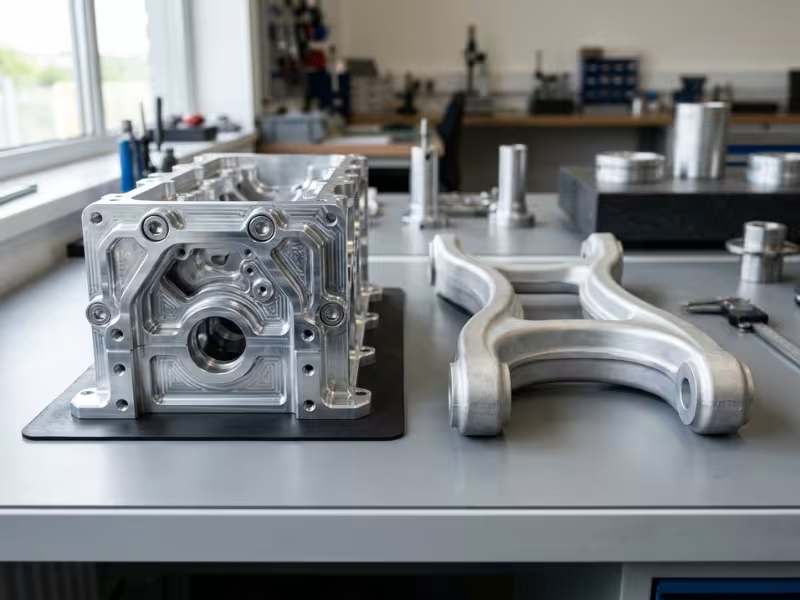
Forging shapes hot aluminum under heavy pressure instead of cutting it.
- Open-die forging works the metal between flat or simple dies. It suits rings, discs, and large blocks.
- Closed-die forging presses a heated blank into a cavity shaped like the part. Most production forgings use this method.
Forging bends the grain inside the metal so it follows the part’s contour. The result is near-net shape, not finished. Bores, threads, and sealing faces still need machining, so most forged parts are also partly machined parts.
Where Billet Has the Edge
- No die cost. You pay for stock, fixtures, and programming.
- Prototypes and one-offs. You can have five test parts in hand before anyone quotes a die.
- Easy design changes. Moving a mounting hole means editing a program, not reworking a hardened steel die.
- Precise geometry. As-forged parts carry draft angles, parting lines, and looser tolerances. Billet gives you square walls, sharp pockets, and tight features across the whole part.
For a static bracket or a custom fixture plate, billet is usually the faster and cheaper answer.
Where Forging Pulls Ahead
This is where the “billet is always stronger” idea falls apart.
Bar stock has grain running along its length. When a curved arm is machined from bar, the cutter slices across that grain at every bend. Those exposed grain ends often become starting points for fatigue cracks. A forging keeps the grain wrapped around the curves, which gives it real advantages:
- Longer fatigue life. Suspension arms, connecting rods, crank arms, and wheels face cyclic loads, and forged grain flow resists crack growth better.
- Better strength-to-weight. Forged sections handle repeated stress well, so designers can often run thinner sections and save weight.
- Consistency at volume. A stable forging process produces similar properties across large runs.
If your part sees constant vibration or repeated impact, ask about forging before you default to billet.
Cost and Lead Time
A closed-die forging tool for aluminum commonly costs $10,000 to $50,000 or more and can take 8–14 weeks to build. At volume, the math flips. Forgings use less metal and need only light finish machining, so per-part cost drops well below billet once the die pays off.
For fatigue-critical parts, the practical route is usually to prototype in billet to prove fit and function, then move to forging for production. As with castings, a billet prototype won’t predict the fatigue life of the forged part, so test production forgings before release.
|
Factor |
Billet (CNC from Solid) |
Forged (Closed-Die) |
|---|---|---|
|
Tooling cost |
Fixtures only |
~$10,000 to $50,000+ |
|
Lead time to first part |
1–3 weeks |
8–14+ weeks |
|
Fatigue resistance |
Good, limited by cut grain |
Excellent, grain follows contour |
|
Dimensional accuracy |
High across the whole part |
Moderate as forged; machined features tight |
|
Design flexibility |
Edit the program |
Rework or rebuild the die |
|
Best-fit use case |
Prototypes, short runs, complex machined detail |
High-volume, cyclic-load structural parts |
Billet vs Cast vs Forged: Which One Fits the Part?
Real projects don’t arrive as neat comparisons. They arrive as a drawing, a quantity, and a deadline. Instead of starting with the process, start with the part. Five questions usually point to one route within minutes.
Five Questions That Narrow the Choice
- How many parts do you need? Under a few hundred, billet almost always wins because you skip tooling. In the thousands, a casting or forging die starts to pay for itself.
- How will the part carry load? Static brackets and fixtures do fine with any well-made process. Parts that flex, vibrate, or take repeated impact lean toward forging.
- How tight are the tolerances? If critical features need ±0.005 in. or better across the whole part, billet gets you there directly. Cast and forged parts can match it only after secondary machining.
- How complex is the shape? Hollow cavities, internal passages, and organic curves favor casting. Deep pockets and crisp, square features favor billet.
- What are your budget and deadline? Billet ships in weeks with no upfront tooling. Casting and forging need a tooling investment and months of lead time.
|
Process |
Typical Volume |
Strength Consistency |
Fatigue Performance |
Tolerance Potential |
Shape Complexity |
Tooling Cost |
Lead Time |
Best Fit |
|---|---|---|---|---|---|---|---|---|
|
Billet (CNC) |
1 to a few hundred |
High, fully dense stock |
Good, limited by cut grain |
Highest, across the whole part |
Moderate, limited by tool reach |
Fixtures only |
1–3 weeks |
Prototypes, short runs, precision parts |
|
Cast |
Thousands and up |
Variable, porosity risk |
Fair |
Moderate, tight on machined features |
Highest, internal passages possible |
~$2K–$100K+ |
6–12+ weeks |
Complex housings at high volume |
|
Forged |
Thousands and up |
High and repeatable |
Excellent, grain follows contour |
Moderate as forged |
Low to moderate |
~$10K–$50K+ |
8–14+ weeks |
Load-bearing parts under cyclic stress |
When the Answers Disagree
Low volume combined with a fatigue-critical load is the classic conflict. A staged plan usually resolves it: prototype in billet, then move to forging once the design stops changing and volume justifies the die. Let the part’s biggest risk lead, whether that’s cost, load, or geometry.
When to Choose Billet Aluminum
The comparisons cover the theory. In practice, the decision comes down to the part in front of you.
Parts That Belong in Billet
Picture a robotics team that needs 12 end-effector brackets for a pilot line, with two design changes likely before production. Billet fits this job well. Nobody waits on a die, each revision is a program edit, and new brackets can be on the bench within days.
Tight tolerances point the same way. A bearing bore held to ±0.0005 in. or a flat sealing face is routine work from solid stock. A casting or forging would need secondary machining to reach those numbers anyway.
Appearance matters too. Visible parts such as camera cages, instrument panels, and motorcycle clamps benefit from crisp edges and an even anodized color, especially when the required CNC machining surface finish is part of the design intent. Castings sometimes reveal porosity once anodized. Machined wrought stock rarely does.
Uncertain demand also favors billet. Spending $40,000 on a die for a product that might sell 300 units is a gamble. Billet lets you test the market without committing to tooling.
Parts That Belong Somewhere Else
- Very high volume. At 20,000 housings a year, every extra minute of spindle time adds up fast. A die pays for itself many times over.
- Hollow or complex internal shapes. A pump body with curved internal passages may be impossible to cut in one piece. Splitting it adds cost and creates leak paths.
- Fatigue-critical parts. A production suspension control arm takes millions of load cycles. Forged grain flow gives it the fatigue life it needs.
- Excessive waste. If a thin-walled enclosure starts as a 6 in. block, 85% of it may become chips. A custom extrusion or sheet metal design often costs far less.
|
Choose Billet When… |
Avoid Billet When… |
|---|---|
|
You need prototypes or small batches |
Volume reaches the thousands per year |
|
Critical features need tight tolerances |
The part has hollow or complex internal passages |
|
Visible surfaces need a clean, even anodize |
The part faces heavy cyclic or fatigue loads |
|
The design will change after testing |
Most of the block would become chips |
|
Demand is uncertain and tooling is hard to justify |
A near-net process can make the shape more cheaply |
Billet works best when flexibility and precision are worth more than unit cost. Once the design stabilizes and volume grows, look at casting or forging again.
Common Billet Aluminum Alloys
“Billet” tells you how a part was made. The alloy and temper tell you how it will perform. Those two callouts affect price, lead time, and service life far more than the process name.
Read the Temper Code First
The letters after the alloy number show how the mill treated the metal. T6 means solution heat-treated and artificially aged for high strength. T651 (plate) and T6511 (bar) add a stretching step that relieves internal stress. For machined parts, stress-relieved stock is worth requesting because it moves less when deep pockets are cut.
6061-T6: The Default Choice
Most billet parts start as 6061-T6. It machines cleanly, anodizes evenly, resists corrosion well, and costs less than high-strength grades. Its yield strength of about 40 ksi covers most brackets, plates, and housings. The trade-off is moderate strength, and welding sharply weakens the area near the weld unless the part is heat-treated again.
7075-T6: When Strength Comes First
7075-T6 reaches about 73 ksi yield, nearly double 6061. Aerospace fittings and AR-15 receivers rely on it. It costs more, resists corrosion poorly without a good anodize, and is generally treated as unweldable by standard fusion methods.
5083: Built for Water and Welding
5083 doesn’t take a T6 temper. It gains strength through cold work and is sold as H116 or H321. It handles seawater well and keeps most of its strength after welding. The catch is gummy machining and strength below 6061-T6.
2024 and 6082: Niche but Useful
2024-T351 offers excellent fatigue resistance for aircraft structures, but it corrodes easily and welds poorly. 6082-T6 is the common European counterpart to 6061, slightly stronger and widely available in the UK and EU.
|
Alloy |
Main Benefit |
Limitation |
Common Use |
|---|---|---|---|
|
6061-T6 |
Balanced strength, easy machining, clean anodize |
Moderate strength, weakens when welded |
Brackets, plates, housings |
|
7075-T6 |
Very high strength |
Higher cost, weaker corrosion resistance, poor weldability |
Aerospace fittings, firearm parts |
|
5083-H116/H321 |
Seawater resistance, retains strength after welding |
Gummy to machine, lower strength |
Marine hardware, welded frames |
|
2024-T351 |
High fatigue resistance |
Poor corrosion resistance and weldability |
Aircraft structures |
|
6082-T6 |
Slightly stronger than 6061 |
Less common in North America |
European structural parts |
How to Evaluate a “Billet” Claim
“Billet” on a product page is a sales word until someone backs it up. Whether you buy aftermarket parts or source custom components, a few direct questions will show whether the claim holds.
Four Questions to Ask Any Supplier
- Which alloy and temper? “Billet aluminum” isn’t a spec. “6061-T6” or “7075-T651” is. If the supplier can’t name both, you don’t know what strength you’re paying for.
- Can you provide material certs? A reputable shop keeps the mill certificate for every lot, with chemistry and mechanical test results. For critical parts, ask for traceability from the cert to your batch.
- Is the whole part machined from solid stock? Some “billet” products only have a machined cover or face, with a cast body underneath. Ask directly.
- How do you inspect it? First-article reports, CMM data, or dimensional check sheets show process control, not just marketing.
|
Ask For |
Red Flag If… |
|---|---|
|
Alloy and temper |
The answer is only “aircraft-grade” or “billet” |
|
Mill cert and lot traceability |
The supplier can’t produce paperwork |
|
Construction details |
The answer about which pieces are machined is vague |
|
Inspection records |
You get photos instead of measurements |
Billet Doesn’t Automatically Mean Better
A well-made casting or forging can outperform a poorly specified billet part. Billet brackets cut from 6061-T4 instead of T6 give up roughly half the yield strength. Sharp internal corners can crack under vibration where a radiused forging would survive. The label doesn’t save either part.
Mixed construction isn’t a problem on its own. A machined cover on a cast housing can be smart engineering, keeping cost down where precision doesn’t matter and adding accuracy where it does. The problem starts when a seller calls the whole assembly “billet” and hides the cast components. Honest suppliers describe each piece clearly.
Real-World Applications Where Billet Makes Sense
The applications where billet pays off share a pattern: low volume, tight features, and no room for hidden defects. Each one also comes with a trade-off worth planning for.
Aerospace Brackets and Fittings
Aircraft programs build in small lots, often a few dozen parts per assembly, which rarely justifies a forging die. Plate in 7075 or 6061 arrives with full mill certs, so traceability stays simple for audited work.
The trade-off: waste. A lightweight bracket may keep only 10–20% of its starting plate. For fatigue-critical primary structure, engineers often still specify forgings.
Automotive Performance Parts
Throttle body adapters, valve covers, and engine brackets suit billet well. Aftermarket runs stay short, and each new engine platform changes the design. Billet lets a builder release a new fitment without buying a tool, and the crisp anodized finish helps the part sell.
The trade-off: price and fatigue life. A billet valve cover can cost several times more than a cast one, and forged control arms and wheels usually handle repeated street loads better.
Hydraulic and Pneumatic Manifolds
Manifolds pack cross-drilled passages and O-ring ports into a compact block. A single pore in a casting can open a leak path under pressure. Solid 6061-T6511 bar is fully dense, so passages hold pressure and port faces seal cleanly. Most manifolds are custom to one machine, which keeps quantities low.
The trade-off: drills only cut straight lines. Curved flow paths need casting or additive manufacturing, and long, deep holes add cycle time and raise the risk of drill wander. Keep passage lengths as short as the circuit allows.
Robotics Plates and Machine Fixtures
End-effector plates, gripper mounts, and fixture bases need flat faces, accurate dowel holes, and quick revisions. From stress-relieved T651 plate, dowel positions within ±0.001 in. are achievable, and when the cell layout changes, the plate can change the same week.
The trade-off: thick plate isn’t cheap, and large parts tie up big machines. Thin plates can also lose flatness after heavy pocketing. Roughing both sides, letting the part relax, and then finishing helps keep it flat.
When low volume, precise features, and dense material all matter, billet pays for itself. When one of those drops away, revisit casting or forging.
FAQ
What is billet aluminum?
Billet aluminum is solid wrought stock, usually bar, rod, or plate, that a shop machines into a finished part. The term describes the starting form, not a specific alloy. To know how a part will perform, check the alloy and temper on the drawing.
Is billet aluminum stronger than cast aluminum?
Usually, when you compare common grades. 6061-T6 bar offers about 40 ksi yield strength, versus roughly 23 ksi for as-cast A380, and wrought stock has no hidden porosity. A well-made A356-T6 casting narrows the gap, and a poorly designed billet part can still fail first.
Is billet aluminum stronger than forged aluminum?
Not under repeated loading. Static strength is broadly similar for the same alloy and temper, but forged grain follows the part’s contour, while machining cuts across it. For suspension arms, wheels, and other fatigue-critical parts, forgings usually last longer.
Why is billet aluminum more expensive?
You pay for metal that becomes chips and for the machine time to remove it. A pocketed part may lose 60–80% of its block. At low volume, billet often costs less overall because it needs no die. At high volume, casting or forging is cheaper per part.
What alloys are used for billet parts?
6061-T6 covers most work. 7075-T6 serves high-strength aerospace and firearm parts. 5083 suits marine and welded structures, while 2024 and 6082 fill niche aerospace and European roles. Always list both alloy and temper on the drawing.
Can billet aluminum be welded?
It depends on the alloy. 5083 welds well and keeps most of its strength. 6061 welds easily, but the area near the weld loses much of its T6 strength unless re-heat-treated. 7075 and 2024 crack easily, so most shops avoid fusion welding them.
Does billet aluminum rust or corrode?
Aluminum doesn’t rust, because rust is iron oxide. It can still corrode in salt spray or through galvanic contact with steel fasteners. 6061 and 5083 resist corrosion well, while 7075 and 2024 need a good anodize or coating in harsh environments.
When should I choose billet over cast or forged aluminum?
Choose billet for prototypes, short runs, tight tolerances, clean anodized surfaces, and designs likely to change. Switch to casting for complex hollow shapes at volume, and to forging for high-volume parts under cyclic loads. Many projects start in billet and move to a die once demand is clear.
Choosing the Right Process for Your Part
Billet aluminum earns its reputation in the right jobs. It gives you precision, clean surfaces, and the freedom to change a design without waiting on a die.
But the word itself proves nothing. Billet is a starting form, not a guarantee of superior performance. A billet part can outperform a casting, or it can crack before a well-made forging shows any wear.
Before you request a quote, check four things:
- Volume. Small batches favor billet. Thousands of parts favor casting or forging.
- Load. Static parts suit any well-made process. Cyclic loads point toward forging.
- Geometry. Hollow shapes and internal passages favor casting.
- Tolerance. Tight features across the whole part favor billet.
Then confirm the alloy and temper on the drawing before you sign off. Match the process to the part, and the “billet” label stops mattering.