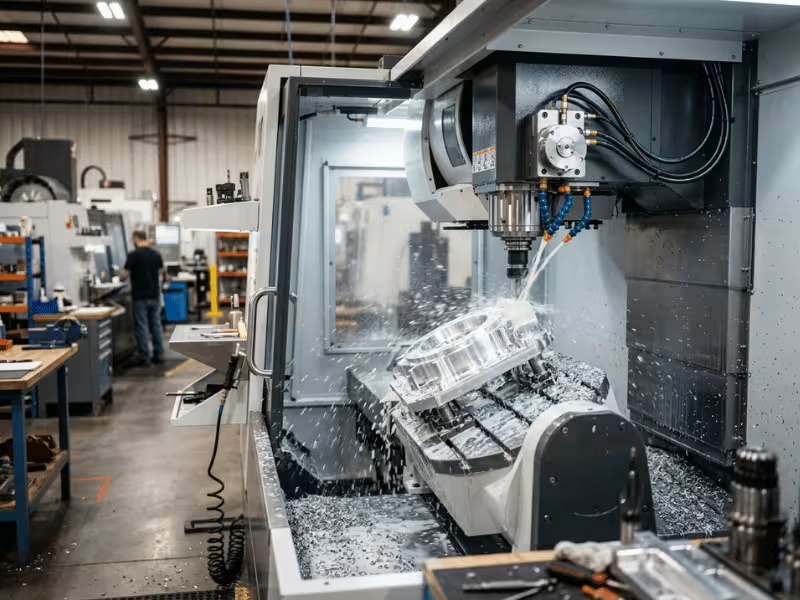
You send the same drawing and the same quantity to three shops. One quotes $9 per part, the next $16, the third $24. Most buyers see that spread and assume it’s noise, or that one shop is just being greedy.
It’s neither. That gap is almost always engineering, process choices, and quality overhead—not luck or price gouging. Each shop read your part a little differently and priced the work it saw.
This guide fixes that guesswork. By the end, you’ll read a quote line by line and know what each number pays for. You’ll judge a shop’s quality claims instead of taking them at face value. And you’ll understand what actually moves your delivery date—which is rarely what buyers blame.
Before you can judge a quote, you need to be clear on what you’re actually buying — and who you’re buying it from.
What Contract CNC Machining Means in Practice
The first thing that trips up buyers isn’t the technology. It’s not knowing whether the company they’re talking to actually cuts metal.
Broker vs. shop that cuts its own metal
Some suppliers take your job and quietly resell it to a shop you never see. A real machine shop cuts your part on its own floor.
That difference changes four things:
Two questions flush this out fast: “Do you machine this in-house?” and “What’s your equipment list?” A direct shop answers both without hesitating.
What you’re actually buying
Contract CNC machining means you outsource machined parts to a shop that owns the equipment, writes the CAM programs, runs the machines, and inspects the output.
Run it in-house instead, and you carry the capital, the machinists, and the calibration burden yourself.
Who buys it and what’s covered
The usual buyers are OEMs, startups without capital equipment, and engineering teams handling overflow or scale-up demand. Under the same roof, you’ll find CNC milling, turning, wire and sinker EDM, grinding, and Swiss-type turning — the full range of contract machining services a real shop keeps on its floor.
Knowing what contract machining is doesn’t tell you whether you should use it. That depends on your volume, your part, and your timeline.
When Outsourcing Makes Sense — and When It Doesn’t
Outsourcing isn’t always the right call. The smart move is to match your part, your volume, and your timeline to the model that fits.
Good fits for contract machining
Some jobs practically beg to be outsourced:
When in-house or a different model wins
Sometimes keeping the work close is smarter:
The cost crossover to watch
The real question is simple: at what annual volume does buying a machine beat paying a shop?
Here’s the math. A new 3-axis VMC runs roughly $60,000–$150,000 installed. Add a machinist at a loaded cost of $25–$45/hr in the US, plus maintenance and tooling. Divide that total across your annual volume and compare it to your outsourced unit price.
|
Situation |
Contract machining usually better |
In-house usually better |
|---|---|---|
|
50 prototype parts, one revision |
✓ |
|
|
40,000 identical parts/year, stable design |
✓ |
|
|
ITAR-controlled defense component |
✓ |
|
|
Demand spike above current capacity |
✓ |
|
|
Titanium part, no in-house 5-axis |
✓ |
Once you’ve decided to outsource, the next question is what kind of shop you’re dealing with — because that’s where the price differences start.
Why Quotes for the Same Part Can Be So Different
That $9-to-$24 spread isn’t random. Four things drive almost all of it: what the part is made from, how tight and complex the geometry is, how the setup cost spreads, and what happens after machining. Walk through each, and the quote stops looking like a mystery.
Material selection and certification
Material is where a quote starts, and it can double your price before a single chip flies.
Grade and availability
Not all metal costs the same to buy or to cut. Use aluminum 6061 as your baseline (call it 1x). It’s cheap and machines fast. From there:
Stock cost is only half the story. Titanium and Inconel cycle times typically run 3–5x longer than aluminum, and they chew through tooling. That machine time and tool wear show up in your unit price, which is why titanium CNC machining carries a premium you should confirm a shop can actually deliver before you commit.
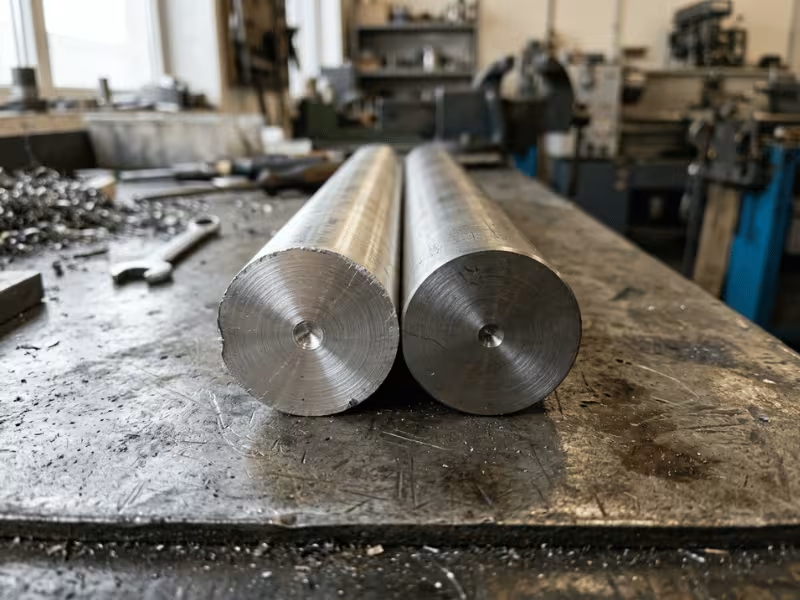
Availability bites too. Ask for a non-stock diameter or a grade in short supply, and the shop either buys oversized bar and machines away the excess or waits for delivery. Both raise your quote. Before you finalize a grade, ask what the shop already has on the shelf.
Certs, traceability, and mill test reports
Certified paperwork costs money. Mill test reports (MTRs), lot tracking, and heat-lot numbers all force the shop to buy certified stock and keep documentation moving with the parts.
That’s mandatory for aerospace, medical, and defense work — no exceptions. For a bracket on a non-critical assembly, it’s usually money you don’t need to spend. As a rule of thumb, full traceability and certs add 5–15% to a job. Buy it when the application demands it, not by reflex.
Geometry and tolerance
Tolerance is the single biggest lever you control on cost, and most buyers over-tighten out of habit.
A tolerance of ±0.005″ is standard and cheap on most CNC work. Tighten to ±0.001″ and the shop slows down and watches it. Push to ±0.0005″ or finer, and you’re into slower speeds, extra inspection, and sometimes grinding — while scrap risk climbs on every part.
Features add their own cost. Thin walls, deep pockets, and small internal radii force specialty tooling and slower feeds. The machine can only push so hard before the part chatters or deflects.
Surface finish works the same way. A standard 125 µin Ra comes off the tool. Ask for a fine 16–32 µin Ra, and you’re paying for extra passes or a secondary operation.
Then there are callouts. Every thread, knurl, or extra note is another operation with its own setup and its own minutes. They add up quietly.
Setup, programming, and tooling
Here’s the biggest reason two quotes for the same part land so far apart: setup cost is largely fixed per job, and it spreads across your quantity.
A 25-piece order carries the full setup on 25 parts. A 2,500-piece order spreads that same cost across 2,500. Same work, wildly different per-unit numbers.
Put real figures on it. Say setup runs $400 for a given job:
Nothing about the part changed — only the volume the fixed cost rides on.
Setup itself typically runs 1–8 hours depending on complexity, at shop rates of $60–$150/hr in the US. That range reflects axis count and whether the machine runs attended or lights-out. Complex geometry also adds CAM programming hours before anyone cuts metal. And custom fixtures are a real upfront cost that only pays back at volume.
This is why you should always ask for pricing at quantity breaks — 25, 100, 500. It shows you exactly how fast setup melts away as volume climbs.
Finishing and secondary operations
Anodizing, powder coat, plating, passivation, heat treatment — these live outside the machining quote and can outweigh it.
Most finishing is subcontracted. That hits you twice: on price and on lead time, because the parts leave the shop and sit in someone else’s queue.
Specify the finish when it’s functional or regulated — a hard anodize for wear, a passivation for corrosion, a heat treat for strength. When the choice is purely cosmetic, leave it open and let the shop recommend the cheapest compliant option. You’ll often save money without losing anything you care about.
|
Cost driver |
Why it increases cost |
Buyer implication |
|---|---|---|
|
Tolerance from ±0.005″ to ±0.0005″ |
Slower speeds, more inspection, higher scrap |
Only tighten features that must be tight |
|
Exotic material (titanium, Inconel) |
3–5x cycle time, heavy tool wear |
Confirm the shop machines it routinely |
|
Low order quantity |
Setup spread over few parts |
Ask for pricing at 25 / 100 / 500 breaks |
|
Fine surface finish (16 µin Ra) |
Extra passes or secondary operations |
Specify finish only where it’s functional |
Now that you know what drives the number, you can look at an actual quote and see whether the shop understood your part — or missed something that will cost you later.
How to Read a CNC Quote Without Missing the Real Risk
A quote is more than a number. It’s a snapshot of how the shop read your part. Learn to read it closely, and you’ll catch the shop that misunderstood the job before it costs you a scrap run.
What a solid quote includes
A real quote spells out what you’re buying, line by line:
When all seven show up, the shop understands your part. When they don’t, you’re filling in blanks the shop should have filled for you.
Red flags to catch before you sign
Some gaps are worse than others. Watch for these:
|
What you see |
What it may mean |
What to ask next |
|---|---|---|
|
“Aluminum” with no grade |
Shop will pick the cheapest, maybe wrong stock |
“Which grade and temper are you quoting?” |
|
Price 40% below the others |
Shop misread tolerance or scope |
“Which tolerances did you quote to?” |
|
No lead-time stated |
No commitment, no accountability |
“What’s your firm ship date at this quantity?” |
Comparing quotes apples to apples
You can only compare quotes fairly when every shop prices the same job. Set that up on your end:
Do this, and the spread stops lying to you. The remaining differences reflect real choices, not mismatched assumptions.
A clean quote tells you the shop understood the part. It doesn’t yet tell you whether they can hold what they promised — that’s a question of quality systems.
What Good Quality Control Actually Looks Like
A shop can quote your part perfectly and still ship you scrap. Quality control is what separates a good quote from a good part. The trick is matching verification effort to what’s actually riding on the part—not buying more than you need, and never buying less.
Certifications that matter by application
Certs aren’t badges. Each one maps to an industry and a risk level. Match the cert to your part’s stakes:
The buyer move is simple: don’t pay AS9100 pricing on a non-critical bracket. A shop carrying medical and aerospace certs prices that overhead into every job. If your part is a cosmetic cover, ISO 9001 is plenty.
Inspection capability to ask about
Certs prove a system exists. Inspection equipment proves the shop can actually measure what it promises.
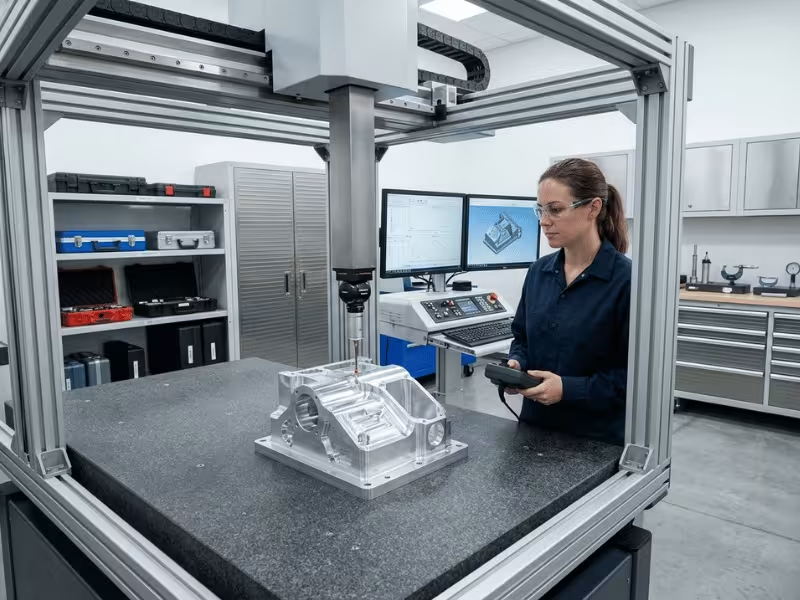
Ask what’s on their floor: a CMM, optical comparators, height gauges, and surface roughness testers. A good CMM measures to around ±0.0001″ under climate control — that’s the equipment that verifies tight tolerances instead of guessing at them. No CMM, no credible claim on precision work.
Then ask about first article inspection (FAI) — the first part off the run checked against every dimension on the drawing. Require it on any new part number or new revision. The first part off a changed program is where errors hide, and FAI catches them before you’ve paid for the whole batch.
Know the difference between two kinds of checking. In-process inspection catches drift while the machine is still running, so the shop can correct before a hundred parts go out of spec. Final inspection and sampling plans check the finished lot — often to an AQL of 1.0 or 1.5 for general industrial work. In-process protects you during the run; final inspection confirms the result. You want both when the part matters.
Documentation that proves it
Good quality leaves a paper trail. Ask to see it:
If a shop can’t produce these on request, the quality system is thinner than the cert suggests.
What buyers misunderstand about quality
Three assumptions cost buyers real money.
|
Project type |
Usually enough |
Often required |
Situational |
|---|---|---|---|
|
General industrial part |
ISO 9001, final inspection |
FAI on new revision |
In-process sampling |
|
Aerospace bracket |
ISO 9001 |
AS9100, FAI, full traceability |
NADCAP for coatings |
|
Medical component |
ISO 9001 |
ISO 13485, traceability |
Validated process, PPAP-level docs |
Read that table by your part’s risk level, not by what sounds impressive. Buy the verification your part needs, then stop.
Even a shop with the right certs and the right CMM can still miss your date. Quality tells you the part will be right; lead time tells you when you’ll actually hold it.
What Really Controls Lead Time
Buyers blame the machine when a part runs late. Almost always, the machine wasn’t the problem. The delay lives in the steps around it — the ones nobody quotes and nobody watches.
Lead time is more than machine time
A part moves through a long chain before it lands on your dock: RFQ clarification, programming, material procurement, setup, machining, inspection, finishing, and shipping. Each link takes time, and only one of them involves a spinning tool.
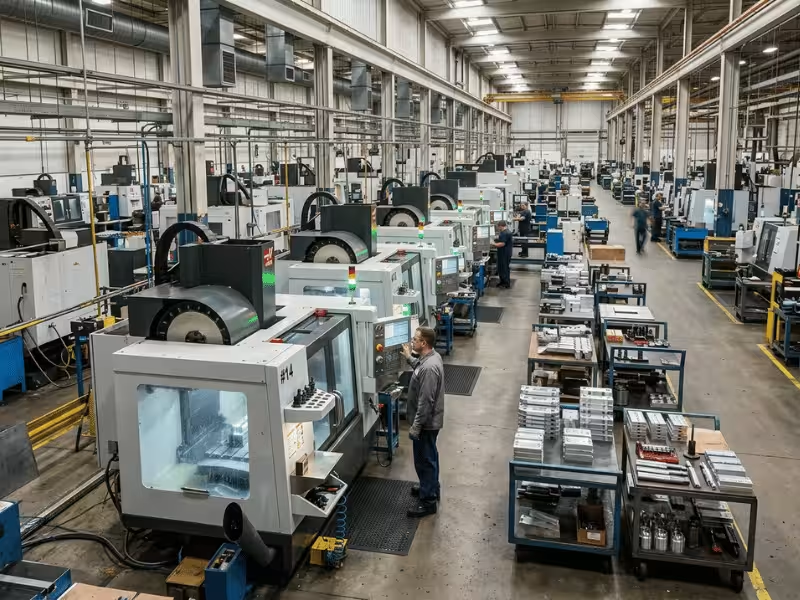
Here’s the part that surprises people: actual spindle time is often the smallest piece. The machining might take two hours. Waiting on material takes a week. Sitting in a finishing queue takes another. The cutting is fast — everything around it is where the days pile up.
Rapid work can compress to that fast timeline only when the part is simple, and the material is already on the shelf. Complexity and out-of-stock metal break that fast timeline every time.
The biggest causes of delay
Five things eat most of your calendar:
When expedite helps — and when it can’t
Paying a rush fee moves your job up the schedule. The shop bumps you ahead of other work, runs overtime, and pays insertion fees to push you higher in an outside processor’s queue. Expedite fees commonly run 25–50% over standard pricing.
That money is well spent when the material is already on hand and the part is straightforward. In that case, speed is genuinely for sale — the shop just reshuffles its own calendar and cuts your part sooner.
|
Delay source |
Typical impact |
How buyers can reduce it |
|---|---|---|
|
Incomplete drawing package |
2–5 days of back-and-forth |
Send GD&T, revision, material, and finish upfront |
|
Out-of-stock material |
3–10 days |
Ask what’s in stock before finalizing the grade |
|
Outside finishing queue |
5–10 days |
Confirm finishing lead time when you order |
Your biggest lever isn’t the rush fee — it’s a clean drawing package and a material choice the shop already stocks. Fix those two, and you kill most of the delay before the job starts.
Cost, quality, and lead time all come back to one thing: whether you picked the right shop. So before you send any PO, you need a way to vet the shop itself.
How to Vet a Contract CNC Shop Before You Send a PO
The shop you pick decides what your parts cost, whether they’re right, and when they show up. A quote can’t tell you all that. A short, pointed conversation can. Here’s how to run it before you commit a dollar.
What to verify before the first order
Don’t take capability on faith. Verify three things first.
Questions worth asking
Run this as a call script. Ask them in order and listen to how fast and how specifically they answer.
The hesitation matters as much as the words. A capable shop answers these in its sleep.
What strong suppliers do differently
The good ones behave differently from the first email, and you can spot it before you sign anything.
They ask smart questions early instead of quoting blind. If nobody asks about your revision level, material temper, or critical features, they’re guessing — and you’ll pay for the guess.
They flag manufacturability issues before you commit, not after they miss the date. They’ll tell you a feature is expensive to hold and suggest an easier way to get the same function.
They state their assumptions in writing. Which tolerances they quoted to, what finish, what quantity — all on paper, so there’s no argument later about what you actually bought.
And they surface constraints before taking the job. Capacity, material availability, finishing lead time — the honest shop tells you about the two-week anodizing queue when you order, not when the part is already late.
|
Checkpoint |
Why it matters |
Pass or concern |
|---|---|---|
|
Machines your material in-house |
Controls quality and lead time |
|
|
Provides FAI and inspection data |
Proves capability, not just claims |
|
|
Gives DFM feedback on your drawing |
Signals an engineering partner, not a broker |
Score every shop against those three before a PO leaves your desk. A shop that clears all three has earned a shot at your work.
Even a well-vetted shop won’t save you from mistakes on your side of the table. The most expensive problems in contract machining are usually self-inflicted.
Common Buying Mistakes That Cause Cost, Delay or Rework
The most expensive problems in contract machining rarely start on the shop floor. They start on your side of the table, before you send the PO. Here are the five that burn buyers most — and the fix for each.
Five mistakes, each with the fix

Avoiding these mistakes still leaves you with the core tension every buyer faces: you can’t max out cost, quality, and speed at the same time.
How to Balance Cost, Quality and Lead Time
Cost, quality, and speed pull against each other. Push hard on one and at least one other gives. The buyers who get burned are the ones who try to max out all three and end up with none. The smart move is to decide which one wins for this specific job — and let the others flex on purpose.
You rarely get all three — decide by scenario
Your priority isn’t fixed. It shifts with the part in front of you. Match the winner to the job, and the trade-offs stop feeling like compromises — they become deliberate choices.
Building a simple scoring approach
Don’t default to unit price on every job. Weight the three variables to what the program actually needs, and let the math point you to the right shop.
Here’s a one-line method: score each shop on cost, quality, and lead time from 1 to 5, weight the columns to your project’s priority, then compare the weighted totals. The shop with the highest weighted score wins — not the cheapest quote.
|
Scenario |
Top priority |
What can flex |
Buyer strategy |
|---|---|---|---|
|
Prototype validation |
Speed |
Unit cost |
Accept higher per-part price for fast turns |
|
Regulated production part |
Quality |
Lead time |
Pay for certs and FAI; don’t rush the process |
|
Stable repeat order |
Cost |
Lead time |
Negotiate volume breaks and blanket POs |
Match the weighting to the row that fits your part, and the right shop usually rises to the top.
Once you’ve picked the shop and set your priorities, a few contract terms decide who eats the cost when something goes wrong.
Before You Place the PO: Terms to Clarify
A clean quote and a vetted shop still leave gaps. Five terms decide who pays when something goes sideways. Nail them down before the PO leaves your desk, and you close the door on the arguments that surface later.
Put it all together, and the picture is simple. A fair quote, a shop that cuts its own metal, quality matched to your part’s stakes, a realistic lead time, and clean contract terms — get those five right and the $9-to-$24 spread stops being a mystery. You’ll know exactly what you’re paying for, why one shop costs more than another, and which one actually deserves your PO.