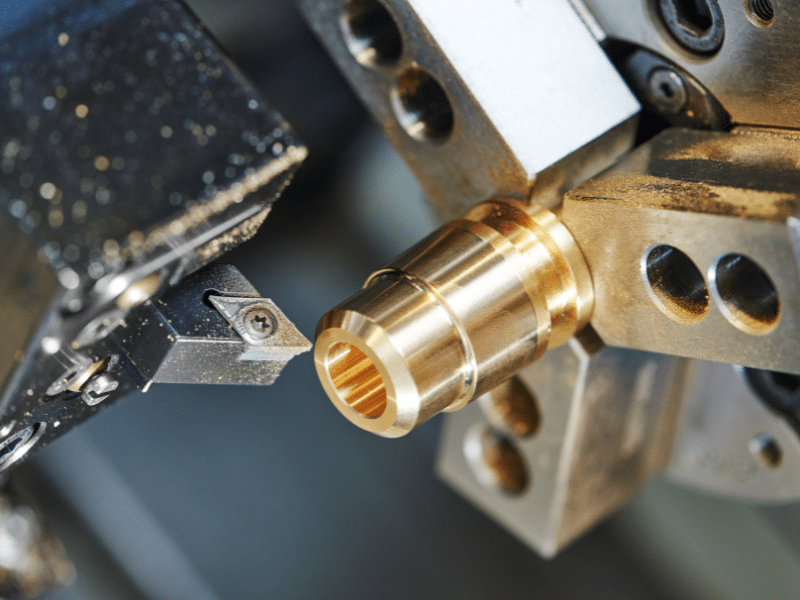
Pick the wrong turning tool and you’ll know it within minutes: chatter marks down the part, blue chips wrapping the chuck, and an insert that’s worn out before lunch. I’ve spent years standing in front of lathes and CNC turning centers, and I’ll tell you straight—the tool decision you make before you hit cycle start matters more than almost anything else on the job.
This guide walks you through lathe cutting tools the way I’d explain them to a new machinist on the floor. Here’s what you’ll get:
- What each tool type actually does, and when to grab it
- How to match insert material and geometry to your part
- How to pick tools for common workpiece materials
- How to fix the tooling problems that ruin finish and tool life
I’ll keep it practical and skip the lecture-hall stuff.
What Lathe Cutting Tools Actually Do
A lathe tool does one simple job: it removes material from a spinning workpiece to shape it into a round part. The part turns, the tool stays put or moves along set paths, and metal comes off as chips. On a CNC machine, those paths are programmed, so the cuts repeat with tight accuracy across dozens or thousands of parts.
Most modern CNC turning tools come in two pieces: a holder (the steel body clamped in the turret) and a replaceable insert (the carbide or ceramic tip that does the cutting). When an edge wears out, you don’t sharpen anything—you loosen a screw, rotate the insert to a fresh corner, or pop in a new one. Fast, cheap, and you stay cutting.
Three things decide how well a tool performs: the insert material, the geometry (angles and nose shape), and the rigidity of the whole setup. Nail those three and most jobs run smoothly. Ignore them and you’ll chase problems all shift.
Key takeaway: A turning tool is a system, not just a sharp tip. The holder, insert, and setup all work together.
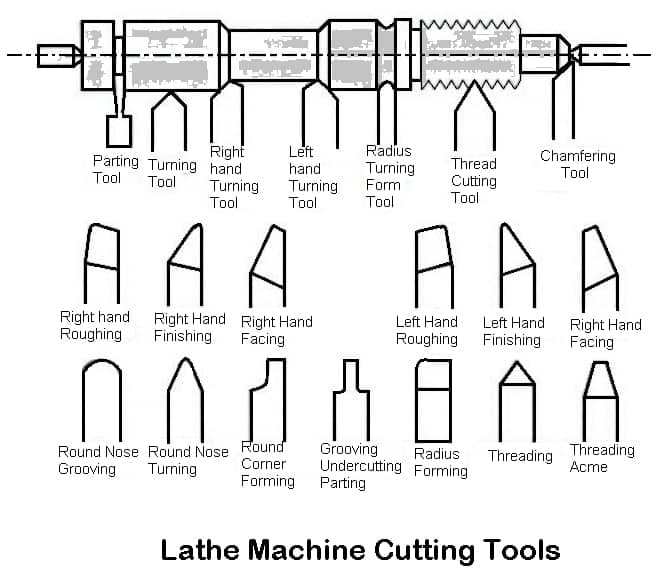
Main Types of Lathe Cutting Tools by Operation
Different cuts need different tools. Using the right one saves time and protects your finish.
- Turning tools — Remove material along the length of the part to reduce diameter. Your bread-and-butter operation, split into roughing (heavy cuts) and finishing (light, precise passes).
- Facing tools — Cut across the end of the part to create a flat, square surface. Usually the first op to clean up and length the stock.
- Parting (cut-off) tools — A thin, deep blade that slices through the diameter to drop the finished part free. Thin and prone to breaking, so they want a rigid setup.
- Grooving tools — Cut narrow channels on the OD, ID, or face. Think O-ring seats, snap-ring grooves, and relief cuts.
- Threading tools — Cut helical threads, external or internal. The insert profile sets the thread form (V, ACME, and so on).
- Boring tools — Enlarge and true up an existing hole from the inside. Single-point and very sensitive to rigidity.
- Drilling tools — Mounted in the tailstock or turret to create a center hole, often before boring or tapping.
- Knurling tools — Press a textured pattern into the surface for grip. These don’t cut; they deform the surface.
- Chamfering tools — Cut an angled edge, often 45°, to break sharp corners or prep for assembly.
In short: Match the tool to the operation first. A turning tool won’t part off cleanly, and a parting blade won’t survive a roughing pass.
Tool Materials: When to Use Each
The insert material sets the ceiling on how fast and hard you can run. Pick wrong and you’ll burn up edges or leave performance on the table.
Material Best for Avoid when Notes
HSS Low-speed work, soft metals, custom form tools High production, hard materials Cheap, tough, easy to regrind. Slow.
Carbide General turning across most metals — The everyday workhorse. Hard, handles heat well.
Coated carbide Steel, stainless, higher speeds Very light interrupted cuts on soft alloys Coatings (TiN, TiAlN, Al₂O₃) add wear and heat resistance.
Ceramic Hardened steel, cast iron, high-speed roughing Interrupted cuts, low rigidity Runs hot and fast but brittle.
CBN Hardened steel (45+ HRC), hard turning Soft steels, aluminum Can replace grinding on hardened parts.
PCD / diamond Aluminum, brass, copper, plastics Steel and iron (chemical wear) Mirror finishes on non-ferrous. Pricey.
A quick field note: diamond and PCD shine in turning because it’s a continuous cut. Don’t put them on steel—the carbon reacts with iron and the edge dies fast.
Start with coated carbide for most steel and stainless work. Step up to ceramic or CBN only when hardness or speed demands it, and reach for PCD on non-ferrous parts where finish matters.
Insert Geometry That Actually Affects Results
A lot of finish and tool-life problems live in the geometry. You don’t need to memorize every angle, but a few matter every day.
Rake Angle
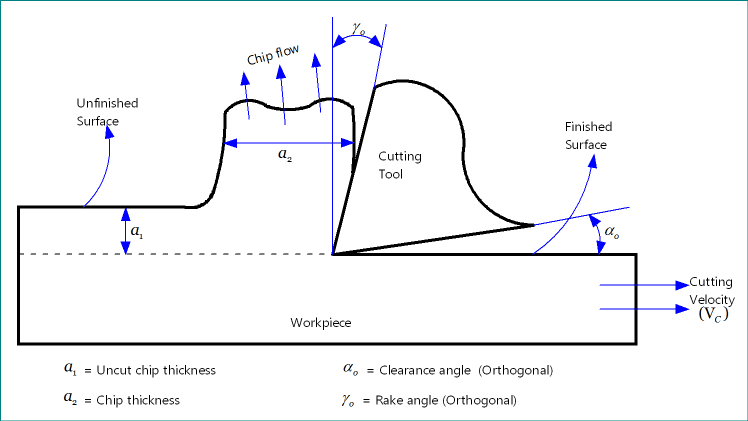
Rake angle controls how the chip flows and how hard the tool has to push.
- Positive rake — Sharper, lower cutting forces. Great for aluminum, soft steel, and thin-walled parts.
- Negative rake — Stronger edge, handles heat and interrupted cuts. Better for hard materials and heavy roughing.
Relief (Clearance) Angle
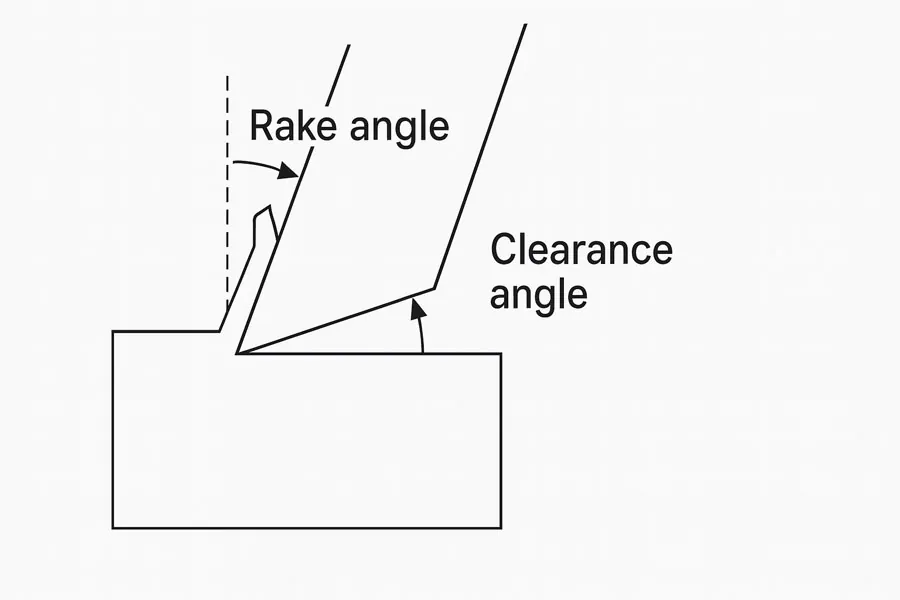
Relief keeps the tool’s flank from rubbing the freshly cut surface. Too little and you get heat and rubbing. Too much and the edge gets weak and chips. For most turning, the insert and holder already set a sensible value—just don’t fight it with a bad setup.
Nose Radius
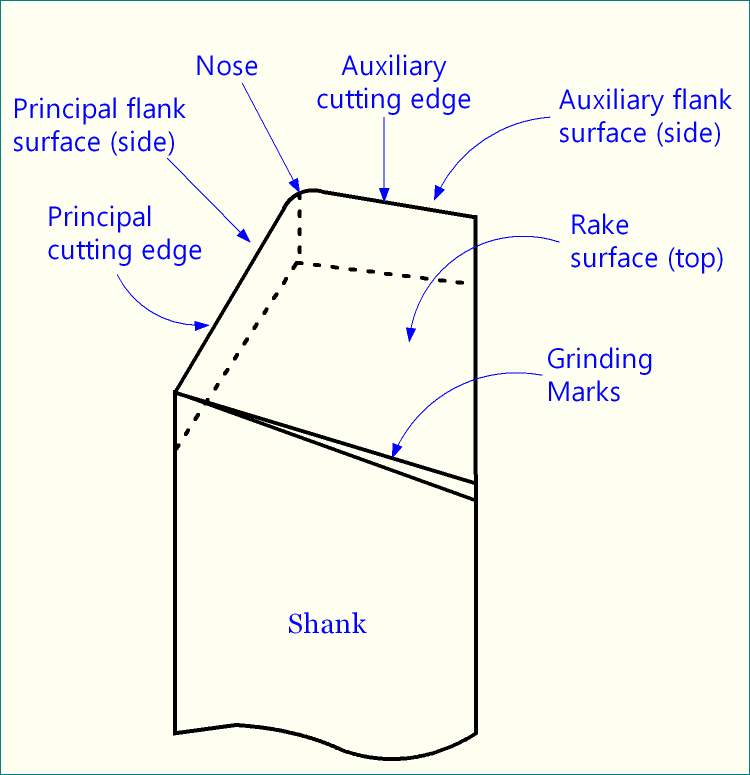
The nose radius is the rounded tip where the cutting edges meet. It’s one of the easiest levers for finish.
- Larger radius — Smoother finish, stronger edge, but more cutting force and higher chatter risk on slender parts.
- Smaller radius — Less force, better for fine work and thin shafts, but a rougher finish at the same feed.
A simple rule: keep your feed rate below about half the nose radius for a clean finish.
Insert Shape
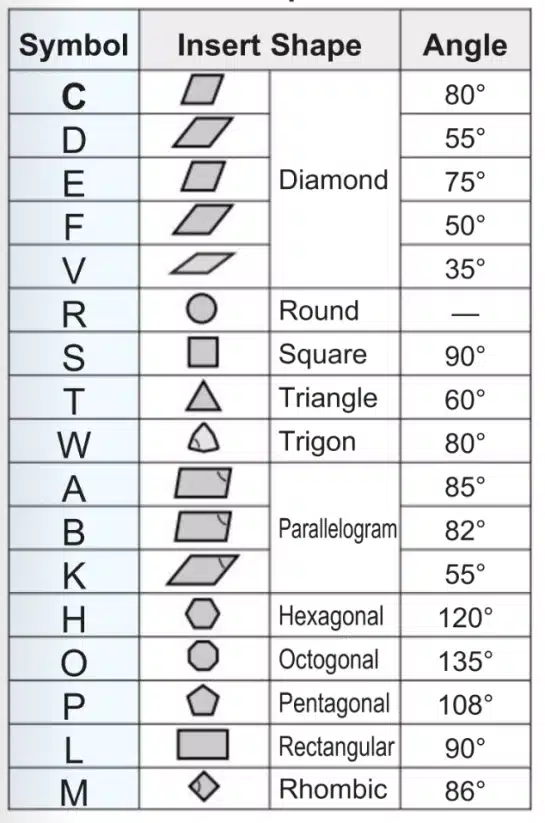
Insert shape trades strength for access.
- R (round), S (square) — Strong edges for heavy roughing; less access.
- C (80° diamond) — The everyday workhorse; balances strength and versatility. If I could stock one shape, it’d be the C.
- D (55°), T (triangle) — Better clearance for contours; weaker edge.
- V (35° diamond) — Reaches tight corners and steep profiles; pointy and breaks easier, so treat it gently.
Hand of Tool
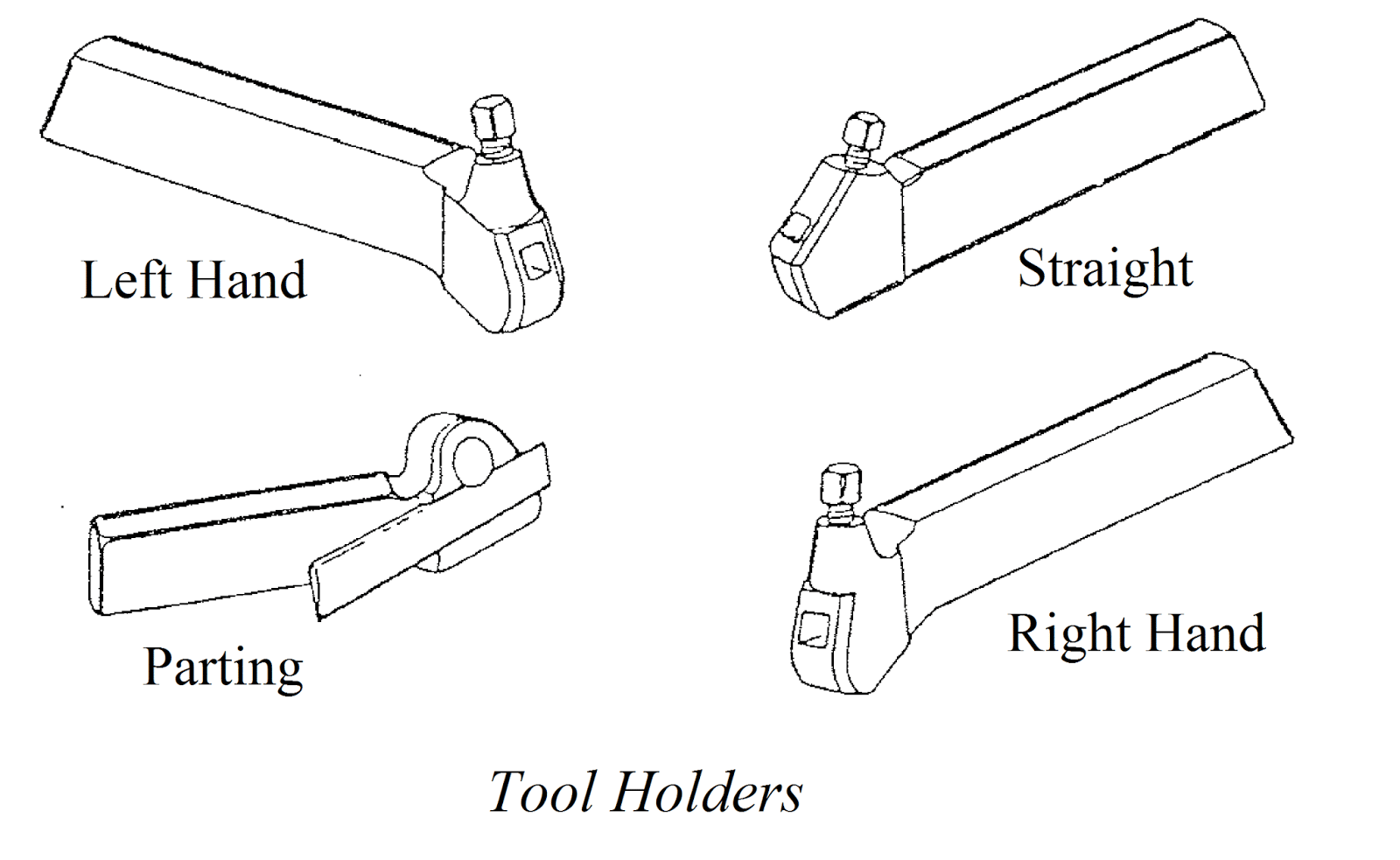
- Right-hand — Cuts right to left toward the headstock. The default for most work.
- Left-hand — Cuts left to right; useful near the tailstock or around obstructions.
- Neutral — Cuts both directions; good for profiling and finishing.
In short: Positive rake and the right nose radius solve more finish problems than any expensive insert grade.
Matching Tool Holders to the Job
A great insert in the wrong holder is a wasted tool. The holder positions the edge, takes the cutting force, and keeps everything rigid.
Shank size has to match your machine’s turret or tool post. Too big and it won’t fit; too small and you’ll have a sloppy, shimmed setup that chatters. Measure before you order.
Clamping style secures the insert in different ways. Screw-down (top-clamp) holders are simple and quick for most turning. Clamp-on and wedge-lock styles grip harder for heavy cuts. Match the clamping to how aggressive your job is.
Approach angle—how the tool meets the part—steers the direction of cutting forces and changes chip thickness. The right approach angle is often the difference between a clean cut and a tool that pushes the part off-line.
Coolant delivery matters more than people think. Many holders route fluid right at the cutting zone, flushing chips away and keeping the edge cool. On deep boring or stainless work, through-tool coolant is a game changer.
Qualified holders are built so the tool tip sits at an exact, known position, putting it right at center height when you load it. That saves setup time and keeps your programmed dimensions honest.
Try this: Before ordering a holder, confirm shank size, clamping style, and whether you need through-tool coolant for the material you’re cutting.
How to Choose Tools by Workpiece Material
Material drives almost every tooling decision. Here’s a practical starting point.
Material Insert material Geometry Watch out for
Aluminum PCD or polished carbide High positive rake, sharp edge Built-up edge; needs sharpness and chip flow
Mild steel Coated carbide Moderate positive rake Long stringy chips; use a chipbreaker
Alloy steel Coated carbide Neutral to slightly negative Heat; keep speeds controlled
Stainless (304/316) Sharp coated carbide Positive rake, sharp edge Work hardening and built-up edge; never dwell
Brass Carbide or PCD Neutral, slight negative Grabby cuts; brass cuts almost too easily
Plastics Sharp carbide or PCD High positive rake Melting and burrs; keep edges keen
Hardened alloys (45+ HRC) CBN or ceramic Negative rake, strong edge Rigidity; hard turning needs a tight setup
For stainless, the biggest mistake I see is too little feed. Dwelling on the surface work-hardens it and kills the next pass. Keep the tool fed and cutting.
Key takeaway: Match insert material and geometry to the workpiece. Sharp and positive for soft, gummy metals; strong and negative for hard, abrasive ones.
Common CNC Turning Problems and Their Tooling Causes
When a job goes sideways, the tooling is often the first place to look. Here’s how to read the symptoms.
- Chatter — Usually rigidity, not the insert. Check overhang, reduce nose radius, lower depth, or bump up speed. Long, thin parts need support.
- Built-up edge (BUE) — Material welding to the tip, common in aluminum and stainless. Fix it with a sharper edge, higher speed, and better coolant.
- Poor chip control — Long bird’s-nest chips mean the wrong chipbreaker or too light a feed. Increase feed or switch to a chip-control geometry.
- Rapid wear — Often too high a speed for the material, or a missing or wrong coating. Slow down or move to a tougher grade.
- Bad surface finish — Check nose radius versus feed, edge condition, and rigidity. A worn tip or too-high feed shows up instantly.
- Tool breakage — Too much depth or feed for the insert, or an interrupted cut on a brittle grade. Use a stronger insert shape or back off the cut.
In short: Before you blame the insert, check the setup. Overhang and rigidity cause more turning problems than any single tool.
Practical Tool Selection Checklist
Run through these before you commit to a tool:
- Operation — Turning, facing, parting, boring, threading?
- Workpiece material — Soft and gummy, or hard and abrasive?
- Internal or external — Boring and internal grooving need slim, rigid tools.
- Slender or stout part — Thin shafts want a small nose radius and minimal overhang.
- Tolerance and finish — Tight specs push you toward finishing inserts and the right nose radius.
- Batch size — One-offs may justify HSS; production favors indexable carbide.
- Machine rigidity and power — A light machine can’t push ceramic at full tilt.
- Coolant — Flood, high-pressure, or dry changes your grade and speed choices.
Use this approach: A two-minute checklist beats a scrapped part. Decide on material, geometry, and rigidity before you load the tool.
Frequently Asked Questions
What’s the difference between a roughing and a finishing insert?
A roughing insert is built for volume. It has a thicker body, a larger nose radius, and a tougher edge so it can take deep cuts and heavy feeds without breaking. You trade surface finish for speed and metal removal. A finishing insert is built for accuracy—a sharper, more precise edge and a smaller nose radius to hold tight tolerances and leave a smooth surface. For tight specs, split the work between the two.
How do I choose the correct nose radius?
Start with your finish and tolerances. A larger radius gives a smoother finish and a stronger tip, so it suits general turning and roughing on stout parts. A smaller radius is sharper and better for fine detail, tight inside corners, and thin shafts. A good rule of thumb: keep your feed under roughly half the nose radius for a clean finish, and don’t run a radius larger than your depth of cut on flimsy parts—it pushes and rubs instead of cutting.
When should I use a boring bar instead of a drill?
Use a drill to make a hole. Use a boring bar to make that hole accurate. A drill gets you close, but it can wander, taper, or come out slightly oversized. When you need a precise inside diameter, a truly round bore, or a specific internal finish, that’s boring bar territory. The usual flow is drill first, then bore to final size.
Why is center height important?
Center height is where the cutting edge sits relative to the part’s centerline. If the tool sits too high or too low, the rake and clearance angles you designed into the insert change—and not for the better. A tool above center rubs and pushes; a tool below center can dig in or leave a little nub at the face. Get the edge dead on center and the insert cuts the way it was meant to.
How does a chip breaker prevent long, stringy chips?
A chip breaker is a molded groove or bump on top of the insert. As the chip curls up and away, it runs into that feature and gets forced to bend sharply, which snaps it into short, manageable pieces. This matters more than it sounds—long, stringy chips wrap around the tool and part, scratch your finish, and can be flat-out dangerous. Match the chip breaker to your feed and depth to keep chips short.
What are the signs that a turning tool is worn out?
Watch and listen. A worn edge usually shows up as a poor surface finish, a change in the sound of the cut, or burrs left on the part. You might also see the part come out oversized as the edge breaks down. Look at the insert too: a shiny wear band on the flank, chipping on the edge, or a crater on the top face all say the same thing—rotate to a fresh corner or swap the insert. Pushing a worn tool just makes scrap and risks a bigger failure.
Can I use the same tool for aluminum and stainless steel?
You can, but you shouldn’t if you care about results. Aluminum likes a sharp, positive-rake, polished edge—often uncoated or PCD—so chips don’t stick. Stainless wants a tougher grade with a coating built to handle heat and work hardening. Run aluminum on a stainless insert and your finish suffers; run stainless on an aluminum-ground edge and you’ll wear it out fast. Keep separate tools for each and both your edges and your parts come out better.
The Bottom Line
Good turning starts with smart tool choices. Match the tool type to the operation, the insert material and geometry to the workpiece, and the setup to the part’s rigidity—and most finish and tool-life problems disappear before they start.
Your next step: take one recurring problem part and run it through the checklist above. Confirm the insert material, nose radius, and overhang fit the job. That single review catches most of the errors I see on the shop floor.
And if you’d rather hand the turning to a team that already lives by these rules, our CNC turning experts can help you choose tooling, dial in the process, and deliver parts to spec—from prototypes to full production runs. Send us your drawings and we’ll help you get it right the first time.