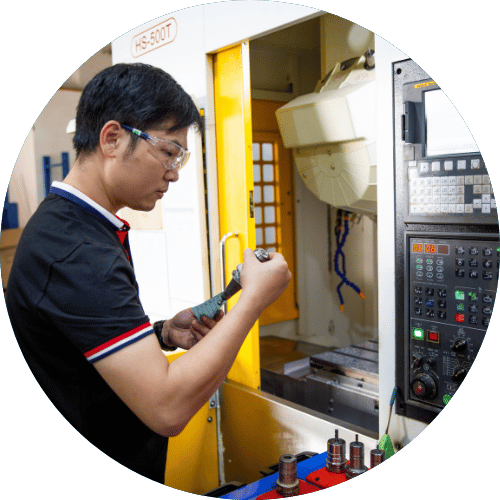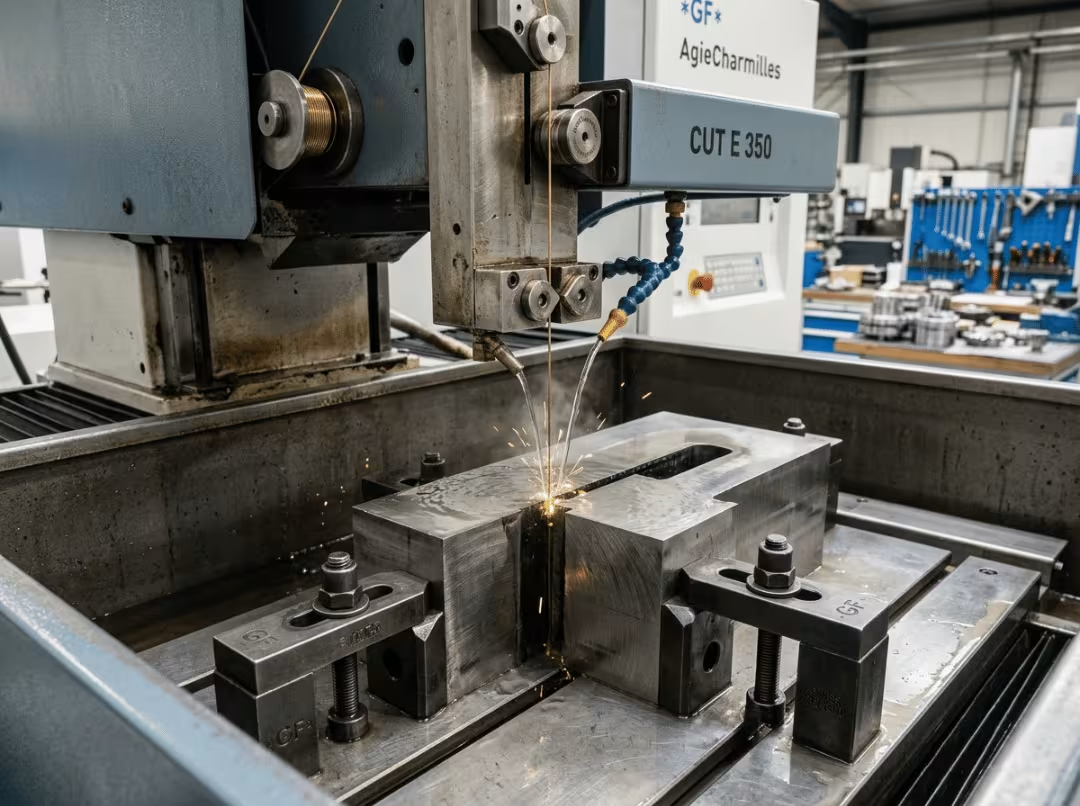
Wire EDM cuts metal without contact. A thin, electrically charged wire erodes hardened steel, carbide, and titanium with clean, burr-free edges — and it does so without the tool pressure that would distort a delicate part. That’s the core appeal.
The limitation is speed and material scope. Wire EDM is slow, it only works on conductive metals, and for a simple bracket profile in thin sheet, it’s usually the wrong process by a wide margin. The precision comes at a real cost in cutting time, and that cost only makes sense when the part actually demands what the process uniquely delivers.
The useful question, then, isn’t “what is wire EDM” — it’s “should I use it for this specific part?” That depends on the material, geometry, tolerance requirement, and volume. This guide works through each of those factors: where wire EDM excels, where it loses to faster processes, what drives the cost, and how it stacks up against laser cutting, waterjet, CNC milling, and sinker EDM.
What Is Wire EDM?
Wire EDM (wire electrical discharge machining) cuts conductive metal using a thin, electrically charged wire, controlled electrical sparks, and a dielectric fluid — with no mechanical contact between wire and part.
The process goes by several names: spark erosion, wire cutting, wire erosion. What it produces is precise 2D profiles and tapered shapes with clean, burr-free edges, often held to tolerances tight enough that no secondary finishing is needed.
One constraint defines everything that follows: wire EDM only cuts materials that conduct electricity. That single fact rules out plastics, ceramics, composites, and glass before geometry or tolerance even enter the conversation.
How Wire EDM Works
Understanding the basic mechanism makes the process limits — corner radius, cut speed, material fit, thickness — easier to reason about.
The cutting action
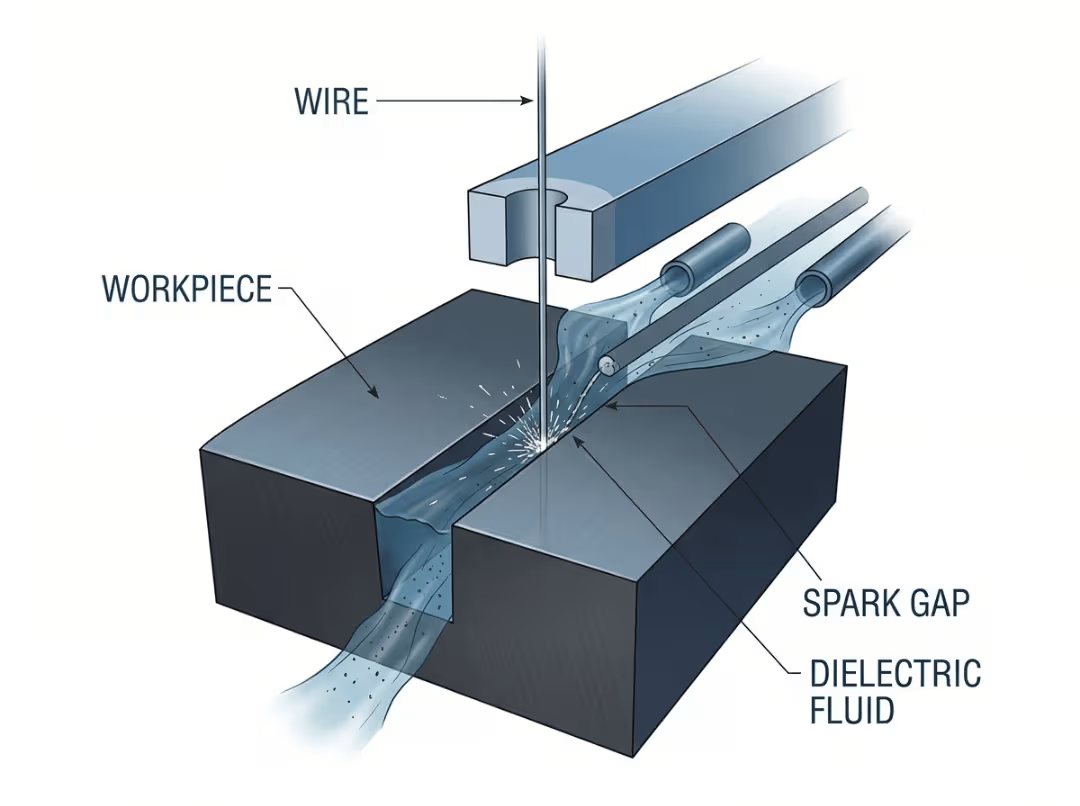
A thin brass wire carries an electrical charge and tracks close to the workpiece without touching it. When the voltage difference across the gap reaches a threshold, a spark jumps across, melting and vaporizing a small amount of metal. Deionized water flushes the debris away and stabilizes the gap. The wire feeds continuously from a spool so fresh material is always cutting; the workpiece moves along a programmed path, and the spark traces out the profile.
Why no contact matters
Because the wire never physically pushes on the part, there is no bending load, no clamping distortion from the cutting process itself, and no tool deflection. A fully hardened block and a paper-thin delicate section both cut without distortion. That’s the deciding advantage for parts that would move or crack under conventional tool pressure — and it’s the single most common reason engineers reach for wire EDM when other processes would seem faster.
What Wire EDM Is Best At
These are the conditions where wire EDM earns its cost and slower pace.
Tight internal corners and intricate 2D profiles
The wire is thin — typically 0.1 to 0.3 mm — which lets it reach internal detail that no rotating cutter can access. Narrow slots, complex contours, and sharp inside corners are its strongest territory. When the geometry physically cannot be cut another way, wire EDM stops being a premium option and becomes the practical one.
Hard and hardened metals, cut in their final state
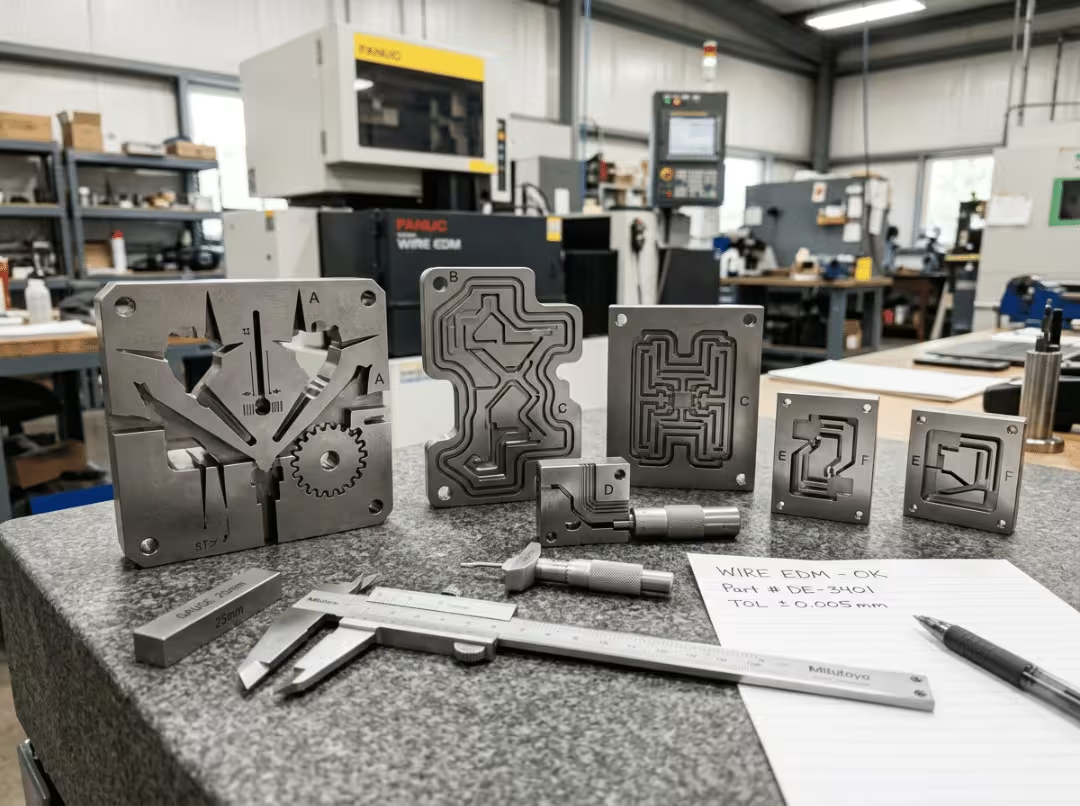
Wire EDM cuts tool steel at full hardness, carbide, and titanium without requiring the material to be softened first or re-hardened after. The consequence is significant: a part can be fully heat-treated before cutting, which eliminates the warp that sometimes follows post-machining heat treatment. For die inserts and punch tooling, this is often the only practical workflow.
No cutting force means no distortion on fragile geometry
Thin walls, delicate ribs, and features that would flex or chatter under a milling tool come out dimensionally correct because nothing physically pushes on them. The process is self-limiting in energy per spark — it cannot apply the kind of force that would spring a thin section.
Burr-free edges and repeatable tight tolerances
The spark erosion process leaves a clean, minimal-burr edge, which matters on components that go directly into assemblies without a deburring step. Where micron-level accuracy is required across a long production run, wire EDM holds it consistently — provided the right number of finishing passes is applied.
When Wire EDM Is the Right Choice
Wire EDM makes sense when a part checks most of these conditions:
- Conductive material — steel, titanium, carbide, copper alloys, or aluminum.
- Hard or hardened metal — material that would dull tooling or deform under conventional cutting.
- Tight-tolerance 2D profiles — contours that must hold their dimensions through the full production run.
- Sharp internal corners or fine detail — features a rotating tool cannot reach cleanly.
- Delicate or thin sections — geometry that would deflect under tool load.
- Burr-sensitive edges — applications where deburring is difficult or unacceptable.
- Low-to-medium volume — programs where cut time per part doesn’t price the process out.
Parts that consistently fit: punch and die inserts, stamping and forming dies, precision gears, medical instruments and implants, aerospace structural profiles, EDM electrodes, keyways, and fine slots. Stainless steel grades and hardened tool steels in their finished condition are the most common wire EDM materials in tooling and precision work.
When Wire EDM Is NOT the Right Choice
This is where most process decisions are actually made. Knowing when to route a part elsewhere saves more time and money than optimizing within wire EDM.
Non-conductive materials — use laser or waterjet
Plastics, ceramics, composites, and glass cannot be spark-eroded. There is no workaround for the conductivity requirement. These go to waterjet, which cuts almost any material without heat, or laser, depending on thickness and tolerance.
Simple profiles that need throughput — use laser or waterjet
For straightforward 2D profiles in sheet metal where tolerance requirements are moderate, laser cutting runs 10 to 100 times faster than wire EDM and costs a fraction of the price. Spending wire EDM’s precision on a mild-steel bracket is spending capability you don’t need and time you don’t have.
High-volume parts — use stamping, laser, or milling
Wire EDM’s cost scales directly with cut time, and cut time per part doesn’t shrink much as volume grows. Once a program reaches volume levels where stamping or laser processing is economical, those processes win decisively on per-part cost. Wire EDM is not a production-volume process for standard geometries.
Blind cavities and 3D mold forms — use sinker EDM or milling
Wire EDM cuts through the full part thickness like a bandsaw. It cannot produce a pocket that doesn’t exit the opposite face, a contoured cavity bottom, or a 3D mold form. Sinker EDM, using a shaped electrode, handles those features. CNC milling handles open 3D pockets and complex surfacing.
Bulk material removal — use CNC milling or turning
When most of the machining work is removing stock — hogging out a block, roughing a bore, cutting a pocket — wire EDM is the wrong tool. Its strength is precise profile cutting, not material removal rate. A CNC milling service does bulk removal faster and at lower cost, often by an order of magnitude.
Wire EDM Tolerances, Surface Finish, and Corner Limits
These numbers and constraints belong in every design conversation before wire EDM is specified.
What tolerances wire EDM realistically holds
Standard production tolerances run around ±0.0005 to ±0.001 in (0.013 to 0.025 mm). Fine work, with careful machine setup and multiple finishing passes, can reach the micron level — roughly ±0.0001 in (0.0025 mm). What separates standard from fine is machine thermal stability, wire quality and consistency, flushing conditions, and the number of passes. Asking for tighter tolerances means asking for more cutting time and, therefore, higher cost.
Surface finish and skim cuts
A single rough cut is fast but leaves a relatively coarse surface. Each subsequent skim cut — a lighter finishing pass — improves surface finish and dimensional accuracy, at the cost of added cutting time. A mold cavity or sealing face may justify three or four skim cuts for a fine finish. A clearance slot does not. Over-specifying surface finish on non-critical features is one of the most common ways wire EDM jobs become more expensive than they need to be.
Minimum inside corner radius
The wire cannot produce a perfectly sharp inside corner. The minimum internal radius achievable is approximately the wire radius plus the spark gap — typically somewhere between 0.05 and 0.15 mm depending on wire diameter and settings. If a design requires a sharper corner than that, the options are to add a corner relief in the drawing or plan a secondary EDM or machining operation. Assuming the wire will produce a true sharp corner leads to parts that don’t meet drawing requirements.
Kerf and dimensional allowance
The wire removes a kerf as it cuts — typically 0.1 to 0.3 mm wide. Parts designed without accounting for that kerf will come out undersized. Program the tool path to compensate, or size the drawing with the kerf already included.
Materials Wire EDM Cuts Well — and What It Cannot Touch
Materials that suit wire EDM
- Hardened tool steel — the most common wire EDM application. Cuts at full hardness with no distortion, no need to re-anneal and re-harden.
- Titanium — conductive, cuts cleanly with minimal heat-affected zone, widely used in aerospace and medical tooling. Parts that also need machined features benefit from combining wire EDM profiles with titanium machining for holes, threads, and 3D surfaces.
- Carbide — highly abrasive to conventional tooling but cut cleanly by wire EDM.
- Stainless steel — cuts well across a range of grades, including hardened and precipitation-hardened types.
- Copper alloys — highly conductive, fast to cut, commonly used for EDM electrodes.
- Aluminum — cuts easily, though for most aluminum parts without demanding profile tolerances, aluminum machining is faster and costs less.
The material boundary that doesn’t move
Non-conductive materials — plastics, ceramics, glass, and composites — cannot be wire-EDM’d. No process adjustment, wire choice, or power setting changes this. Those materials go to waterjet or laser.
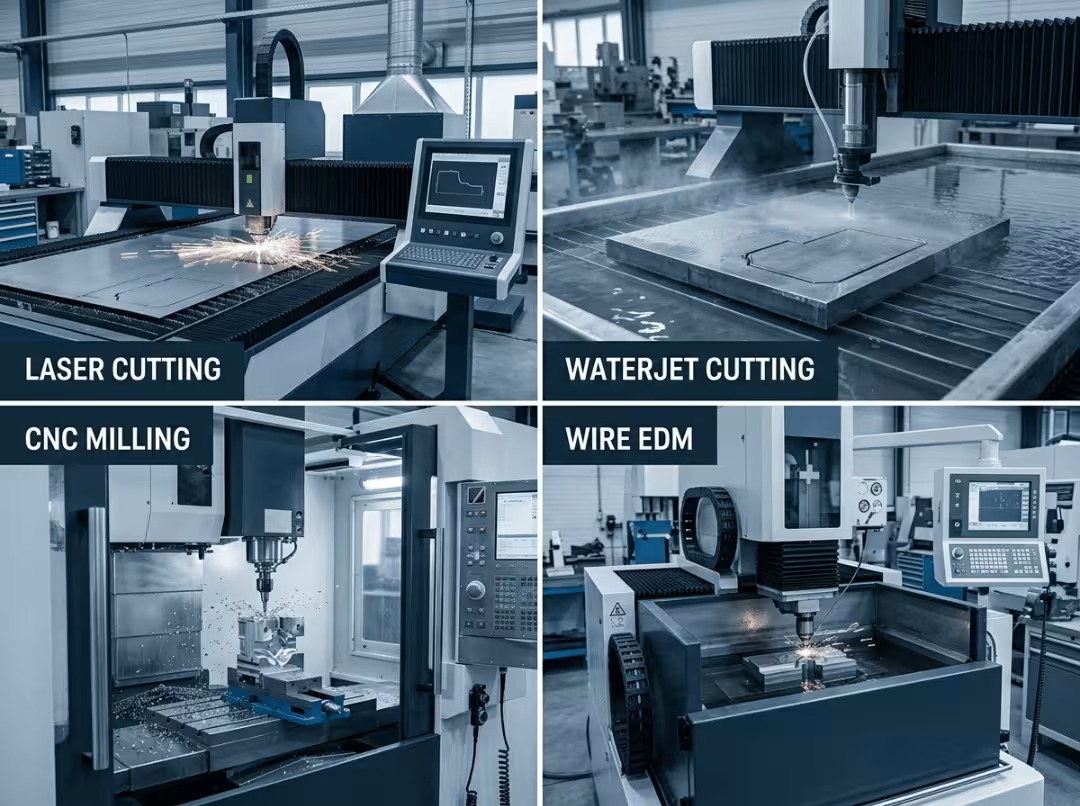
Wire EDM vs Laser Cutting, Waterjet, CNC Milling, and Sinker EDM
The right process depends on the specific part. Most buyers are choosing between wire EDM and one of these four alternatives, not evaluating EDM in isolation.
|
Process |
Material fit |
Best geometry |
Speed |
Precision |
Typical use |
|---|---|---|---|---|---|
|
Wire EDM |
Conductive metals only |
Tight 2D profiles, sharp internal corners |
Slow |
Very high |
Dies, punches, precision contour work |
|
Laser cutting |
Most materials, thin sheet |
Simple to moderate 2D |
Fast |
Moderate |
High-throughput sheet processing |
|
Waterjet |
Almost any material |
2D, thick sections |
Moderate |
Moderate |
Thick or non-conductive stock |
|
CNC milling |
Nearly any metal |
3D features, pockets, threads |
Moderate to fast |
High |
Prismatic and 3D parts |
|
Sinker EDM |
Conductive metals only |
Blind cavities, 3D mold detail |
Slow |
Very high |
Mold cavities, complex forms |
Choose wire EDM when the material is conductive and hard, the part needs tight-tolerance 2D profiles or sharp internal corners, delicate features would distort under tool load, or burr-free edges are required.
Choose laser cutting when you’re processing thin sheet at volume, tolerances are moderate, and throughput matters more than micron-level accuracy.
Choose waterjet when the material is thick, non-conductive, or heat-sensitive, and moderate tolerances are acceptable.
Choose CNC milling when the part has 3D features, pockets, or threads, bulk material removal is most of the work, or faster cycle time is the priority. Prismatic and pocketed parts run on a CNC machining service.
Choose sinker EDM when the part needs blind cavities, 3D mold geometry, or features that a through-cutting wire physically cannot produce.
Wire EDM Cost: What Actually Drives the Price
Wire EDM cost is almost entirely a function of cutting time. Understanding what drives time tells you what drives cost.
The main cost factors
- Material thickness — the wire has to erode through the full height of the part. Thicker stock means more cutting time per millimeter of profile.
- Total cut length — the more profile length programmed, the longer the job runs.
- Tolerance and finish — tighter dimensional requirements mean more skim passes; mirror finishes can require four or more.
- Part count per setup — fixed setup cost spreads across the run, so higher quantities lower the per-part figure.
- Wire consumption and dielectric maintenance — consumable costs that run in the background on every job.
Why the slow cut rate matters for the budget
A simple thin part with moderate tolerances might take minutes per piece. A thick part with a long perimeter profile, tight tolerances throughout, and a fine surface requirement can take hours. If you can estimate the cut path length and the required number of passes, you can make a reasonable estimate of the job’s cost before you quote it. Over-specifying tolerance on features that don’t need it is the most common avoidable cost driver.
When wire EDM is not worth the price
When a slightly looser tolerance would meet the functional requirement, or when a faster process can hold the specification, wire EDM’s precision premium is money spent unnecessarily. The process earns its cost on parts where hardness, fine geometry, or distortion sensitivity makes other options impractical — not on parts that could have been laser-cut or machined.
Design Tips for Wire EDM
These are the decisions that separate parts that cut cleanly from parts that cause problems at setup.
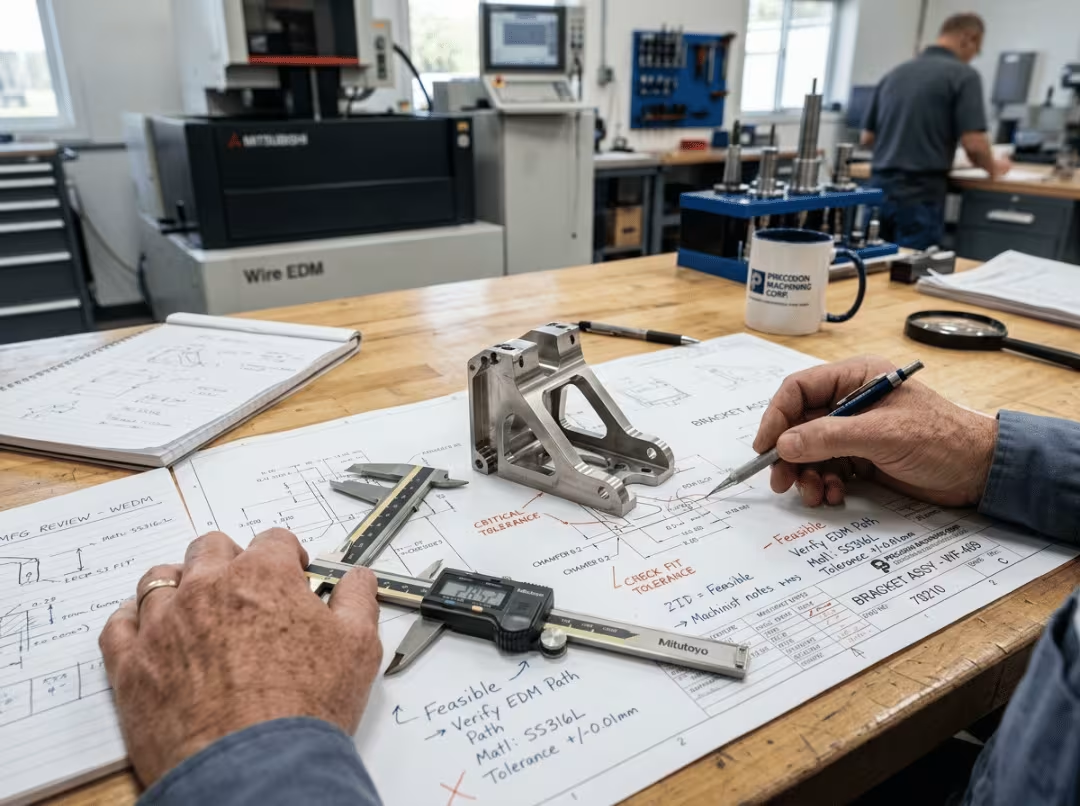
Add start holes for closed internal cutouts
The wire must thread through a hole to begin cutting an internal feature. If no start hole exists, the shop has to add one — or the feature can’t be cut at all. Call it out on the drawing to avoid a surprise conversation after the job is quoted.
Respect the minimum inside corner radius
Don’t dimension inside corners sharper than the wire can produce. If the function genuinely requires a sharper corner than the wire allows, add a corner relief radius or slot in the design, or specify a secondary operation. Trying to hold a true zero-radius inside corner leads to non-conforming parts.
Account for kerf in the nominal dimensions
Size features with the wire’s kerf already included in the dimensions, or confirm the shop’s CAM compensation will handle it. Ignoring kerf consistently produces undersized parts.
Specify tight tolerances only on features that need them
Tolerancing everything on a wire EDM part to micron-level accuracy multiplies the number of skim passes across the entire cut path. Flag the critical features — the mating surfaces, the profile that controls fit — and let everything else run at standard tolerance.
Plan for tabs and slug capture on cutouts
When a cutout is fully profiled, the slug that’s cut free can drop into the work zone and disrupt the wire or damage the part surface. Plan for a small retaining tab, or discuss slug removal with the shop before the job runs.
Note the material condition clearly
State on the drawing whether the stock is annealed, pre-hardened, or fully hardened. The cut parameters, wire selection, and flushing setup differ by condition. Ambiguity here causes either a wrong setup or a delay.
Is Wire EDM Right for Your Part?
Run through these questions. The more “yes” answers, the stronger the fit:
- Is the material electrically conductive?
- Is it hard, hardened, or difficult to machine conventionally?
- Does the part need tight-tolerance 2D profiles?
- Are there sharp internal corners or fine features a rotating tool can’t reach?
- Is the volume low to medium?
- Does the geometry only require through-cuts, with no blind cavities or 3D forms?
- Are burr-free edges important to the function or assembly?
If most answers are yes, wire EDM is likely the right process. If most are no, go back to the comparison section — laser, waterjet, or CNC milling will usually deliver the part faster and at lower cost.
How to Get Wire EDM and Precision Machined Parts
Wire EDM rarely does everything a part needs on its own. A punch insert needs its profile cut by wire EDM, but the mounting holes, threads, and clearance bores typically come from CNC milling or turning. Most precision parts involve more than one process, and failing to plan for the handoff between them is where lead time and rework originate.
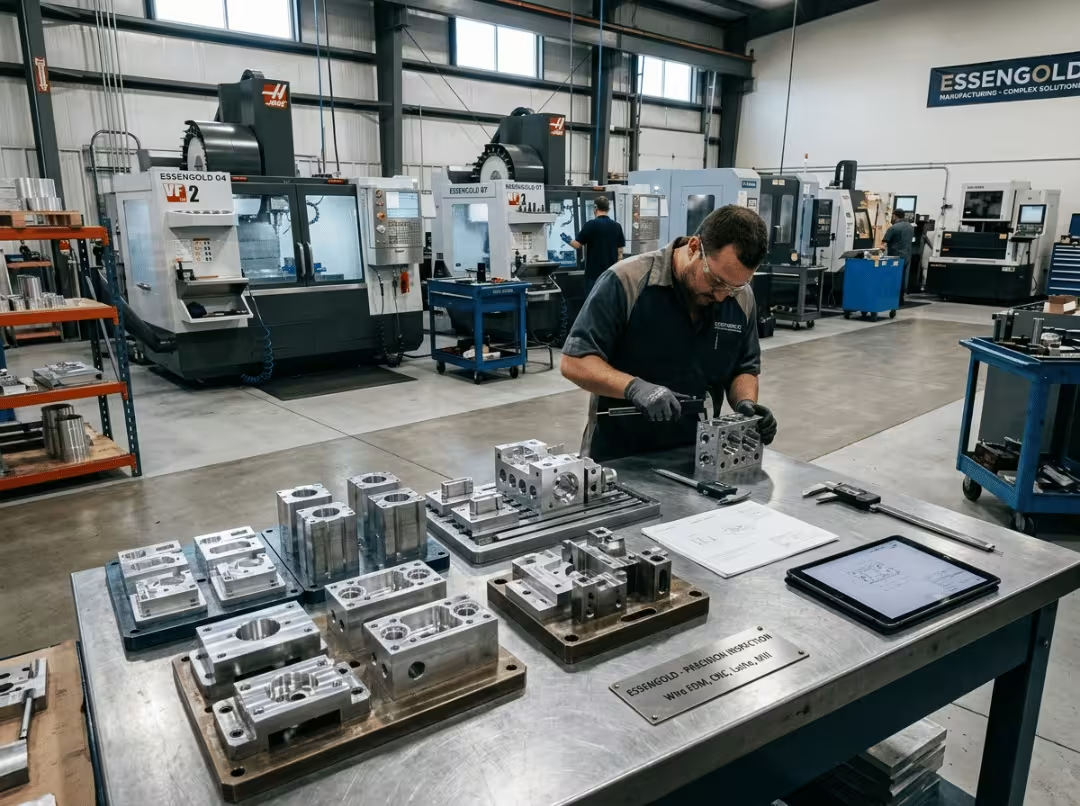
Starting with a partner who understands both wire EDM and machining means the entire part — profile plus secondary features — can be evaluated against the drawing at once. Feature tolerances get assigned to the right process, and machining allowances or datum references that affect both operations get resolved before cutting starts rather than after the first batch comes back wrong.
If your part is heading toward wire EDM, send us the drawing or model. We’ll confirm whether it’s the right process for each feature, check that the tolerances are achievable, and quote the complementary machining through our CNC machining services. And if it turns out the part doesn’t actually need wire EDM, we’ll say so and show you what machining it from solid would look like instead.
Frequently Asked Questions
What is wire EDM used for?
Wire EDM cuts precise 2D profiles in hard or hardened conductive metals — punch and die inserts, forming dies, precision gears, medical instruments, aerospace profiles, and fine slots or keyways. It’s the standard choice wherever tight tolerances, sharp internal corners, or fully hardened material rule out conventional cutting.
Is wire EDM better than laser cutting?
Neither is universally better. Wire EDM holds tighter tolerances and cuts hard, thick, or delicate conductive parts without distortion, but it’s slow and limited to conductive metals. Laser is far faster on thin sheet and handles non-conductive materials, with moderate tolerance capability. The right choice depends on material, thickness, tolerance, and volume.
Can wire EDM cut hardened steel?
Yes, and this is one of its primary advantages. Wire EDM cuts fully hardened steel with no mechanical force, so the part geometry doesn’t change during cutting. That means heat treatment can happen before the final profile is cut, eliminating the warp that sometimes follows post-machining hardening.
What materials cannot be cut with wire EDM?
Any material that doesn’t conduct electricity — plastics, ceramics, glass, and composites — cannot be wire-EDM’d. For those, waterjet or laser cutting is the alternative.
How accurate is wire EDM?
Standard tolerances run around ±0.0005 to ±0.001 in (0.013 to 0.025 mm). With careful setup and multiple finishing passes, fine work can reach near ±0.0001 in (0.0025 mm). Actual accuracy depends on machine thermal stability, wire quality, flushing consistency, and how many passes the part receives.
Is wire EDM expensive?
It can be, because cost tracks cutting time closely. Thin parts with short profiles and moderate tolerances are affordable. Thick parts with long perimeters, tight tolerances throughout, and fine surface requirements take hours and cost accordingly. If the part doesn’t genuinely need the precision wire EDM provides, a faster process is usually cheaper.
What is the smallest internal corner wire EDM can cut?
Inside corners cannot be sharper than approximately the wire radius plus the spark gap — typically 0.05 to 0.15 mm. If the design requires a sharper corner than the wire can produce, the solution is to add a corner relief in the geometry or specify a secondary operation. A true zero-radius inside corner is not achievable.
Does wire EDM leave burrs?
Very little, which is part of why it’s preferred for precision components that go directly into assemblies. The spark-erosion process leaves a clean edge, and many parts come off the machine without requiring a deburring step.
When should I use sinker EDM instead of wire EDM?
Use sinker EDM when the feature is a blind cavity, a contoured pocket bottom, or a 3D mold form. Wire EDM cuts through the full part thickness from face to face — it cannot produce anything that doesn’t exit the opposite side. Sinker EDM forms those features using a shaped electrode.
Conclusion: Match the Process to the Part
Wire EDM is a precision tool, not a general-purpose one. It’s right for hard, conductive metals where the geometry demands tight-tolerance 2D profiles, sharp internal corners, or distortion-free cutting of hardened material. It’s wrong for non-conductive materials, high-volume simple profiles, bulk material removal, and 3D cavity work.
Before committing to wire EDM, run the part through the fit conditions and cost logic. If it clears the bar, the process delivers accuracy that few alternatives can match. If it doesn’t, laser, waterjet, or CNC milling will get the same part done faster and for less.
If you have a part that looks like a wire EDM candidate, send us the drawing or model. We’ll confirm the process fit, verify that the tolerances are achievable, and help you get it built right — including the machining that most precision parts need alongside the wire work.