Choosing the wrong metal costs you tool life, wasted material, and parts that fail in the field. This metal softness chart fixes that. It ranks common metals from softest to hardest so you can match the right material to your machining, forming, or wear job in seconds, not hours.
Here’s the quick truth: “softness” isn’t a standalone lab measurement. Engineers read it as the inverse of hardness, so a metal softness chart is really a metal hardness chart flipped the other way. Lead, tin, and pure aluminum sit at the soft end. Tool steel, titanium, and stainless steel rank near the top.
Below you’ll get the full metal hardness comparison, a softest metals list, clear rankings, and a decision framework that tells you exactly which metal to spec. Let’s get to it.
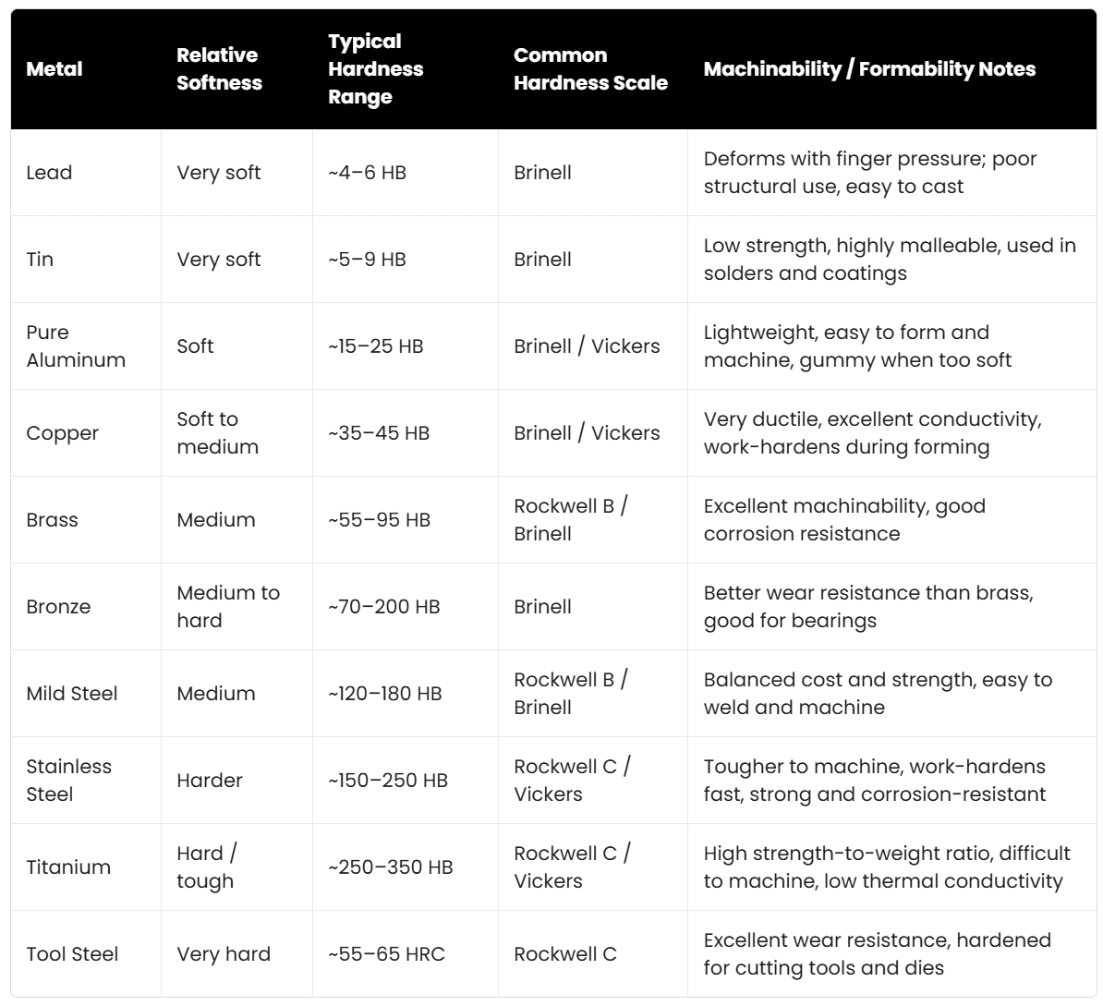
Metal Softness Chart for Common Metals
This is the chart you came for. It ranks common metals from softest to hardest, with typical hardness ranges, the scale used to measure them, and the practical notes that actually drive your decision.
Treat the hardness values as general ranges, not exact specs. Real numbers shift with alloy grade, temper, and heat treatment.
| Metal | Relative Softness | Typical Hardness Range | Common Hardness Scale | Machinability / Formability Notes |
|---|---|---|---|---|
| Lead | Very soft | ~4–6 HB | Brinell | Deforms with finger pressure; poor structural use, easy to cast |
| Tin | Very soft | ~5–9 HB | Brinell | Low strength, highly malleable, used in solders and coatings |
| Pure Aluminum | Soft | ~15–25 HB | Brinell / Vickers | Lightweight, easy to form and machine, gummy when too soft |
| Copper | Soft to medium | ~35–45 HB | Brinell / Vickers | Very ductile, excellent conductivity, work-hardens during forming |
| Brass | Medium | ~55–95 HB | Rockwell B / Brinell | Excellent machinability, good corrosion resistance |
| Bronze | Medium to hard | ~70–200 HB | Brinell | Better wear resistance than brass, good for bearings |
| Mild Steel | Medium | ~120–180 HB | Rockwell B / Brinell | Balanced cost and strength, easy to weld and machine |
| Stainless Steel | Harder | ~150–250 HB | Rockwell C / Vickers | Tougher to machine, work-hardens fast, strong and corrosion-resistant |
| Titanium | Hard / tough | ~250–350 HB | Rockwell C / Vickers | High strength-to-weight ratio, difficult to machine, low thermal conductivity |
| Tool Steel | Very hard | ~55–65 HRC | Rockwell C | Excellent wear resistance, hardened for cutting tools and dies |
How to read this chart: the lower the hardness number on a given scale, the softer the metal. Softer metals machine and form more easily but wear out faster under repeated contact.
Bookmark this metal softness chart now. Pull it up before your next quote or material order, and you’ll spec with confidence instead of guesswork.
Softest to Hardest Metals Ranked
Need the fast answer? Here’s the general order of common metals from softest to hardest:
- Lead — softest common metal
- Tin
- Pure Aluminum
- Copper
- Brass
- Bronze
- Mild Steel
- Stainless Steel
- Titanium
- Tool Steel — hardest on this list
One caveat: alloying and heat treatment can reshuffle this order. A hardened aluminum alloy can outrank a soft annealed steel. This softest metals list reflects the typical, untreated form of each metal.
What Does “Softness” Mean in Metals?
Softness is how easily a metal’s surface gives way to a dent, scratch, or press. It’s the practical inverse of hardness. Score low on a hardness scale, and we call the metal soft. Simple as that.
There’s no dedicated “softness test.” Technicians press a hard indenter into the surface and measure the mark. A bigger or deeper indent means a softer metal. That’s indentation hardness, measured with Brinell, Rockwell, and Vickers scales.
Here’s the point most people miss: softness is not weakness. Copper is soft yet highly ductile and tough, so it bends and absorbs energy instead of cracking. Lead is soft but dense and stable. Softness only describes surface resistance to deformation, nothing about strength, toughness, or fatigue life.
So when someone hands you a metal softness chart, they’re handing you a metal hardness comparison read in reverse. Lower hardness equals higher softness.
Metal Softness vs Hardness, Strength, and Toughness
These four properties get confused constantly, and that confusion leads to expensive material mistakes. They’re related, but each measures something different.
| Property | What It Tells You | Quick Example |
|---|---|---|
| Hardness | Resistance to surface indentation or scratching | Hardened tool steel resists wear on a cutting edge |
| Softness | Informal term for low hardness; deforms easily at the surface | Lead dents under light pressure |
| Strength | Resistance to permanent deformation or fracture under load (tensile strength) | High-strength alloy steel holds heavy loads without yielding |
| Toughness | Ability to absorb impact energy without fracturing | Structural steel bends before it breaks |
A metal can be hard but brittle, like glass-hard tool steel that chips on impact. It can also be soft but tough, like annealed copper. Smart material selection means matching the right balance to your application, not chasing the highest hardness number on the spec sheet.
Hardness Scales Used in a Metal Softness Chart
Every metal softness chart leans on standardized hardness scales. Each presses an indenter into the surface and measures the result. For engineering metals, three scales do almost all the work.
Brinell Hardness (HB)
The Brinell hardness chart uses a spherical carbide ball pressed into the surface under a heavy load. You measure the diameter of the indent.
Because the indent is large, Brinell shines on coarse or uneven materials like castings, forgings, and softer metals. The big footprint averages out local variations and gives a representative reading on rough metal.
Rockwell Hardness (HRB, HRC)
Rockwell is the workhorse in most machine shops. It measures penetration depth under a major load against a smaller preload. Deeper indent, softer metal.
It’s fast, easy to read, and leaves a small mark. Use HRB for softer metals like brass and mild steel, and HRC for hardened steel and tool steel. Need a quick, reliable number on hardened steel? Rockwell C is your first stop.
Vickers Hardness (HV)
Vickers uses a diamond pyramid indenter and covers the full range, from very soft to very hard. It’s the go-to for thin sections, small parts, and precise lab work.
You measure the diagonals of the square indent under a microscope. It’s accurate and versatile, which is why labs trust it. The trade-off: it’s slower and demands careful measurement.
Knoop is a close cousin to Vickers, using an elongated diamond indenter for a shallow, narrow mark. It suits brittle materials and thin coatings, but you’ll see it less in general metalwork.
Scales like Mohs (geology) and Shore/Durometer (rubber and plastics) exist too, but they don’t belong on a metal softness chart. For metals, stick with Brinell, Rockwell, and Vickers. Conversion tables like ASTM E140 let you translate between them, but treat conversions as estimates.
What Makes a Metal Softer or Harder?
Here’s what trips people up: the same metal can be soft or hard depending on how it’s made and treated. Four factors control where it lands on the chart.
Alloy Composition
Adding elements changes hardness. Carbon hardens steel. Zinc turns soft copper into harder brass. Tin makes bronze tougher than pure copper. The base metal sets the starting point; the alloy recipe moves it up or down.
Heat Treatment
Heat treatment is the biggest lever for steel. Quenching rapidly cools heated steel, locking in a hard, brittle structure. Tempering reheats it at a lower temperature to trade some hardness for toughness. Tune these steps and you dial in an exact hardness target.
Cold Working
Working a metal at room temperature (rolling, bending, drawing) makes it harder and less ductile. That’s work hardening. Copper and stainless steel work-harden fast, which is why they get tougher to machine as you cut deeper.
Annealing
Annealing reverses work hardening. Heat the metal, hold it, then cool it slowly. This softens it, restores ductility, and relieves internal stress. Annealed copper and aluminum are noticeably softer and easier to form than their cold-worked state.
Temperature
Most metals soften as temperature rises, because heat increases atomic movement and lowers resistance to deformation. That’s why high-temperature applications need special heat-resistant alloys that hold hardness under heat.
How to Use a Metal Softness Chart in Material Selection
This is where the chart pays off. The right pick saves tool life, cuts scrap, and keeps parts in the field longer. Use these decision rules to choose fast.
Choosing for machining? Softer metals like aluminum and brass cut faster, save tool life, and lower cost per part. Watch out: very soft metals turn gummy and tear instead of chipping cleanly. Harder metals like titanium and tool steel demand slower speeds, rigid setups, and better tooling, so budget for it upfront.
Choosing for forming or stamping? Go soft and ductile. Copper, aluminum, and mild steel bend, draw, and stamp without cracking, perfect for deep draws and tight bends. Hard or brittle metals resist forming and split at the bend, so rule them out early.
Choosing for wear resistance? Go harder. Gears, bearings, and cam surfaces get hardened for a reason. If your part faces grit or repeated contact, pick a harder metal or harden the surface to keep it in spec longer.
Need a quick strength estimate? In many steels, hardness and tensile strength rise together, reliably enough to estimate tensile strength from a Brinell reading. Use it as a fast check, not a replacement for a pull test.
Your decision framework at a glance:
- Want easy machining or forming? Choose softer metals: aluminum, brass, copper, mild steel.
- Want wear resistance or a cutting edge? Choose harder metals: tool steel, hardened stainless.
- Want strength with low weight? Choose titanium, and plan for harder machining.
- Want a balance? Mild and stainless steels hit the sweet spot.
The bottom line: match hardness to the actual job. Push hardness too high and you trade durability for brittleness, because a chipped part fails just as surely as a worn one.
Ready to spec your next part? Run your material through this metal softness chart, lock in the hardness range your job needs, and request a quote with confidence. The right call here is the difference between a part that ships and one that gets reworked.
FAQs About Metal Softness Chart
What is the softest common metal?
Lead is the softest common metal, with a Brinell hardness around 4–6 HB. It deforms under light pressure and is easy to cast and shape. Tin and pure aluminum are also very soft and sit near the bottom of any metal softness chart.
Is aluminum softer than steel?
Yes. Pure aluminum is much softer than steel, typically around 15–25 HB versus 120 HB or more for mild steel. Some hardened aluminum alloys close the gap, but in general aluminum is softer and easier to machine and form than steel.
Is copper softer than brass?
Yes. Copper is softer and more ductile than brass. Adding zinc to copper creates brass, which raises hardness and improves machinability. That’s why brass is a favorite for machined fittings while pure copper wins where conductivity and ductility matter most.
Does heat treatment make metal softer or harder?
It can do either. Quenching makes steel harder and more brittle, while annealing softens metal and restores ductility. Tempering sits in between, trading some hardness for toughness. The treatment you choose decides where the metal lands on the chart.
Is softer metal easier to machine?
Usually, yes. Softer metals cut faster, reduce tool wear, and lower machining cost. The exception is very soft, gummy metals like pure aluminum or pure copper, which can smear or tear and need sharp tools and the right speeds for a clean finish.
Is softness the same as ductility?
No. Softness is low resistance to surface deformation. Ductility is the ability to stretch and bend without breaking. Many soft metals are also ductile, like copper, but the two properties measure different behaviors. A metal can be soft yet brittle, or harder yet still fairly ductile.
Can you convert between hardness scales on a softness chart?
Yes, within limits. Conversion tables like ASTM E140 let you translate between Brinell, Rockwell, and Vickers. Treat conversions as estimates, since each test measures hardness differently. When accuracy is critical, test on the scale your spec actually calls for.
Is a harder metal always better?
No. Harder metals tend to be more brittle and can chip or crack under impact. Most applications need a balance of hardness, strength, toughness, and ductility. Match the metal to the load, wear, and forming demands of your part rather than chasing maximum hardness.
The Bottom Line
A metal softness chart turns a tricky material decision into a fast, confident call. Keep these essentials front and center:
- Softness is the inverse of hardness, measured with Brinell, Rockwell, and Vickers scales.
- Lead, tin, and aluminum are the softest common metals; tool steel and titanium rank hardest.
- Softness is not weakness — strength, toughness, and ductility are separate properties.
- Heat treatment, alloying, and cold working can move any metal up or down the chart.
Your next move is simple. Save this metal softness chart, match the hardness range to your machining, forming, or wear requirements, and spec the right metal the first time. Do that, and you’ll protect your tool life, trim your costs, and keep field failures off your record. Have a part in the pipeline? Pull up the chart, make the call, and get your quote moving today.