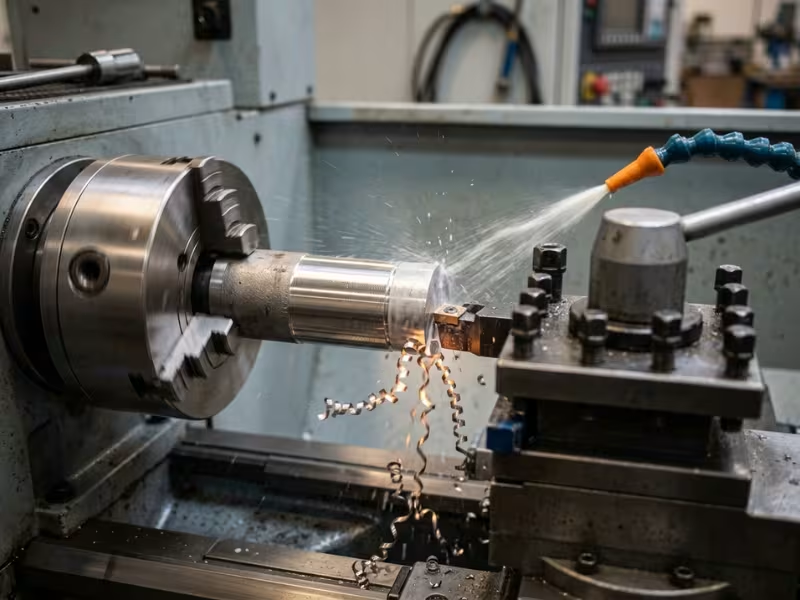
Many engineers and buyers need precise round parts. But they often aren’t sure which process gives the best result for the price. Lathe machining usually answers that question.
A lathe spins the workpiece and keeps every diameter true to one centerline. That makes it fast, accurate, and cost-effective for shafts, pins, bushings, and threaded fittings.
I review drawings every week and choose the right process for each job. This guide covers the checks I run before I send a part to a lathe.
You’ll see how a lathe works and what it does best. You’ll also learn when turning makes sense and when another process will serve you better.
What Lathe Machining Is
Lathe machining is a subtractive process. You start with a solid bar or blank, and the machine cuts material away until only your part remains.
The workpiece spins, and the cutting tool feeds in straight lines along the part or across its face. Every cut happens around one centerline. As a result, diameters, bores, and shoulders share the same axis by default.
That’s why turning shines on rotationally symmetric parts. Picture your part spinning on its axis. If it looks the same from every angle, it’s a strong candidate for a lathe.
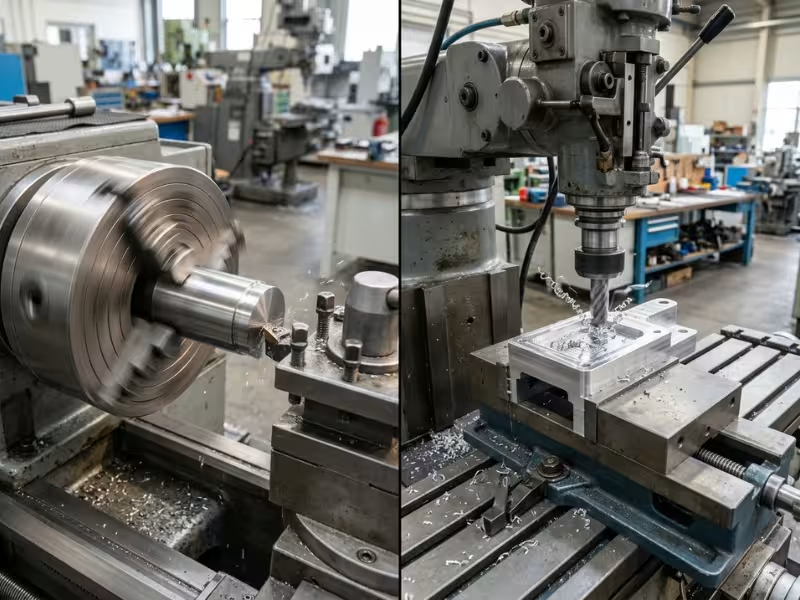
Milling flips this logic. The tool spins, and the workpiece stays clamped in a vise or fixture. That setup suits flat faces, pockets, slots, and boxy shapes.
|
Factor |
Lathe Machining |
Milling |
|---|---|---|
|
What rotates |
The workpiece |
The cutting tool |
|
Best shapes |
Round, cylindrical, concentric |
Flat, prismatic, pocketed |
|
Typical parts |
Shafts, pins, bushings |
Brackets, housings, plates |
Why Lathe Machining Matters in Real Part Production
A process only matters if it saves you time, money, or scrap. On round parts, the lathe often saves all three.
Take a shaft. The lathe grips the bar, turns the outside, bores the inside, cuts the thread, and parts off the piece. You often get a finished part from raw bar in one cycle. Bushings, pins, and threaded parts follow the same path.
Concentricity comes almost free. The part never leaves the chuck between cuts, so your bearing journal and seal diameter line up. A mill needs careful fixturing and indicating to match that.
Diameter control stays simple. The tool moves straight toward the center, so one axis sets the size. A good CNC lathe holds a ±0.01 mm journal batch after batch.
Axial features fit naturally. Shoulders, grooves, chamfers, and threads all sit around the centerline. Short, simple tool moves cut them.
Now put that same shaft on a mill. A spinning cutter chases a round shape step by step. You add passes, setups, and chances to lose alignment. That’s why a dedicated CNC turning service usually delivers better round parts for less money.
How a Lathe Works
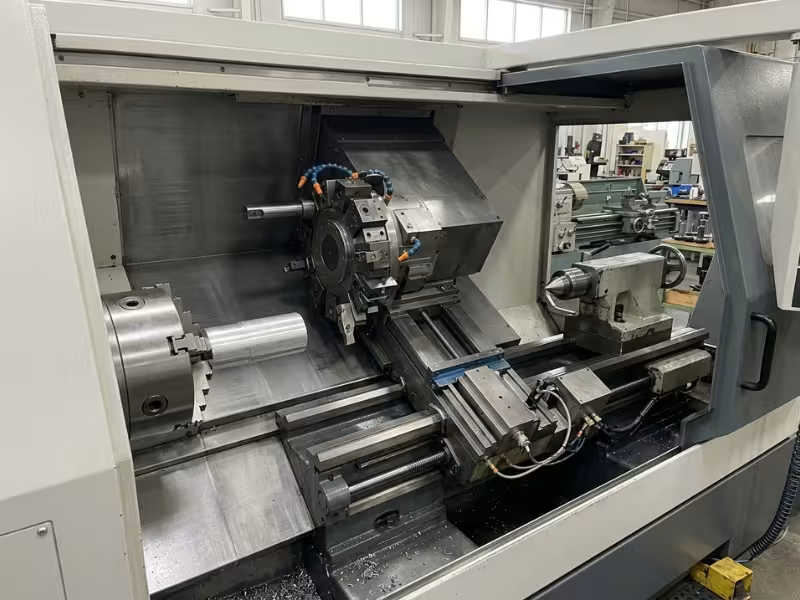
A lathe looks busy, but its logic is simple. Four parts do most of the work, and one cutting rhythm repeats on almost every job.
The Four Parts That Matter
Spindle and chuck. The spindle spins the workpiece, and the chuck grips it with three or more jaws. If the chuck holds the part off-center, every diameter will wobble. I always check runout here first.
Cutting tool. A small carbide insert sits in a tool post or turret. Its shape decides the feature: a sharp point for profiles, a narrow blade for grooves.
Carriage. The carriage moves the tool along the part (Z axis) and toward the center (X axis). On a CNC lathe, servo motors drive these moves from the program.
Tailstock. The tailstock sits opposite the chuck. It supports long, slim parts so they don’t bend or chatter. It can also hold drills for center holes.
From Setup to Finished Part
When the tool travels along Z, it sizes the diameter. When it travels along X, it cuts the face. Combine both moves, and you get tapers, radii, and curves.
Every job then follows the same sequence:
- Setup: The machinist loads the bar, sets jaw pressure, and touches off each tool. This tells the machine exactly where each tool tip sits.
- Passes: Roughing passes strip material fast. A light finishing pass then brings the part to size. I usually leave 0.2–0.5 mm for that last pass.
- Measurement: The operator checks the first part with micrometers, bore gauges, or thread gauges. Small offset tweaks keep the batch in tolerance.
- Coolant: Coolant pulls heat away, flushes chips, and extends tool life. Without it, stainless steel and titanium heat up and grow out of size mid-cut.
Common Lathe Operations and What They Make
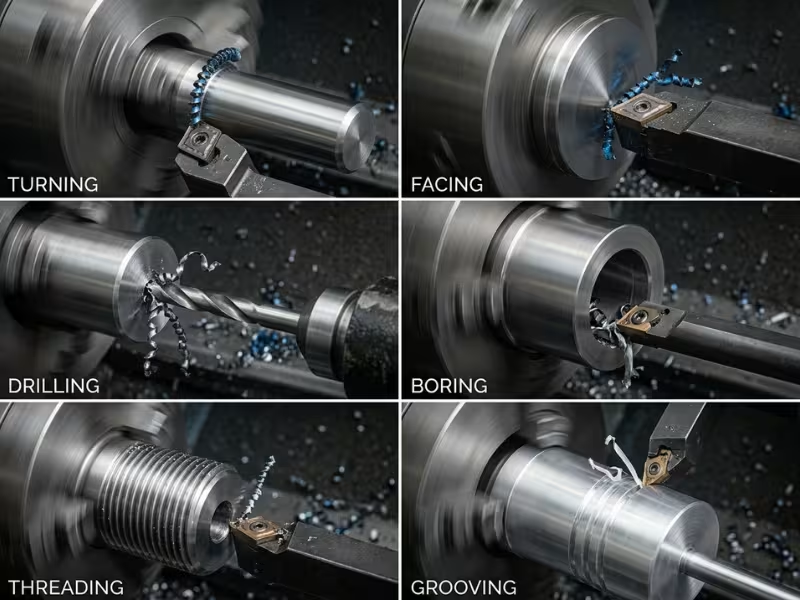
Every turned part combines a few core operations. When I review a drawing, I break it into these moves first. That tells me how many tools, setups, and minutes the job will need.
|
Operation |
What it does |
Typical feature or part |
|---|---|---|
|
Turning |
Reduces and shapes the outside diameter |
Shaft journals, stepped pins, tapers |
|
Facing |
Flattens the end and sets length |
Square shoulders, flange faces, part ends |
|
Drilling |
Makes a centered axial hole |
Through-holes in bushings and spacers |
|
Boring |
Enlarges and finishes a bore |
Bearing seats, precise sleeve IDs |
|
Threading |
Cuts internal or external threads |
Bolts, hydraulic fittings, threaded caps |
|
Grooving |
Cuts narrow channels |
O-ring grooves, snap-ring slots, thread relief |
|
Parting |
Cuts the finished part off the bar |
Final separation of every bar-fed part |
A few points matter for your design:
- Facing comes first. A true face becomes the reference for every length on the drawing.
- Drill, then bore. A drilled hole rarely holds a bearing-seat tolerance. If your bore needs a tight fit, plan a boring pass.
- Threading stays flexible. A single-point tool cuts metric, UNC, NPT, and custom pitches without special taps.
- Every operation adds time. Stick to standard groove widths and common thread sizes. Avoid deep, small-diameter bores when you can.
What Lathe Machining Is Best For
Not every part belongs on a lathe. But some shapes and features fit it so well that any other process feels like a detour. Here’s how I sort them.
Ideal Part Geometries
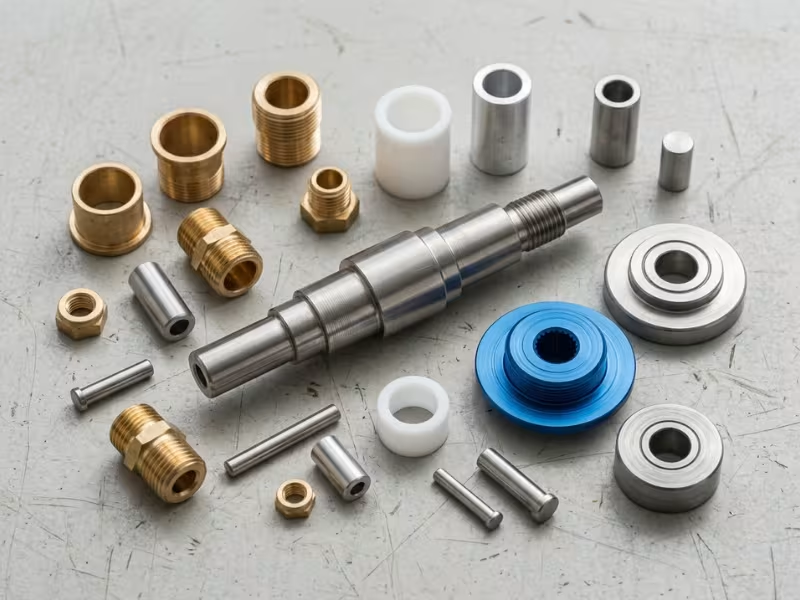
Start with the overall shape. If the part has one clear centerline and most surfaces wrap around it, you’re in lathe territory.
|
Part type |
Why a lathe fits |
|---|---|
|
Shafts |
Cuts long stepped diameters and journals in one setup |
|
Pins |
Bar-fed runs move fast with minimal handling |
|
Bushings |
OD and ID stay concentric from the same chuck grip |
|
Sleeves |
Boring keeps walls even around the full circle |
|
Threaded fittings |
Turning, drilling, and threading happen in one cycle |
|
Rollers |
Holds tight roundness and runout across the full length |
|
Hubs |
Bore, face, and shoulder share one true axis |
A few flats or cross holes won’t rule a part out. A live-tool turning center or a short trip to the mill can add them afterward.
Best-Suited Features
Shape gets a part onto the lathe. Features decide how well it runs there.
- OD control: A good CNC lathe routinely holds ±0.01 mm on journals and seal surfaces.
- Concentric bores: Bore the ID in the same setup as the OD, and the two line up naturally.
- Stepped diameters: A five-step shaft often costs only a little more than a two-step one.
- Threads: Single-point threading cuts almost any pitch, inside or out.
- Tapers: Two-axis motion cuts clean Morse tapers and locking cones.
- Grooves: O-ring, snap-ring, and relief grooves take seconds each.
Common Materials
Material affects speed, tool life, and price as much as geometry does.
- Aluminum cuts fast and clean. It’s my first pick for light spacers, housings, and prototypes.
- Carbon steel such as 1018 or 1045 turns well and costs little. It suits shafts and pins that need real strength.
- Stainless steel (303, 304, 316) resists corrosion but work-hardens. Sharp inserts, steady feeds, and plenty of coolant keep it under control. Choose 303 when your application allows it, since it machines far more easily. Our stainless steel CNC machining services page explains how each grade behaves.
- Brass may be the friendliest metal to turn. Chips break short, and the finish looks great right off the tool.
- Plastics like Delrin, nylon, and PEEK turn nicely with sharp tools and light clamping.
- Titanium runs fine on a lathe, but it demands slower speeds and wears tools faster. Expect a higher price per part. You can compare grades on our titanium CNC machining services page.
When to Choose Lathe Machining — and When Not To
The most expensive mistake I see is a part sent to the wrong machine. The part still gets made, but it costs more and takes longer than it should.
Signs Your Part Belongs on a Lathe
If you answer “yes” to two or more of these, quote the lathe first.
- Is the part rotationally symmetric? Most surfaces wrap around one centerline.
- Does diameter tolerance matter? Bearing journals, seal surfaces, and press-fit pins need sizes you can trust.
- Does concentricity matter? When your OD and bore must stay within 0.02 mm runout, cut them in one chuck grip.
- Do you need repeatable round features? Once the program runs, part 500 matches part one.
- Does your volume fit? A CNC lathe handles 10 to 1,000 pieces with little setup. For 10,000 pins or fittings, bar-fed and Swiss-type lathes push the unit price down hard.
Red Flags That Point Elsewhere
- The part is mainly prismatic. Brackets, plates, and housings belong on a mill.
- It has many pockets or 3D contours. Live tooling adds a few flats. Deep pockets and sculpted surfaces need a 3- or 5-axis mill.
- It has complex internal channels. A lathe drills straight down the centerline. Curved passages call for 3D printing or drilled-and-plugged designs.
- The walls are fragile and thin. Chuck pressure can squeeze a sleeve out of round. Walls under 0.5 mm on large diameters often need special fixtures or a design change.
- A finishing process fits better. Steel above about 45 HRC or tolerances tighter than ±0.002 mm point to grinding. Sharp internal corners point to EDM.
Choose or Avoid at a Glance
|
Factor |
Choose a lathe when… |
Avoid a lathe when… |
|---|---|---|
|
Overall shape |
Round, cylindrical, one clear axis |
Boxy, flat, or prismatic |
|
Key features |
ODs, bores, threads, grooves, tapers |
Pockets, slots, 3D surfaces |
|
Tolerance |
Tight diameters and runout |
Sub-micron finish on hardened steel |
|
Internal geometry |
Straight axial holes and bores |
Curved or intersecting channels |
|
Wall strength |
Solid or moderate walls |
Very thin, easily distorted walls |
|
Material state |
Machinable metals and plastics |
Fully hardened or very hard alloys |
One habit helps every project. Mark your critical diameters and runout callouts clearly on the drawing. Your machinist will know right away whether the lathe fits.
Lathe Machining vs Milling: Which One Fits Your Part?
Buyers ask me this more than any other question. The answer depends on the shape of your part, not on which machine a shop owns.
Why Turning Wins on Shaft-Like Parts
Picture a 20 mm steel shaft, 150 mm long, with three steps and a groove. A CNC lathe can often finish it from bar stock in about two minutes. One insert does most of the work.
On a mill, the cutter traces each diameter in small moves. You flip the part at least once and risk losing alignment. Cycle time can pass ten minutes, and the quote climbs with it.
The reverse holds true too. A flat plate with pockets and bolt holes would waste hours on a lathe. For that kind of part, a CNC milling service is the smarter choice.
The Comparison Table
|
Factor |
Lathe Machining |
Milling |
|---|---|---|
|
What rotates |
The workpiece |
The cutting tool |
|
Tool motion |
Linear, along or across the axis |
Multi-axis paths around the part |
|
Typical parts |
Shafts, pins, bushings, fittings |
Brackets, housings, plates, molds |
|
Strongest features |
ODs, bores, threads, grooves, tapers |
Pockets, slots, flat faces, 3D surfaces |
|
Concentricity |
Built in from one chuck grip |
Needs careful fixturing |
|
Cost on round parts |
Low |
Higher |
|
Cost on prismatic parts |
Often impractical |
Low to moderate |
|
Typical setups |
One, or two with a flip |
Two or more for full access |
When One Part Needs Both
Many real parts don’t fit neatly in one column. A shaft needs a keyway. A flange needs a bolt-hole pattern. A fitting needs wrench flats.
In these cases, I usually turn the part first. Turning sets the round features and creates a true datum. The mill then adds flats, slots, and cross holes that line up with that datum.
Mill-turn machining combines both steps in one setup. You skip extra handling, and every feature stays aligned. These machines carry a higher hourly rate, so they pay off on complex parts or larger runs. For a simple shaft, a standard lathe still costs less.
Lathe Machining vs Grinding, EDM, and 3D Printing
Milling isn’t the only alternative. Grinding, EDM, and 3D printing each beat the lathe in specific situations.
Turning vs Grinding: Partners More Than Rivals
Think of turning as the sculptor and grinding as the polisher. A lathe removes material fast, holds ±0.01 mm, and leaves a finish around Ra 0.8–1.6 µm. A cylindrical grinder reaches ±0.002 mm and finishes below Ra 0.4 µm, even on hardened steel.
On precision shafts, I use both. The lathe leaves 0.1–0.3 mm on critical diameters, and the grinder finishes them after heat treatment. You only pay grinding rates where you truly need them. Hard turning with CBN inserts can sometimes replace grinding for modest tolerances.
Turning vs EDM: Speed vs Reach
EDM removes metal with electrical sparks, so hardness barely matters. Wire EDM also cuts sharp internal corners and delicate profiles with almost no cutting force.
The catch is speed. EDM runs many times slower than turning and only works on conductive materials. For machinable round parts, the lathe wins on time and cost.
Turning vs 3D Printing: Production vs Possibility
3D printing shines on internal cooling channels, lattices, and quick one-off prototypes. For dense round production parts, turning still wins. A turned shaft comes from solid bar with full strength, and it costs far less at volume.
My rule for clients: print the shape you can’t machine, and turn the shape you can.
What Affects Lathe Machining Quality and Cost
Two shops can quote the same shaft at very different prices. The gap usually comes from a few factors you control through your drawing and your order.
Tolerance and Surface Finish
Every extra decimal place costs money. At ±0.05 mm, the machinist runs fast and checks parts now and then. At ±0.01 mm, they slow the finishing pass, measure more often, and change inserts sooner.
Surface finish follows the same rule. A sharp insert gives you Ra 1.6 µm straight off the tool. Ra 0.4 µm usually means grinding or polishing. Plating, anodizing, and other treatments add their own cost and lead time, so review your CNC machining surface finish options early. Save tight callouts for surfaces that touch a bearing, seal, or mating part.
Material and Tooling
Brass and aluminum let the lathe run fast, and one insert can last hundreds of parts. 304 stainless and titanium force slower speeds and wear inserts quickly. A free-machining grade like 303 or 12L14 may cost more per bar yet still lower your total quote.
Part Rigidity and Workholding
Long, slim shafts push away from the cutter and come out barrel-shaped. Chuck pressure squeezes thin walls out of round. Both problems invite chatter. Past about 4:1 length-to-diameter, I plan tailstock support. Past 10:1, I reach for a steady rest or a Swiss-type lathe.
Secondary Operations
Heat treatment, grinding, milled flats, and plating each add handling and lead time. Heat treatment can also warp a part, so I leave grind stock on critical diameters. A live-tool lathe can add simple flats and cross holes in the same setup.
Setup, Programming, and Batch Size
Programming, tool loading, and first-part checks take one to three hours, no matter how many parts you order. Spread over five parts, setup dominates your price. Spread over 500, it nearly disappears. Repeat runs also cost less because the program already exists.
|
Factor |
Impact on Cost |
Impact on Quality |
|---|---|---|
|
Tolerance and finish |
Rises sharply below ±0.01 mm or Ra 0.8 µm |
Better fits, sealing, and bearing life |
|
Material and tooling |
Hard alloys raise cycle time and insert spend |
Free-machining grades give cleaner finishes |
|
Rigidity and workholding |
Supports and fixtures add setup time |
Poor support causes taper, chatter, out-of-round |
|
Secondary operations |
Each step adds handling and lead time |
Grinding and heat treat raise precision and strength |
|
Setup and batch size |
Small runs carry high cost per part |
Proven programs give steadier repeat batches |
Manual Lathe vs CNC Lathe: Pick the One That Fits the Job
Clients often ask me which lathe is better. I answer with two questions: what are you making, and how many?
Where a Manual Lathe Still Earns Its Place
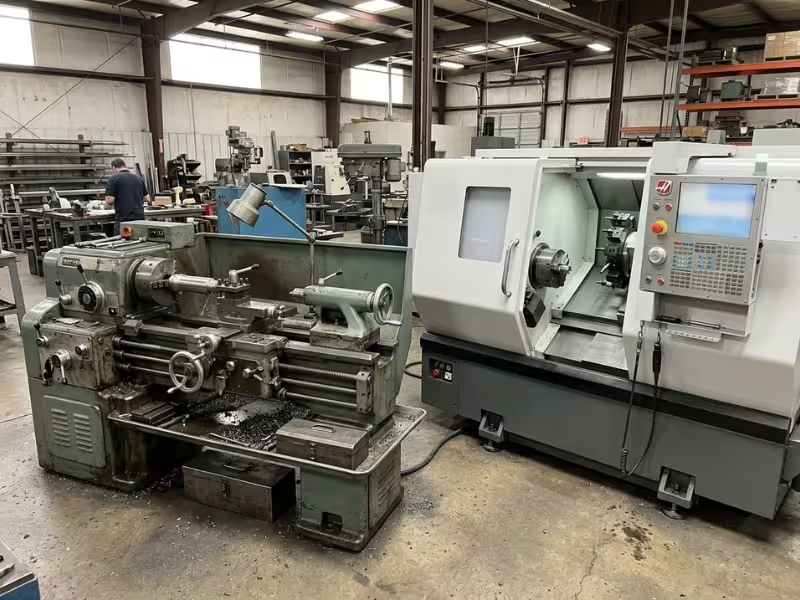
On a manual lathe, the machinist guides every cut by hand. No program needs writing, so cutting starts in minutes. That suits repair work, like skimming a worn shaft or recutting a thread. It also fits one-off spacers, bushings, and fixture pins.
The limit is repeatability. Holding ±0.02 mm across a batch takes real skill and frequent measuring.
Where a CNC Lathe Pays Off
A CNC lathe repeats the same tool paths on every piece, so part 500 matches part one. It holds ±0.01 mm across a full run and cuts radii and profiles that are slow by hand. Programming takes time, though, so very small jobs can cost more.
|
Factor |
Manual Lathe |
CNC Lathe |
|---|---|---|
|
Best for |
Repairs, one-offs, simple parts |
Batches, repeat orders, complex profiles |
|
Setup time |
Minutes |
One to three hours on the first run |
|
Consistency |
Depends on operator skill |
Same result on every part |
|
Cost per part at volume |
High |
Low |
My rule is simple. For one or two simple parts or a quick repair, go manual. For ten or more parts, tight tolerances, or repeat orders, go CNC.
FAQ
What is the difference between a lathe and a turning center?
“Lathe” covers any machine that spins the workpiece against a cutting tool. A turning center is an enclosed CNC lathe built for production. It adds a turret, high-pressure coolant, and a chip conveyor. Many models also include live tooling, a sub-spindle, or a Y axis.
Can a lathe make non-round features?
Yes, within limits. A turning center with live tooling can mill flats, keyways, hex shapes, and cross holes. When a part needs deep pockets or many flat faces, a mill does the job faster and cheaper.
What materials are difficult to machine on a lathe?
Titanium, Inconel, and other nickel alloys top my list. They trap heat at the cutting edge and wear inserts quickly. Stainless steels like 304 and 316 work-harden if the tool rubs. Hardened steel above about 45 HRC needs CBN inserts or grinding.
What tolerances can lathe machining hold?
A good CNC lathe holds ±0.01 mm on diameters as routine work. With careful setup and a stable shop temperature, you can achieve ±0.005 mm on critical features. For anything tighter, plan on grinding after turning.
Is lathe machining expensive?
For round parts, turning is usually the cheapest machining option. Setup time, material, tolerances, and batch size drive your price. Loosen non-critical tolerances and order larger batches to lower your unit cost.
When should I choose a CNC lathe instead of a manual lathe?
Go CNC when you need more than a handful of parts, tight tolerances across a batch, or curved profiles. Stick with manual for repairs, one-offs, and simple parts, where programming would cost more than the cutting.
Can a lathe cut internal threads?
Yes. A single-point threading tool on a boring bar cuts internal threads over several light passes. For small holes, a tap in the tailstock or turret works faster. Design in a relief groove so the tool can exit cleanly.
How do I know if my part should be turned or milled?
Look at where most features sit. If they wrap around one centerline, turn the part. If they sit on flat faces, mill it. If your part needs both, turn it first or ask your shop about mill-turn.
Start With the Axis, Then Pick the Machine
Every process decision I make begins with one question: where do the critical features sit?
If they wrap around a single centerline, the lathe is your best tool. Shafts, pins, bushings, and threaded fittings come off it accurate, concentric, and affordable. Tight diameters and low runout come from the way the machine spins the part.
When the geometry changes, change the process. Flat faces and 3D contours belong on a mill. Hardened journals and mirror finishes call for grinding. Sharp internal corners point to EDM. Curved internal channels suit 3D printing.
Plenty of good parts use more than one process. Turn the round features first, then let the next process finish what the lathe can’t reach.
If you’re reviewing a round part and want a manufacturability check before quoting, send us your drawing. Our CNC turning service team is happy to help you pick the right path.