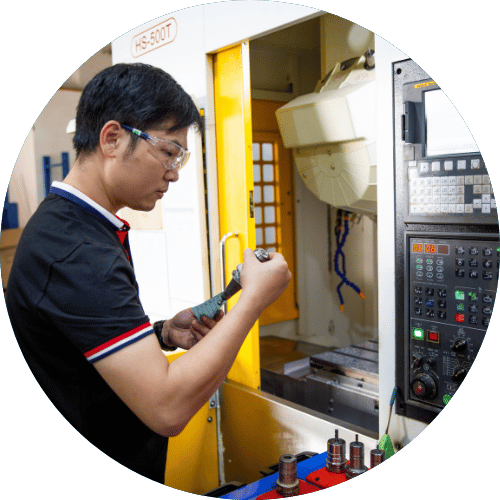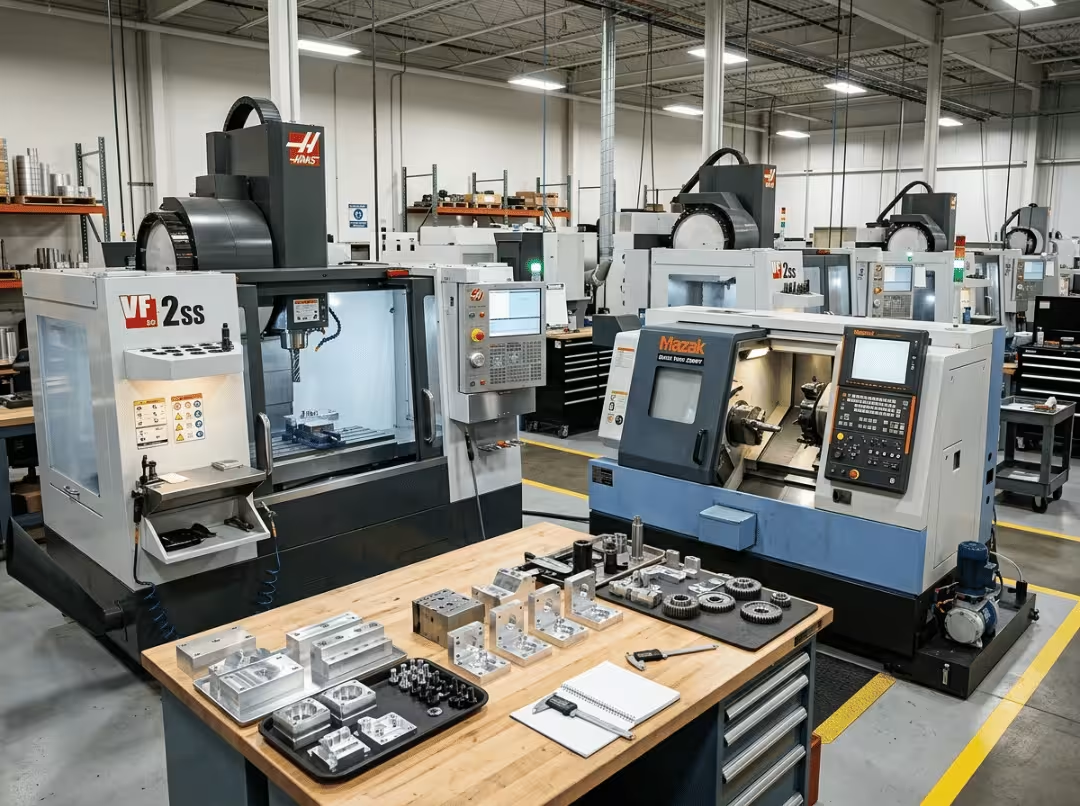
Most searches for “types of CNC machines” come from someone with a specific part in hand — a bracket that needs pockets, a shaft that needs threads, an insert made from hardened steel. The real question isn’t what machines exist. It’s which one handles this geometry, at this tolerance, without over-engineering the job or inflating the cost.
That’s what most articles on this topic miss. They catalog machines and stop. You finish reading knowing what exists and no clearer on what to pick. The information is present; the judgment is absent.
This guide is organized around the judgment. It opens with a classification framework that gives the machine landscape a readable structure. It then covers every major type in the same decision-focused format — what it does best, where it fails, what it runs, and what it costs. The comparison sections — milling versus turning, laser versus plasma versus waterjet, three-axis versus five — are written to resolve specific decisions, not to describe differences in the abstract. It closes with a selection sequence you can run against your own part tonight.
How CNC Machines Are Actually Classified
The confusion in most lists comes from mixing three separate classification axes without distinguishing them. A milling machine and a five-axis machine aren’t parallel entries — a five-axis machine is usually a milling machine with more movement freedom. Once you separate the three questions buried in “what type,” the field organizes itself.
By machining function — what operation the machine performs. Milling, turning, drilling, and grinding all remove material with a solid cutter in direct contact with the part. The differences come down to whether the tool or the part rotates, and what shape of feature results.
By cutting method — how material is removed. Laser, plasma, waterjet, and EDM skip the solid cutter entirely. They remove material through heat, abrasive pressure, or electrical discharge — and they earn their place on work where a rotating tool would struggle or fail outright.
By axis capability — how freely the machine moves. Three-axis and five-axis mills perform the same fundamental operation. More axes let the tool reach the part from more angles, which unlocks complex geometry and cuts down how often the part needs to be repositioned.
|
Classification axis |
Examples |
What it tells you |
|---|---|---|
|
Machining function |
Milling, turning, drilling, grinding |
The type of feature and geometry produced |
|
Cutting method |
Laser, plasma, waterjet, EDM |
How material is removed, and what materials are excluded |
|
Axis capability |
3-axis, 4-axis, 5-axis, turn-mill |
Geometry complexity and setup count |
Once you know which of these three questions you’re actually asking, the right machine becomes considerably easier to identify.
What Is a CNC Machine?
A CNC machine moves a cutting tool or energy source along a programmed path without the operator controlling every motion. The instructions come from G and M code derived from a CAD/CAM model and govern position, speed, feed rate, and tool changes automatically. That automation is what makes parts repeat consistently across a production run.
Most CNC machines are subtractive — they start with a solid blank and remove material until the part remains. Additive manufacturing (3D printing) builds a part up layer by layer and works on the opposite principle. Because printers often run under computer control, they tend to get folded into “CNC machine” lists, which is part of why those lists feel cluttered. Printing is addressed briefly near the end.
CNC Machine Types by Machining Function
Each type below follows the same structure to keep comparisons clean.
CNC Milling Machines
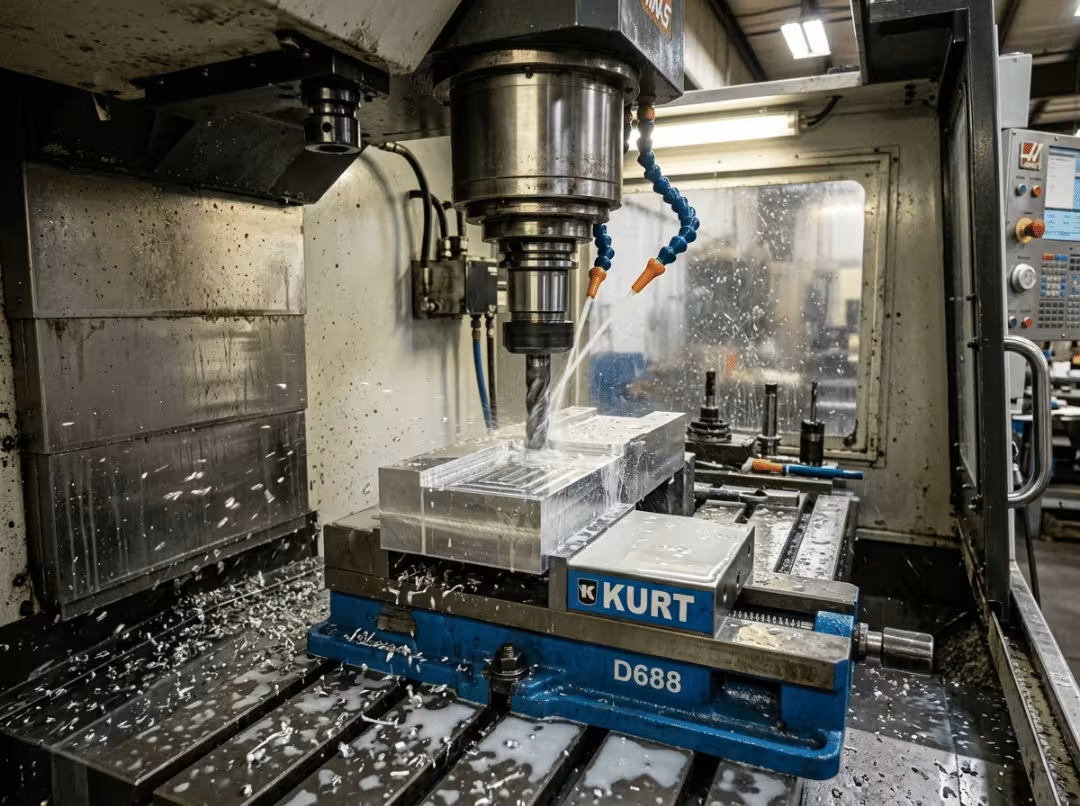
What it does: A milling machine spins a multi-point cutter while the workpiece stays clamped to the table. The spindle travels across at least three axes to remove material and produce features. Vertical mills — spindle oriented up and down — are the shop default and handle the bulk of prismatic work. Horizontal mills run the spindle parallel to the table, which suits heavier cuts and multi-face work on a tombstone fixture.
Best for: Prismatic parts — blocks, plates, brackets, housings — with pockets, slots, faces, contours, and complex 3D surfaces.
Not ideal for: Fully round, symmetrical parts. A mill can produce a cylinder, but a lathe does it faster, rounder, and with better surface finish. Running round parts on a mill is one of the more reliable ways to burn time and money.
Common materials: Aluminum, steel, stainless, titanium, brass, and engineering plastics.
Typical parts: Housings, manifolds, brackets, mold plates, fixtures, structural components.
Cost note: A capable three-axis vertical mill runs roughly $30,000 to $80,000. Five-axis machines climb well past that.
If a part is not obviously round, a mill is usually the first machine to consider. It covers more geometry types than any other single process. Essengold’s CNC milling service handles everything from simple plates to complex multi-face components — tolerances to ±0.005 mm.
CNC Lathes and Turning Centers
What it does: On a lathe, the relationship inverts. The part rotates in a chuck while a stationary tool feeds into it. That rotation makes the lathe the natural fit for axially symmetric shapes — cylinders, cones, shafts, threaded features. Variants matter here. Swiss-type lathes grip long, slender parts close to the cutting zone, giving exceptional precision on small-diameter work. Slant-bed and multi-axis turning centers add rigidity and live tooling for more demanding jobs.
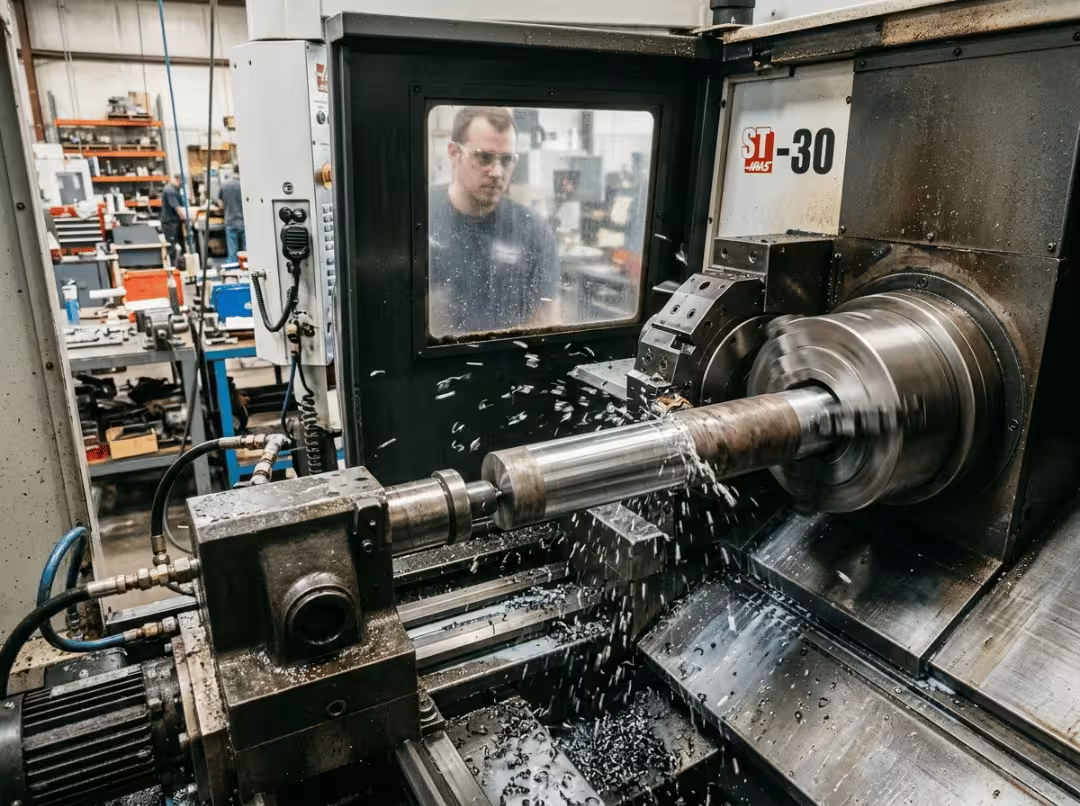
Best for: Round, symmetrical parts — shafts, pins, bushings, fittings, and threaded components.
Not ideal for: Parts with off-axis features or prismatic geometry. A standard lathe cannot machine a square pocket or a cross-drilled hole at an angle. Those features go on a mill — or a turn-mill.
Common materials: Steel, stainless, aluminum, brass, and machinable plastics.
Typical parts: Shafts, spindles, connectors, fasteners, hydraulic fittings.
Cost note: A standard three-axis lathe typically runs between $38,000 and $60,000; Swiss and multi-axis machines cost more.
Essengold’s CNC turning service covers precision shafts, custom fittings, and high-volume turned components — ideal for symmetric parts where surface finish and dimensional consistency matter.
Turn-Mill (Multi-Tasking) Machines
What it does: A turn-mill combines turning and milling in a single clamping. The part rotates as it would on a lathe, and live milling tools handle off-axis features — flats, cross-holes, angled slots — without the part ever leaving the machine. This is a genuinely different capability, not a mild upgrade.
Best for: Complex parts carrying both round and prismatic features that must hold tight spatial relationships. A stainless shaft with a pair of drilled cross-holes and a milled flat is the obvious example. Getting those features onto a lathe, then a mill, and expecting them to land in the right positions relative to each other introduces risk. One setup eliminates that risk.
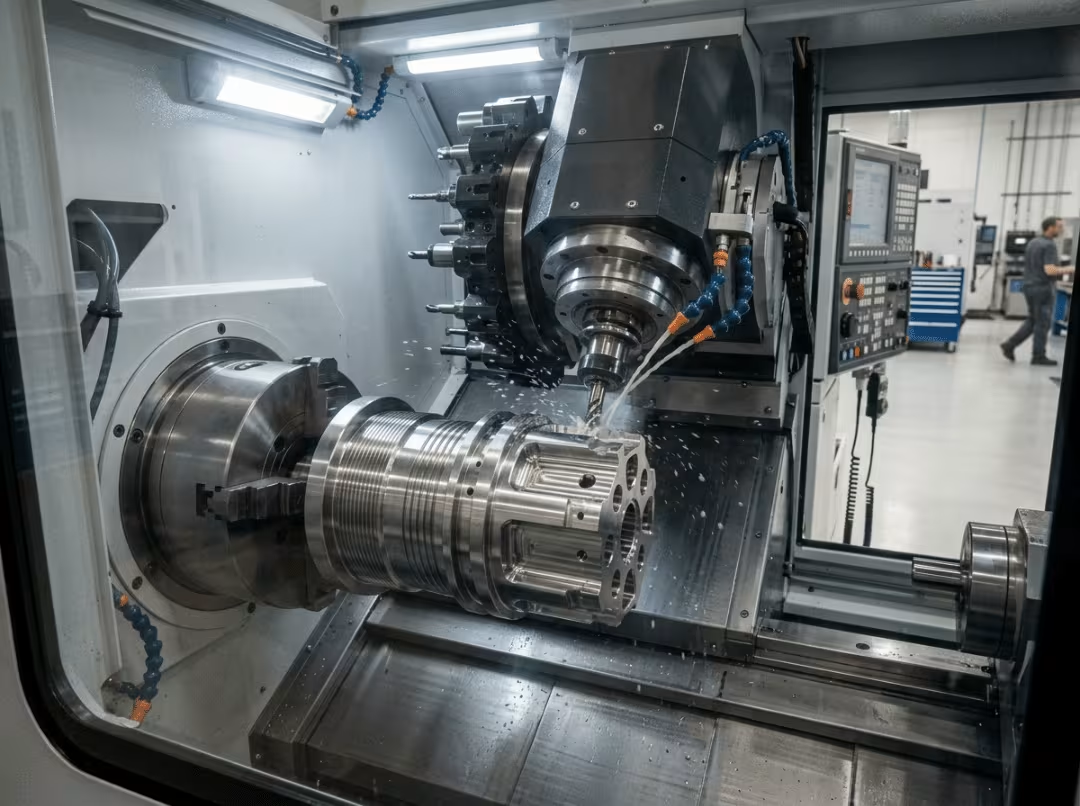
The real payoff: Every transfer between machines introduces potential for misalignment. Setup error accumulates. Keeping the part in one clamping removes that accumulation — which is why turn-mill is the standard in medical device and aerospace work, where feature-to-feature accuracy can determine whether a part passes inspection or goes in the scrap bin.
Not ideal for: Parts that only need turning or only need milling. The machine’s capability is wasted, but its hourly rate is not. Running a simple shaft on a turn-mill center is an expensive way to get ordinary results.
Common materials: The same range as lathes and mills, weighted toward higher-value alloys where the accuracy justification is clearest.
Typical parts: Surgical implants, valve bodies, aerospace fittings, complex shafts with off-axis detail.
Cost note: Industrial turn-mill centers routinely exceed $100,000; smaller machines start around $40,000.
Essengold’s millturn machining capability is built specifically for parts that require both turning and milling features held to precise relationships — one setup, one clamping, consistent results.
CNC Drilling Machines
What it does: A dedicated CNC drill positions and drives a rotating bit to produce through-holes and blind holes, along with reaming, boring, and tapping. The spindle steps down to cut; the bit’s flutes clear chips upward.
Best for: High-volume, repetitive hole patterns where a specialized machine outpaces a mill running the same operations.
Not ideal for: Anything beyond hole-making. It is a specialist tool with a narrow job description.
Common materials: Metals, plastics, composites.
Typical parts: Plates, flanges, structural members, parts defined by dense hole patterns.
Cost note: Basic machines start near $15,000; large-capacity and multi-spindle drills exceed $50,000.
Worth noting: most shops drill on a mill. A standalone drilling machine earns its place mainly in high-volume production where cycle time per hole becomes a real bottleneck.
CNC Grinding Machines
What it does: A grinder removes very small amounts of material with a rotating abrasive wheel. It is not built for stock removal — it exists to hit dimensional tolerances and surface finishes that cutting alone cannot consistently achieve, almost always as a finishing step after milling or turning.
Best for: Precision finishing to tolerances and Ra values that a cutter can’t reliably hold, and for working hardened materials that would destroy a standard end mill.
Not ideal for: Heavy stock removal or shaping from a raw blank. It is slow and intentional, built for the final few microns.
Common materials: Hardened steel, tool steel, ceramics, and other hard or precision-critical materials.
Typical parts: Bearing races, gear flanks, cutting tool surfaces, precision shafts, die faces.
Cost note: Entry machines start around $6,000; production CNC grinders run well past $50,000.
|
Machine |
Best geometry |
Typical tolerance |
Cost range |
|---|---|---|---|
|
Milling |
Prismatic, complex 3D |
±0.025 mm |
$30K–$80K+ |
|
Turning |
Round, symmetrical |
±0.025 mm |
$38K–$60K+ |
|
Turn-mill |
Combined round + prismatic |
±0.01 mm |
$40K–$100K+ |
|
Drilling |
Dense hole patterns |
±0.05 mm |
$15K–$50K+ |
|
Grinding |
Precision finishing |
±0.002 mm |
$6K–$50K+ |
CNC Machine Types by Cutting Method
These machines do not use a solid cutter. They remove material through heat, abrasive pressure, or electrical discharge — and they belong on the jobs that rotating tools cannot handle cleanly.
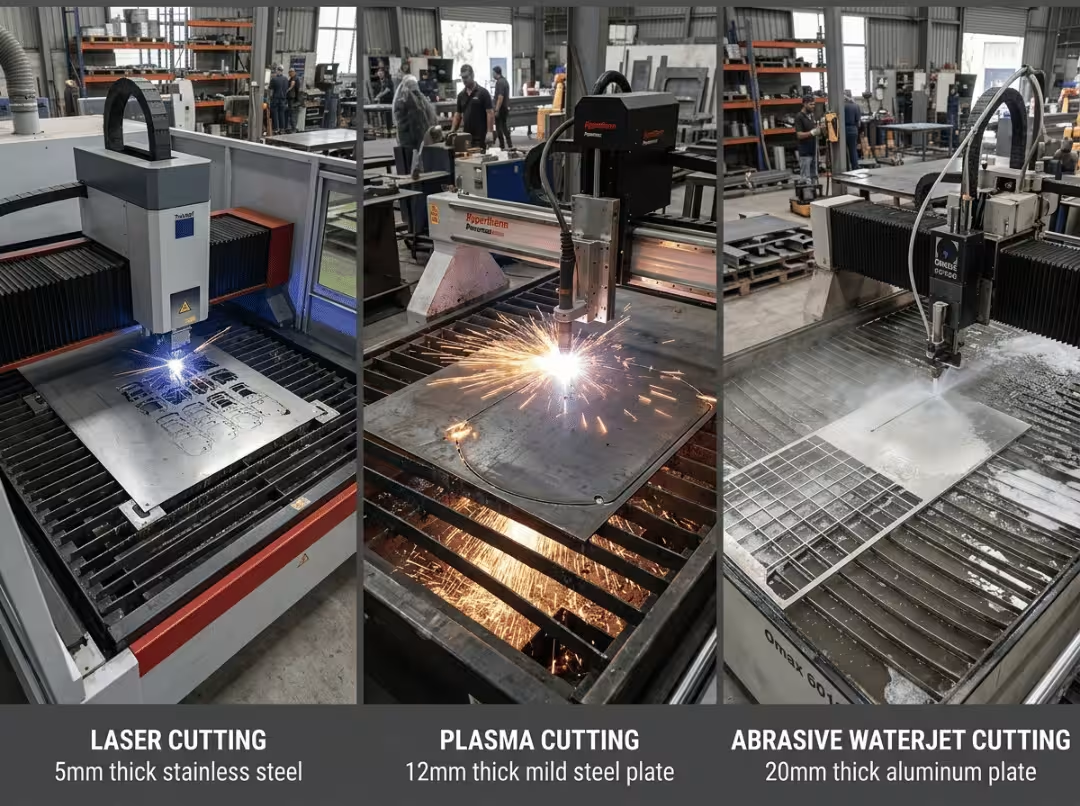
CNC Laser Cutting Machines
What it does: A laser cutter focuses a high-energy beam to melt or vaporize material along a programmed path. The small, precise beam produces clean edges and fine detail. CO₂ lasers suit non-metals and thinner stock; fiber lasers cut reflective and thicker metals faster and more efficiently.
Best for: Precise cuts and fine detail on thin-to-medium sheet — metals, plastics, and composites. If the part is a flat profile with tight edge tolerances and the material is under about 20 mm, laser is usually the answer.
Not ideal for: Very thick plate, and highly reflective metals like copper and brass on CO₂ systems. The beam reflects rather than cutting, which creates problems in the optics and erratic edge quality on the part.
Common materials: Sheet steel, stainless, aluminum, acrylic, composites.
Typical parts: Sheet-metal panels, gaskets, engraved plates, brackets, intricate 2D profiles.
Cost note: Entry systems start near $10,000; industrial machines reach $200,000 and beyond.
CNC Plasma Cutters
What it does: A plasma cutter drives an ionized gas jet at extreme temperature through a nozzle to cut conductive metal. It moves fast through mid-thickness plate at lower operating cost than a comparable laser.
Best for: Fast, economical cutting of conductive metal in the 1 mm to 50 mm range. If the part is structural steel plate and edge quality is secondary to throughput, plasma wins on cost and speed.
Not ideal for: Non-conductive materials, very thin sheet where heat distorts the edge, or work where laser-grade edge quality is a design requirement.
Common materials: Carbon steel, stainless, aluminum, other conductive metals.
Typical parts: Structural steel, enclosures, brackets, ducting, heavy plate components.
Cost note: Small systems start around $12,000; larger machines pass $50,000.
CNC Waterjet Cutting Machines
What it does: A waterjet cuts with an ultra-high-pressure stream, usually mixed with abrasive garnet for hard materials. It is a cold process — no heat-affected zone — so the edge does not warp, harden, or change metallurgical properties near the cut.
Best for: Thick, hard, or heat-sensitive materials where a thermal process would compromise the part. Composites, titanium plate, hardened steel, stone, and glass all cut cleanly on a waterjet where laser or plasma would either damage the material or struggle with the thickness.
Not ideal for: Speed-sensitive production or the tightest tolerances, where laser has the advantage.
Common materials: Metals, stone, glass, ceramics, composites, rubber, foam. Thickness can reach several inches on softer materials.
Typical parts: Thick plate, composite panels, stone tile, gaskets, heat-sensitive components.
Cost note: Machines range from roughly $50,000 to $180,000 or more.
|
Process |
Materials |
Max thickness |
Edge quality |
Heat-affected zone |
Relative cost |
|---|---|---|---|---|---|
|
Laser |
Metals, plastics, composites |
Thin–medium |
Excellent |
Minor |
Medium–high |
|
Plasma |
Conductive metals only |
~50 mm |
Moderate |
Yes |
Low–medium |
|
Waterjet |
Nearly any |
Several inches |
Good |
None |
Medium–high |
CNC EDM Machines
What it does: Electrical discharge machining erodes material with controlled electrical sparks between an electrode and the workpiece, submerged in dielectric fluid. No cutting force, no physical contact — which makes material hardness largely irrelevant. Wire EDM uses a continuously fed wire to cut through profiles. Sinker (ram) EDM uses a shaped electrode to burn cavities and blind features into a block.
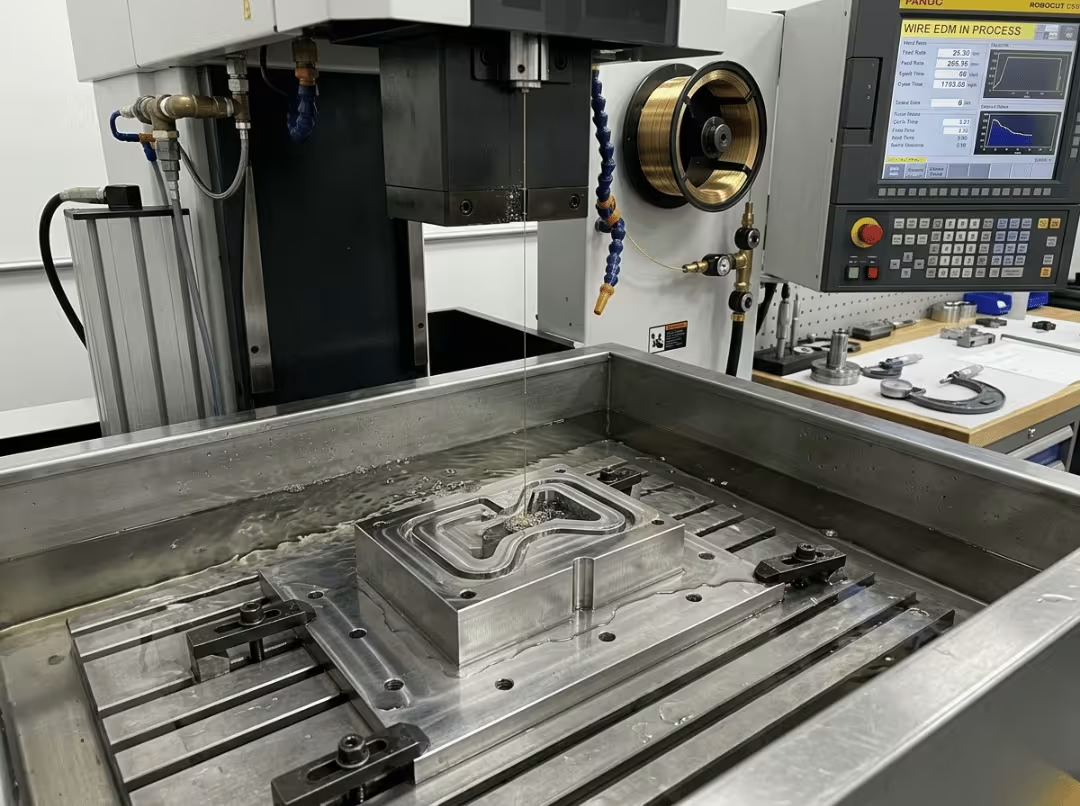
Best for: Hardened tool steel and tough conductive metals, sharp internal corners a round cutter geometrically cannot produce, and delicate features that would fracture under contact force. A D2 tool steel block at 60 HRC with a 0.2 mm internal corner radius is impossible on a mill — it’s a straightforward EDM job.
Not ideal for: Non-conductive materials, jobs where cycle time matters, or geometry that a mill could handle in a fraction of the time. EDM is not a general-purpose machine; it’s the right answer for specific problems.
Common materials: Hardened tool steel, carbide, titanium, other conductive metals.
Typical parts: Injection molds, stamping dies, turbine components, intricate internal cavities.
Cost note: Machines typically run $90,000 to $150,000; smaller units are available below $50,000.
CNC Machine Types by Axis Capability
This grouping describes how freely a machine moves, not what it does. The same milling operation produces very different results at three axes than at five.
3-Axis Machines
A three-axis machine moves along X, Y, and Z. It is the practical default for a large share of machined parts: plates, brackets, housings, and anything whose features face one direction. Affordable, easy to program, and available at almost any shop. The limit appears on parts with features on multiple faces — each new face requires a fresh setup, and every setup adds alignment uncertainty.
4-Axis and 3+2 Machines
Adding a rotary axis lets the part present a new face to the tool without manual re-fixturing. In 3+2 work, the machine locks the part at a fixed angle and cuts in three axes from that position. This reduces setup count substantially for parts with features on several sides, at lower cost and complexity than full simultaneous five-axis motion.
5-Axis and Multi-Axis Machines
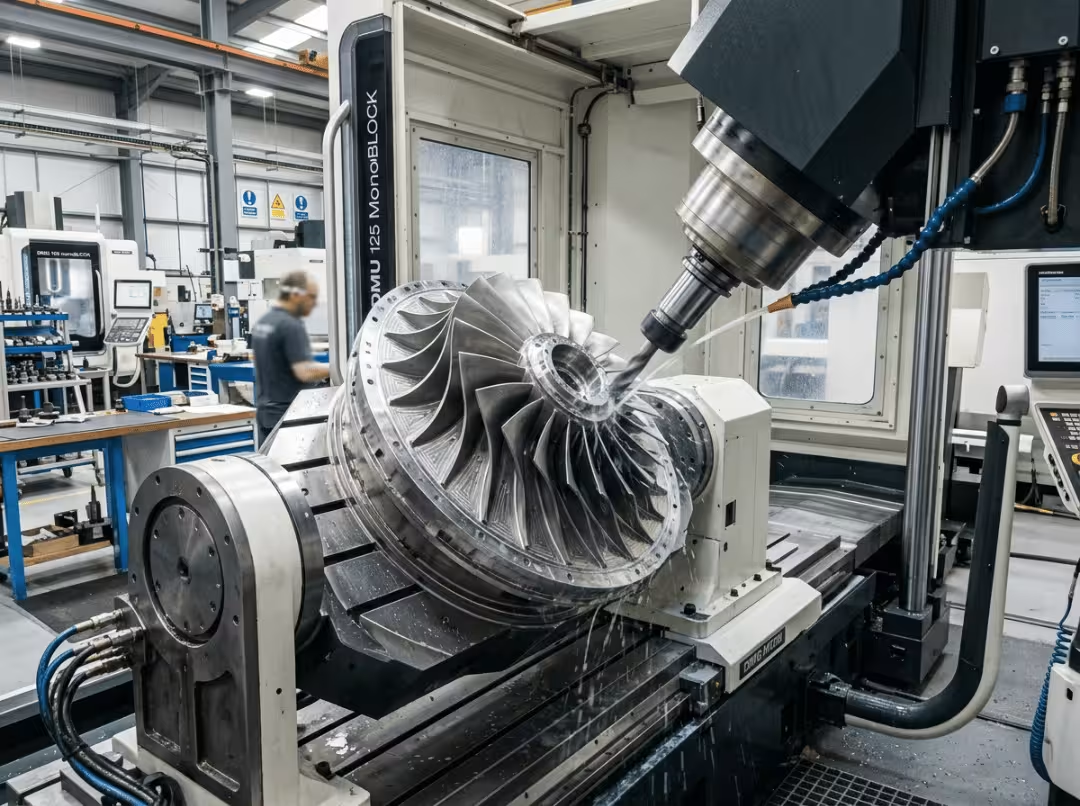
A five-axis machine moves along three linear axes and rotates about two more, simultaneously. That combination reaches undercuts, complex contours, and compound angles that three-axis machines cannot access. It also keeps complex parts in a single clamping, removing the alignment error that accumulates across multiple setups. The trade-off is real: higher machine cost, more demanding programming, and operators whose skill level matches the complexity.
More axes do not mean better in any general sense. They mean fewer setups and more accessible geometry — at a cost premium that is only justified when the part geometry demands it.
CNC Milling vs Turning — Which One Fits Your Part?
The core difference is one line: in milling, the tool spins and the part stays fixed; in turning, the part spins and the tool stays fixed. That distinction drives nearly everything that follows.
Choose milling when the part is prismatic. Flat faces, pockets, slots, bosses, or complex non-round geometry all belong on a mill. A housing, a manifold, a bracket with counterbored holes — these are milling parts.
Choose turning when the part is round and symmetrical. A shaft, a bushing, a threaded fitting — these come off a lathe faster, with better roundness and surface finish than any milling approach. Trying to produce a precision shaft entirely on a mill is a common and expensive mistake.
When you need both, turn-mill is the answer. A shaft with a drilled cross-hole and a milled flat needs the roundness of turning and the off-axis reach of milling. Doing it in two separate machines means accepting the alignment uncertainty of two setups.
|
Factor |
Milling |
Turning |
|---|---|---|
|
Motion |
Tool rotates, part fixed |
Part rotates, tool fixed |
|
Best geometry |
Prismatic, complex |
Round, symmetrical |
|
Typical parts |
Housings, brackets, manifolds |
Shafts, fittings, fasteners |
|
Where it falls short |
Slow and inaccurate on round parts |
Cannot reach off-axis features |
CNC Router vs Milling Machine — Not the Same Tool
Routers and mills share a working principle — rotating spindle, stationary part — but they’re built for different material regimes.
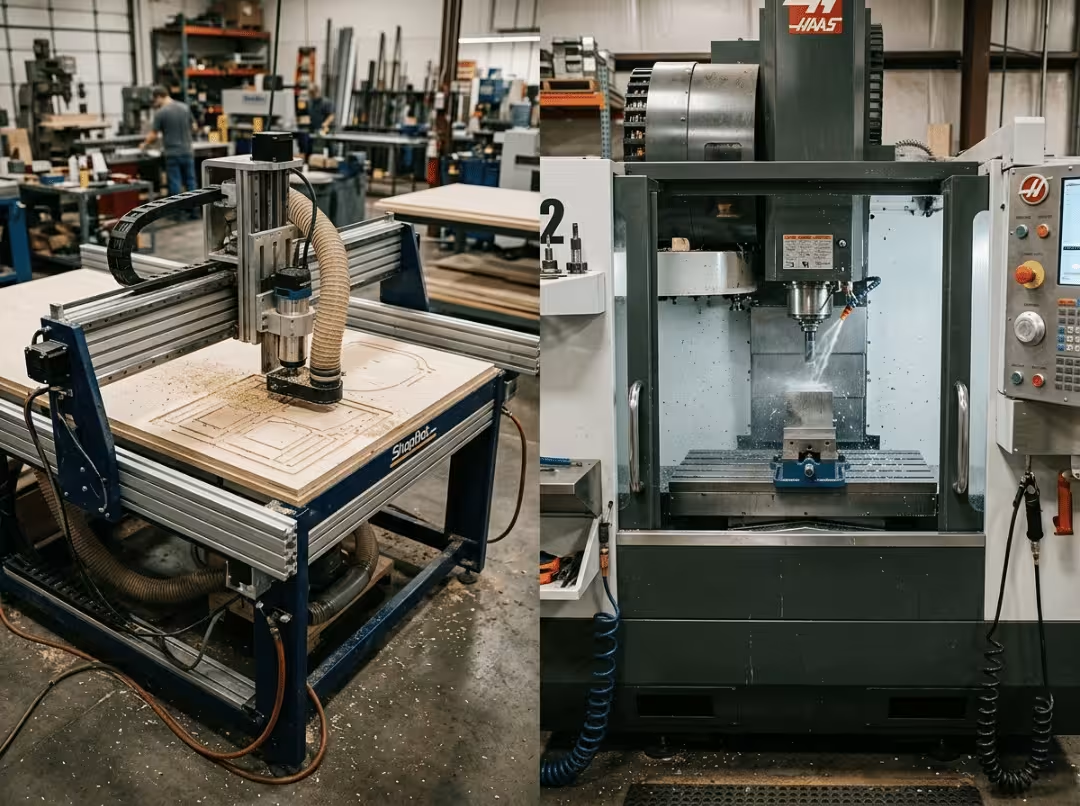
A mill is a heavy, rigid machine designed to push a cutter through hard metal under load and hold tight tolerances. A router is lighter and faster, with a high-speed spindle built for soft materials and large flat sheets where the material offers little resistance and throughput matters more than rigidity.
Choose a router when you’re cutting wood, foam, plastic, or thin aluminum sheet across a large work area and the geometry is relatively shallow.
Choose a mill when the material is a harder metal, the cuts are deep, or the tolerance requirements mean that any flex in the machine shows up as error in the part.
A router is not a cheaper mill. Treating it as one produces poor finishes, broken tooling, and scrapped parts.
Laser vs Plasma vs Waterjet — Choosing a Cutting Process
These three cover the majority of CNC profile-cutting work. The right choice comes down to material, thickness, edge requirement, and heat tolerance.
Laser wins on precision and edge quality for thin-to-medium sheet. When clean edges and tight features matter and the stock is not unusually thick, laser is the default. The beam is small, the kerf is narrow, and the HAZ is manageable on most metals and plastics.
Plasma wins on speed and cost for conductive metal at mid thickness. Edge quality trails a laser, but it moves fast through plate steel at a fraction of the operating cost. For a structural bracket cut from 12 mm mild steel where edge finish is secondary, plasma is the practical answer.
Waterjet wins when the material cannot tolerate heat, when thickness exceeds what laser handles well, or when the material is non-metallic and abrasive. A 40 mm titanium plate, a glass panel, a CFRP composite layer — these cut cleanly on a waterjet where the other two either cannot or should not be used.
To make the call: start with material. Non-conductive eliminates plasma. Heat-sensitive or very thick points toward waterjet. Then weigh edge quality against throughput — laser for finish, plasma for volume on conductive metal, waterjet for the materials neither can touch.
EDM vs Conventional Cutting — When Sparks Beat a Cutter
Milling and turning run into consistent limits: hardened steel that destroys tooling quickly, sharp internal corners a round cutter cannot physically form, and features too delicate to survive contact force.
EDM is the right choice when the material is hardened, when the geometry requires a sharp internal corner, or when the feature won’t survive cutting forces. A punch plate in A2 tool steel at 60 HRC with tight internal radii — that’s an EDM job. A sinker EDM can produce a cavity with corner radii under 0.1 mm that no end mill could approach. Wire EDM can hold ±0.002 mm on through-profiles that a mill would struggle to reach.
EDM is the wrong choice when cycle time matters, the material is non-conductive, or the geometry is simple enough that a mill handles it faster and cheaper. EDM is slow by design. Running mild steel parts through an EDM when a mill would do it in a fraction of the time is a resource decision that rarely makes sense.
EDM trades cycle time for the ability to machine what a solid tool cannot. Use it where conventional cutting hits a wall — not as a substitute for it.
3-Axis vs 5-Axis CNC — Is the Upgrade Worth It?
Five-axis machining offers two concrete benefits: geometric reach and setup reduction. It can access undercuts, sculpted contours, and compound angles that a three-axis machine simply cannot. And by keeping complex parts in one clamping, it eliminates the alignment error that stacks up across multiple three-axis setups.
Three-axis is the right choice when the part is prismatic and features face one direction, when the budget doesn’t justify the five-axis rate, or when part complexity doesn’t require it. Programming is simpler, machine time is cheaper, and the result is the same. Over-specifying here adds cost with no quality gain.
Five-axis earns its cost when the part has complex contours, undercuts, or compound-angle features; when the tolerance is tight enough that multiple setups would accumulate unacceptable error; or when the number of required three-axis setups makes the total job time uncompetitive. Aerospace components, complex medical implants, and impeller geometries are the standard cases. The geometry demands it; the economics follow.
Choose axes based on part geometry and the number of setups the alternative requires. The most capable machine available is not automatically the right one.
How to Choose the Right CNC Machine for Your Project
Work through these five questions in order. The right machine usually becomes clear before you reach the end.
1. Start with geometry
Geometry eliminates options faster than any other variable. Round and symmetrical → turning. Prismatic or complex 3D → milling. Both round and off-axis → turn-mill. Sharp internal corners, hardened material, or delicate cavity features → EDM. Flat sheet profile → laser, plasma, or waterjet. If a shaft needs both its turned diameter and a milled keyway to land within 0.01 mm of each other, that’s a turn-mill job — not a lathe-then-mill sequence.
2. Match material to process
Material rules processes in or out before anything else. Non-conductive eliminates plasma and EDM. Hardened stock eliminates standard milling and turning and points toward EDM or grinding. Heat-sensitive eliminates laser and plasma and points to waterjet. Thin aluminum sheet suits laser. Thick CFRP composite suits waterjet. Get this right first; the remaining choices narrow fast.
3. Set tolerance and surface finish requirements honestly
Loose tolerances leave the most options open. As requirements tighten, so does the list of viable machines. General milling and turning hold ±0.025 mm reliably. Grinding and EDM go considerably tighter. But be precise about what the design actually requires — a tolerance tighter than function demands drives you toward slower, more expensive processes for no real benefit. Over-specifying is a design problem masquerading as a quality standard.
4. Factor in production volume
A prototype and a 50,000-piece production run call for different answers on the same geometry. Low volume favors flexible, general-purpose machines and often makes outsourcing the cleaner economic choice. High volume justifies dedicated setups, specialized machines, and automation that pulls per-part cost down. The question is not just “which machine can make this part” but “which machine makes sense at this quantity.”
5. Weigh cost against lead time honestly
Finally, consider budget and schedule together — and be honest about both. Machine cost, setup time, programming time, and total ownership overhead all factor in. So does whether the part is needed in two weeks. Sometimes the right machine is one you don’t own, because a machining partner can run it faster and cheaper than acquiring the capability yourself.
The best machine for any job is the one that fits geometry, material, tolerance, and volume — not the one with the most impressive specification.
A Quick Word on CNC 3D Printers
3D printers appear on most CNC machine lists. They deserve a brief mention here mainly to clarify what they are not.
3D printing is additive — it builds parts layer by layer rather than removing material from a blank. That difference has real consequences. Printing is better when geometry is too complex to machine directly, when a fast physical prototype is the goal, or when internal channels or lattice structures are part of the design. Machining holds the advantage for tight tolerances, fine surface finish, full material density and strength, and higher production volumes.
The two are complementary tools. Treating them as the same category produces confusion. A printed prototype that passes a form-and-fit check does not validate the machined production part — they are different processes with different material properties.
When Outsourcing CNC Machining Makes More Sense Than Owning a Machine
The purchase price is the most visible cost of a CNC machine. The full picture includes trained operators, tooling, programming software, preventive maintenance, floor space, and the overhead cost of a machine sitting idle between jobs. A capable shop needs several machine types to handle varied work — and each one carries that same overhead.
Ownership makes sense when there is steady, high-volume, repeat work that keeps machines productive, and when in-house process control is a genuine business requirement. At that consistency and scale, the economics of ownership are clear.
Outsourcing makes more sense when parts span several machine types, demand swings up and down, turnaround needs to be fast, or five-axis, turn-mill, or EDM capability is needed occasionally rather than constantly. A machining partner provides access to the full range of processes described in this guide — without the capital commitment, staffing overhead, or maintenance schedule.
For prototypes, one-off parts, and mixed-process jobs, outsourcing is almost always the sharper economic choice. If your project fits that description, Essengold’s CNC machining services cover milling, turning, millturn, and precision work across metals and engineering plastics — upload your design files for a DFM review and a direct recommendation on the right process for your part.
Types of CNC Machines — FAQ
How many types of CNC machines are there?
There is no fixed number. It depends entirely on how you classify. By machining function: milling, turning, drilling, grinding. By cutting method: laser, plasma, waterjet, EDM. By axis: three-, four-, and five-axis variants. The practical working set covering most production work is milling, turning, turn-mill, drilling, grinding, laser, plasma, waterjet, and EDM.
Which CNC machine type is most commonly used?
CNC milling and turning together handle the majority of production machining. Milling covers prismatic and complex parts; turning covers round, symmetric geometry. Between them, they account for most of what a general machine shop produces daily.
What’s the difference between a CNC router and a CNC mill?
Rigidity, spindle power, and the material range each is designed for. A mill is a stiff machine built for hard metals and tight tolerances under load. A router is lighter and faster, built for soft materials and large flat sheet stock where the material resists the cutter less. They share a working principle but suit different jobs — substituting one for the other reliably produces poor results.
Is a 5-axis CNC machine always better than 3-axis?
No. Five-axis is better when the part geometry demands it — complex contours, undercuts, multi-face features that would require many three-axis setups. For a simple prismatic part with features on one face, a three-axis machine is faster to set up, cheaper to run, and produces equivalent results. The extra capability is wasted money and wasted programming time.
When should EDM be used instead of milling?
When the material is hardened, the feature requires a sharp internal corner a round tool cannot form, or the geometry is too delicate to survive contact force. EDM’s lack of cutting force and indifference to material hardness make it the right answer for those specific problems. For softer materials and accessible geometry, milling is far faster.
Laser, plasma, or waterjet — how do I choose?
Start with the material. Non-conductive eliminates plasma. Heat-sensitive or very thick points toward waterjet. Then weigh edge quality against throughput: laser for precise edges on thin-to-medium stock, plasma for fast economical cuts on conductive metal, waterjet for thick or heat-sensitive material neither of the other two handles well.
What tolerance can CNC machining hold?
It depends on the process. General milling and turning hold ±0.025 mm reliably in production. Grinding and EDM can reach into single-micron territory for critical features. Specify the tolerance the design actually requires — tighter than necessary drives cost and cycle time up without functional benefit.
Conclusion
“Types of CNC machines” only becomes a useful concept when you stop treating it as a flat inventory and start classifying by function, cutting method, and axis capability. That structure converts a confusing field into a set of manageable decisions.
From there, the choices follow logically. Milling and turning handle the large majority of machined parts. Turn-mill, EDM, and multi-axis machines address the harder cases. Every head-to-head decision — mill versus lathe, laser versus plasma versus waterjet, three-axis versus five — traces back to the same four variables: part geometry, material, tolerance, and production volume. Work through those in sequence and the right machine tends to identify itself.
If you’d rather access the full process range through one partner, Essengold offers CNC milling, turning, millturn, and precision machining across metals and engineering plastics — submit your design files for a DFM review and get a direct recommendation on the right machine and process for the part.