Quick Answer
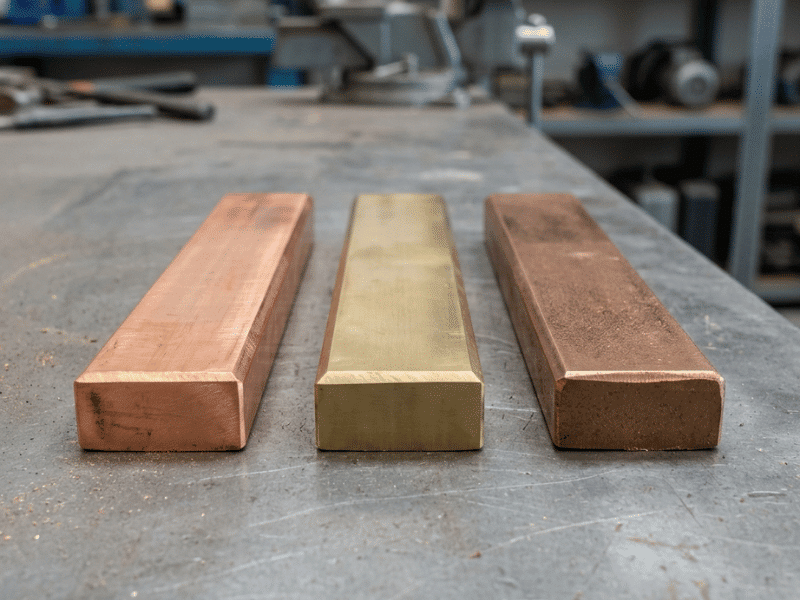
Need a fast answer? Choose copper when electrical or thermal conductivity is the top priority—it outperforms both alloys on that measure. Choose brass when you need the best balance of machinability, cost, and appearance, making it the default for fittings, valves, and decorative hardware. Choose bronze when wear resistance and saltwater corrosion resistance matter most, covering bearings, bushings, and marine components.
One important caveat: picking the right metal family is only the first decision. The specific grade you select within that family often has more impact on final performance than the family itself.
Introduction
Brass, bronze, and copper share a warm metallic appearance that makes them easy to confuse—yet they behave very differently under load, heat, and corrosion. Choosing the wrong one doesn’t just affect performance; it can quietly compromise an entire component. The real question isn’t simply “what’s the difference?” It’s “which one should I actually specify for this part?”
This guide answers both. You’ll get a master comparison table, a plain-English breakdown of the properties that matter most, and clear if/then logic for making a decision. We’ll also cover the best material for each application, why specific alloy grades affect the outcome, what drives cost differences, common misconceptions, and a targeted FAQ. By the end, you’ll be able to make a defensible material choice—not a guess.
Master Comparison Table
The table below captures the general rules across the most important selection criteria. Treat it as your starting point; each property carries nuance depending on the specific grade, which we unpack in detail further down.
| Property | Brass | Bronze | Copper |
|---|---|---|---|
| Composition | Copper + zinc (plus lead, tin, etc.) | Copper + tin (or aluminum, phosphorus) | Pure copper (99%+) |
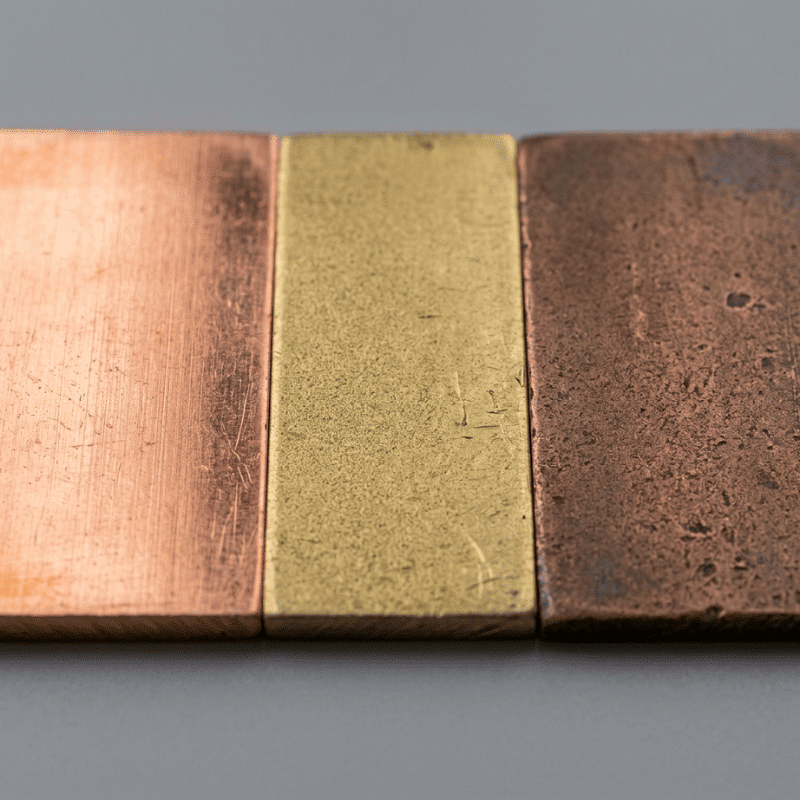
| Color | Muted yellow-gold | Reddish-brown, dull gold | Bright reddish-orange |
| Tensile Strength | ~338–470 MPa | ~350–635 MPa | ~210 MPa |
| Corrosion Resistance | Good | Excellent (great in saltwater) | Excellent |
| Electrical Conductivity | ~28% of copper | ~15% of copper | 100% (the benchmark) |
| Machinability | Excellent (free-machining grades) | Moderate | Good but "gummy" |
| Relative Cost | Lowest | Moderate–high | Highest |
| Common Uses | Fittings, valves, hardware, instruments | Bearings, bushings, marine parts | Wiring, heat sinks, busbars |
These values shift by grade. A leaded free-machining brass and a naval brass behave differently, just as phosphor bronze and aluminum bronze aren’t interchangeable. Use this table to narrow your options, then confirm your choice using the grade-level sections below.
What Are Brass, Bronze, and Copper?
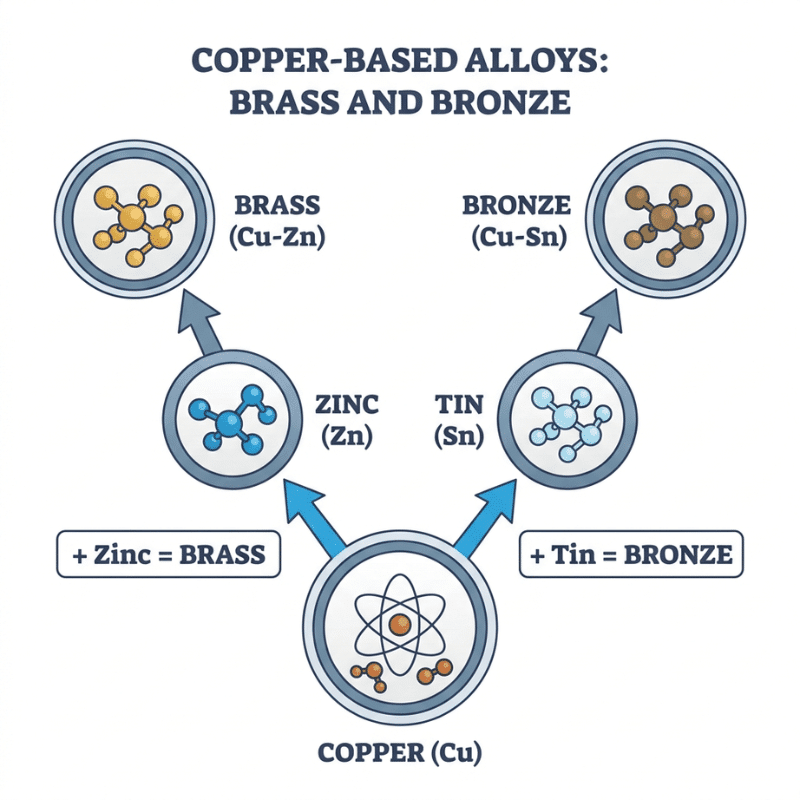
All three are copper-based, but only one is a pure metal. Understanding how they relate to each other makes every downstream decision easier.
Copper – The Base Metal
Copper is a naturally occurring pure element—not an alloy. It sits at the foundation of this entire metal family. Both brass and bronze start with copper and add other elements to change their behavior.
Copper’s defining strengths are outstanding electrical and thermal conductivity, high ductility, and solid corrosion resistance. It’s so conductive that it serves as the industry benchmark: when you see a rating like “28% IACS,” it means 28% of copper’s conductivity.
The trade-off is softness. Copper bends and stretches easily, which is exactly what you want for wire and tubing—but makes it a poor choice for load-bearing or wear-critical structural parts.
Brass – Copper + Zinc
Brass is a copper alloyed with zinc, and the zinc content is the key variable. It directly controls color, strength, ductility, and machinability. Higher zinc content produces a paler, stronger alloy; lower zinc content keeps the metal more reddish and more ductile.
Many brasses also contain small amounts of lead, which dramatically improves machinability. That’s one reason brass is a go-to for high-volume machined parts—it cuts cleanly, produces good finishes, and is easy on tooling.
Because zinc is cheaper than both copper and tin, brass is typically the most affordable of the three. That combination of low cost, easy machining, and attractive appearance explains its dominance in fittings, valves, hardware, and decorative components.
Bronze – Copper + Tin (and More)
Bronze is traditionally a copper alloyed with tin, but the modern definition is broader. Today, “bronze” refers to a family that includes aluminum bronze, phosphor bronze, silicon bronze, and bearing bronze. Treating them as a single material is a common and costly mistake.
Saying “use bronze” is a bit like saying “use steel.” The category is large, and the grades vary widely. Aluminum bronze delivers exceptional strength and seawater resistance; phosphor bronze excels for springs and wear surfaces; leaded bearing bronze is purpose-built for low-friction bushings.
What runs through all of them is durability. Bronzes tend to be hard, wear-resistant, and highly corrosion-resistant—especially in marine environments.
Key Property Differences Explained
Numbers alone rarely tell the full story. Here’s what each property means in practice, and why the metals differ the way they do.
Strength and Durability
Bronze typically leads in strength. Its tin or aluminum content creates a harder, denser structure that resists deformation and wear, which is why bronze holds up inside bushings and gears where surfaces grind against each other for years.
Brass sits in the middle. It’s stronger than pure copper thanks to its zinc content, but generally softer than most bronzes. Copper is the softest of the three; as a ductile pure metal, it’s excellent for forming but unsuitable for load-bearing applications.
The practical rule: if a part must resist wear or carry mechanical stress, lean toward bronze. If it needs to conduct or bend rather than bear a load, copper’s softness works in your favor.
Corrosion Resistance
All three form a protective surface patina that slows further corrosion—but they don’t perform equally. Bronze is the standout in saltwater. Its tin and aluminum content forms a stable oxide layer that shrugs off marine environments, which is why propeller shafts and boat fittings are so often made of bronze. This isn’t just tradition; it’s chemistry.
Copper also resists corrosion well, developing the familiar green patina over time. Brass is good, but the weakest of the three. High-zinc brasses are vulnerable to “dezincification,” in which zinc gradually leaches out, leaving a weak, porous copper structure—a real risk of failure in aggressive water or chemical environments.
Electrical and Thermal Conductivity
Copper is the conductivity benchmark at 100%. Adding any alloying element disrupts the crystal structure that allows electrons to flow freely, so conductivity drops. Brass falls to roughly 28% of copper’s value; bronze drops further to around 15%.
The reason is straightforward: zinc and tin atoms scatter moving electrons. More alloying content means more resistance. Thermal conductivity behaves similarly, since heat and electricity travel through metals by related mechanisms.
If a part’s primary job is carrying current or moving heat—such as wiring, busbars, or heat sinks—copper is the clear default. Alloys only make sense when other performance factors outweigh the need for conductivity.
Machinability and Formability
Free-machining brass, particularly leaded grades, is among the easiest metals to machine. The lead acts as both a chip breaker and an internal lubricant, allowing tools to run at high speeds with clean finishes and minimal wear. That directly reduces machining cost, which is why it’s a machinist’s first choice for high-volume production runs.
Bronze is moderate: harder and tougher, it cuts more slowly and wears tooling faster. Copper is deceptively difficult. Its softness makes it gummy—it grabs tools and produces stringy chips instead of clean breaks, which slows cycle times and increases scrap.
For formability—bending, drawing, stamping—the order flips. Copper’s ductility makes it superbly formable, brass is workable, and many bronzes are too hard to form without cracking.
Weight and Appearance
The three metals are close in density, but color is the quickest field identifier. Fresh copper is a bright reddish-orange—think of a new penny. Brass is a muted yellow-gold, warmer and paler. Bronze tends toward a reddish-brown with a duller tone, sometimes shifting toward brownish-gold.
Color isn’t infallible—patina, surface finish, and lighting all shift appearance, and bronze and copper are the trickiest pair to separate by eye. But as a first-pass check, it’s still the fastest tool you have.
How to Choose
The fastest path to a decision: match the metal to your single most critical requirement, then lock in the grade.
Choose Copper If…
- You need maximum electrical conductivity (wiring, connectors, busbars).
- You need maximum thermal conductivity (heat sinks, heat exchangers).
- Ductility and formability outweigh strength requirements.
- The part is not load-bearing or wear-critical.
Choose Brass If…
- Machinability and cost are top priorities (high-volume machined parts).
- You need an attractive decorative finish.
- You’re making fittings, valves, or hardware in moderate-corrosion environments.
- You need reasonable strength without the cost premium of bronze.
Choose Bronze If…
- Wear resistance is critical (bearings, bushings, gears, sliding surfaces).
- The part faces saltwater or marine conditions.
- You need high strength and fatigue resistance under sustained load.
- Long service life justifies a higher material cost.
Quick Decision Flow
Work through these three questions in order. Stop at the first “yes.”
| Ask Yourself | If Yes → Choose |
|---|---|
| Is conductivity (electrical or thermal) the top requirement? | Copper |
| Does the part face saltwater, wear, or heavy mechanical stress? | Bronze |
| Do machinability, cost, and appearance matter most? | Brass |
If two criteria compete, ask which failure is less acceptable—a poorly conducting part, a worn-out part, or an over-budget part. That answer usually resolves the tie.
Best Material by Application
Sometimes the clearest path is to start from the application itself. Here’s the typical best fit by use case, with the reasoning behind each recommendation.
Plumbing and Fittings
Usually brass. It machines cleanly into threads and valve bodies, handles moderate water corrosion well, costs less than bronze, and carries natural antimicrobial properties. For aggressive water chemistry, specify a low-zinc or dezincification-resistant (DZR) brass grade to avoid long-term corrosion failures.
Marine and Saltwater
Usually bronze. Aluminum bronze and silicon bronze handle seawater exceptionally well. When a brass is required, naval brass (C464) is the right choice—it adds tin specifically to resist saltwater. Standard yellow brass degrades quickly in marine service. Grade selection here is non-negotiable.
Electrical Components
Usually copper. For anything carrying significant current or heat, copper’s conductivity is unmatched. Brass terminals are a reasonable compromise when you need strength, threadability, or spring behavior and can accept lower conductivity—think connectors and terminal blocks, not primary conductors.
Bearings and Bushings
Usually bearing bronze—not just “bronze.” Leaded bronze and phosphor bronze deliver low friction, high wear resistance, and the ability to retain lubricant over long service cycles. Specifying generic “bronze” here risks the wrong grade; bearing-specific grades are what actually produce long service life.
Decorative Hardware
Usually brass. Its warm gold tone, ease of machining, and high polish make it the standard choice for handles, trim, fixtures, and instruments. Bronze is a credible alternative when a darker, more antique appearance is desired—and it accepts a wide range of surface finishes.
CNC-Machined Parts
Usually free-machining brass (C360). It’s among the fastest and most economical metals to machine, with excellent surface finish and minimal tool wear. Specify bronze only when the part requires wear resistance, or copper only when conductivity is essential—and accept the slower cycle times and higher cost that come with either.
Alloy Variation Matters – Grades Change Everything
This is where careful material decisions, separate from rough approximations, come into play. Each metal family contains grades that behave very differently from one another. Specifying “brass” or “bronze” without a grade is a bit like ordering “a vehicle” without specifying a model—the range is enormous, and the wrong choice fails in service.
Common Brass Grades
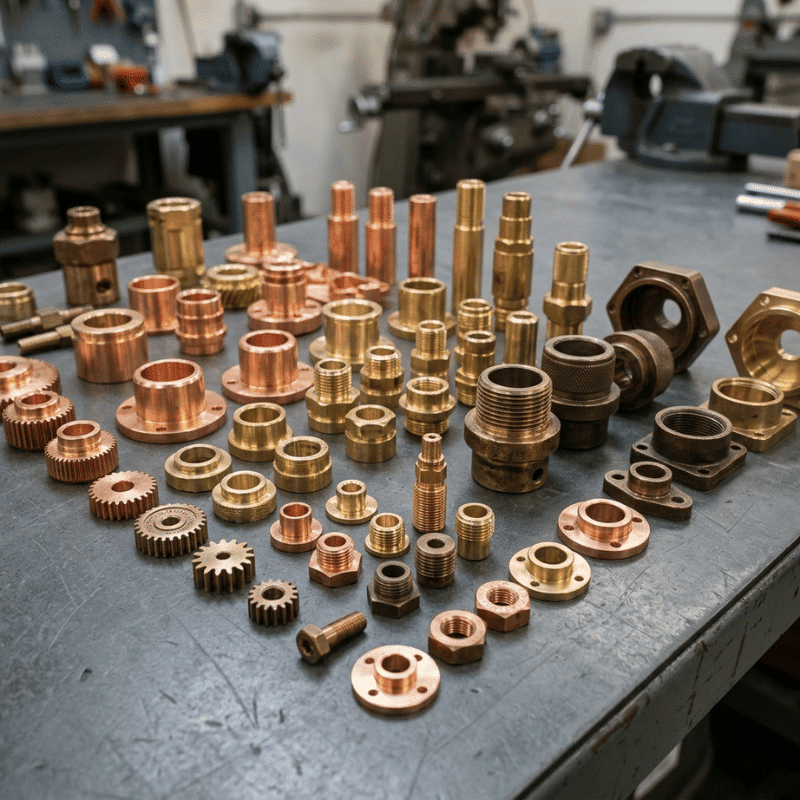
- C360 (Free-Machining Brass): The production standard for machined parts. Fast cutting speeds, clean finishes, low tool wear—ideal for high-volume CNC work, fittings, and fasteners.
- C260 (Cartridge Brass): High ductility and excellent cold-working characteristics. Used for deep-drawn components, ammunition casings, and formed parts.
- C464 (Naval Brass): Tin is added specifically to build saltwater corrosion resistance. The standard choice for marine hardware and fittings where standard brass would fail.
Common Bronze Grades
- Phosphor Bronze: Copper-tin with phosphorus additions. Excellent fatigue resistance and wear performance make it the go-to for springs, electrical contacts, and sliding surfaces.
- Aluminum Bronze: High strength combined with outstanding seawater corrosion resistance. Specified for marine hardware, pump components, and heavy-duty structural parts.
- Bearing Bronze (Leaded): Purpose-formulated for low-friction bushings and bearings. Good load capacity and lubricant retention make it a reliable, long-life choice for sliding-contact applications.
Common Copper Grades
- C101 (Oxygen-Free Copper): Highest purity and ductility. Used where maximum conductivity and long-term reliability are essential.
- C110 (ETP Copper): The most widely used electrical copper. Excellent conductivity at a lower cost—the standard for wiring, busbars, and electrical distribution.
- C145 (Tellurium Copper): Tellurium additions significantly improve machinability while preserving high conductivity. A smart choice for precision-machined electrical components.
Why “Family” and “Grade” Are Two Decisions
Choose the family first, based on your dominant requirement: conductivity, machinability, and cost, or wear and marine resistance. Then choose the grade to fine-tune performance and economics.
Skipping the second step is where most material failures originate. A bronze bushing made from the wrong bronze grade wears out prematurely; a brass marine fitting in the wrong brass grade can dezincify and lose structural integrity. The family narrows your field; the grade closes the decision.
Cost and Availability
Material price follows composition logic. Understanding what drives cost helps you avoid overspecifying—and overspending.
Why Brass Is Usually Cheapest
Brass replaces a portion of expensive copper with zinc, which costs considerably less. That substitution brings the base material price down. Combine that with brass’s fast machinability—which lowers labor and tooling costs—and brass frequently delivers the lowest total part cost of the three.
Copper and Bronze Price Drivers
Pure copper is the most expensive of the three, tracking the global copper commodity market with no lower-cost element to offset it. Bronze falls in between: it’s predominantly copper, with tin or aluminum additions that carry their own price. Specialty grades such as aluminum bronze and phosphor bronze command a further premium due to alloying complexity and lower production volumes.
Total Cost Beyond Material
Raw material price is only part of the cost equation. Machining costs can significantly shift the total. A copper part may cost more to machine than an equivalent brass part because copper’s gumminess slows cycle times, increases tool wear, and generates more scrap.
Factor in tooling life, surface finishing, and yield rates before finalizing a material decision. Free-machining brass frequently delivers the lowest total cost, even when its raw material price is comparable to alternatives, because it machines faster with less waste. Always evaluate total cost, not just the per-kilogram material price.
Common Mistakes and Misconceptions
A handful of persistent myths consistently lead to wrong material choices. Here’s how to recognize and avoid them.
“Brass and Bronze Are Interchangeable”
They are not. Brass is copper-zinc; bronze is copper-tin or copper-aluminum. They differ meaningfully in strength, corrosion resistance, wear behavior, and cost. Substituting one for the other—especially in marine or bearing applications—often leads to premature failure.
“Bronze Is Always Stronger”
Usually, but not unconditionally. Strength depends on the specific grade. A high-strength aluminum bronze significantly outperforms a soft leaded brass, but a hardened brass can exceed a soft bearing bronze in tensile strength. Always compare grade to grade, not family to family.
“Pure Copper Is Always Easiest to Machine”
Copper is soft, which makes this assumption feel intuitive—but it’s wrong in practice. Copper’s softness makes it gummy. It grabs tooling, produces long stringy chips, and resists clean breaking cuts, making it harder to machine efficiently than free-machining brass. For machined parts, brass almost always delivers faster cycle times and lower scrap.
“You Can Always Tell Them Apart by Color”
Color is a useful first clue, not a reliable identifier. Patina, surface finish, aging, and ambient lighting all change how these metals look—and bronze and copper are particularly close in tone when freshly machined. For certainty, verify the supplied grade documentation or use compositional testing rather than relying on the eye alone.
FAQ
Which is better – brass, bronze, or copper?
None is universally superior. Each wins in specific situations. Copper leads for conductivity, brass for machinability and cost, and bronze for wear resistance and marine durability. The right choice is the one that matches your part’s most critical performance requirement.
Is bronze stronger than brass?
Generally, yes. Bronze typically delivers higher tensile and yield strength due to its tin or aluminum content. However, strength varies significantly by grade, so compare the specific alloys under consideration rather than the families in the abstract.
Is brass cheaper than copper?
Yes. Brass contains zinc, which is considerably cheaper than copper. By replacing some of the expensive copper with zinc, brass becomes the most affordable of the three, and its high machinability further reduces total part cost.
Which metal is best for saltwater or marine use?
Bronze—specifically, aluminum bronze or silicon bronze. If a brass is required, specify naval brass (C464), which adds tin for saltwater resistance. Standard yellow brass corrodes quickly in marine environments and should not be used in that service.
Which is easiest to machine: brass, bronze, or copper?
Free-machining brass (C360) is the easiest by a clear margin. Bronze is moderate. Copper is surprisingly difficult because its softness produces gummy, stringy chips that resist clean cutting and increase cycle times.
How can you tell brass from bronze by color?
Brass shows a muted yellow-gold tone, while bronze is reddish-brown with a duller, sometimes darker finish. The difference is visible but subtle, and patina or surface treatment can blur it. For a reliable identification, check the grade documentation or test the composition.
Is copper softer than brass?
Yes. Pure copper is softer and more ductile than brass. Adding zinc increases hardness and strength. That softness makes copper excellent for forming into wire, tube, and complex shapes—but a liability under mechanical load.
Which is better for bearings: bronze or brass?
Bronze—specifically bearing bronze or phosphor bronze. These grades are formulated for low friction, high wear resistance, and lubricant retention. Brass lacks the wear performance required for reliable, long-life bearing applications.
Does bronze or copper conduct electricity better?
Copper, by a substantial margin. Copper is the conductivity benchmark at 100%; bronze conducts at roughly 15%. For any application where electrical performance matters, copper is the unambiguous choice.
Conclusion
Brass, bronze, and copper share a copper foundation but diverge sharply where it counts. Copper delivers unmatched conductivity. Brass balances machinability, cost, and appearance. Bronze leads in wear resistance and saltwater durability. Getting the choice right begins with identifying your part’s single most critical requirement and matching it to the right family.
But the family is only half the answer. The grade you specify—C360 versus C464 brass, phosphor versus aluminum bronze, C110 versus C145 copper—often determines whether a part succeeds or fails in service. Skipping that step is the most common and most avoidable error in material selection.
Use the master comparison table and the Quick Decision Flow to narrow your options, then validate them with the grade-level guidance and total-cost analysis before finalizing the spec. Match the property that matters most to the grade built to deliver it, and you’ll get a part that performs as designed—at a cost that makes sense.