Sheet metal bending looks simple until you’ve watched a perfectly cut part come off the press brake with cracked edges or an angle that’s three degrees off. After years on the shop floor, I can tell you that good bends come down to a few fundamentals: knowing your material, picking the right method, and respecting the math behind the process.
This guide walks through what truly matters when bending metal in a production setting. You’ll learn the core principles, the standard methods and when to use each one, the tools that get the job done, and the design rules that keep parts out of the scrap bin.
Here’s what you’ll take away:
- How material behavior dictates your approach
- The trade-offs between air bending, bottoming, and coining
- Simple design rules to avoid cracks, oval holes, and warping
- Practical fixes for the most common defects
Let’s get into it.
Core Principles of Metal Bending
At its heart, metal bending deforms material along a straight axis to create a specific shape. You press the metal past its elastic limit, so it takes on a new form and holds it. That permanent change is called plastic deformation, and it’s the whole reason a bent bracket stays bent instead of springing flat again.
The Neutral Axis
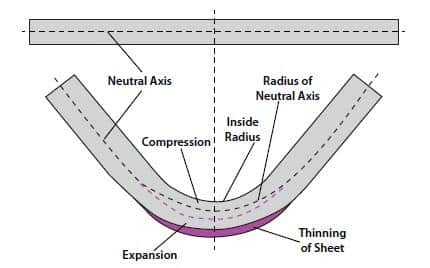
When you bend a piece of metal, the outer surface stretches while the inner surface compresses. Somewhere in between sits a layer that doesn’t change length at all. That’s the neutral axis.
This matters more than it sounds. Because the outside stretches and the inside crowds, your flat blank needs to be sized around that neutral axis—not the inside or outside dimension. Get this wrong, and your finished part comes out too long or too short every time.
Material Choices and Properties
Most shop work involves three families of metal:
- Aluminum — light, easy to form, but prone to cracking on tight radii.
- Stainless steel — strong and corrosion-resistant, but it springs back hard and work-hardens fast.
- Carbon steel — the workhorse, predictable and forgiving across a wide range of bends.
Two properties drive everything: thickness and yield strength. Thicker material needs more force and a larger bend radius. Higher yield strength means the metal resists deformation, so you’ll fight more springback and need more tonnage. Always know these numbers before you set up a job.
Standard Metal Bending Methods
The method you choose depends on how precise the part needs to be and how many you’re making. Here are the four you’ll use most.
Air Bending
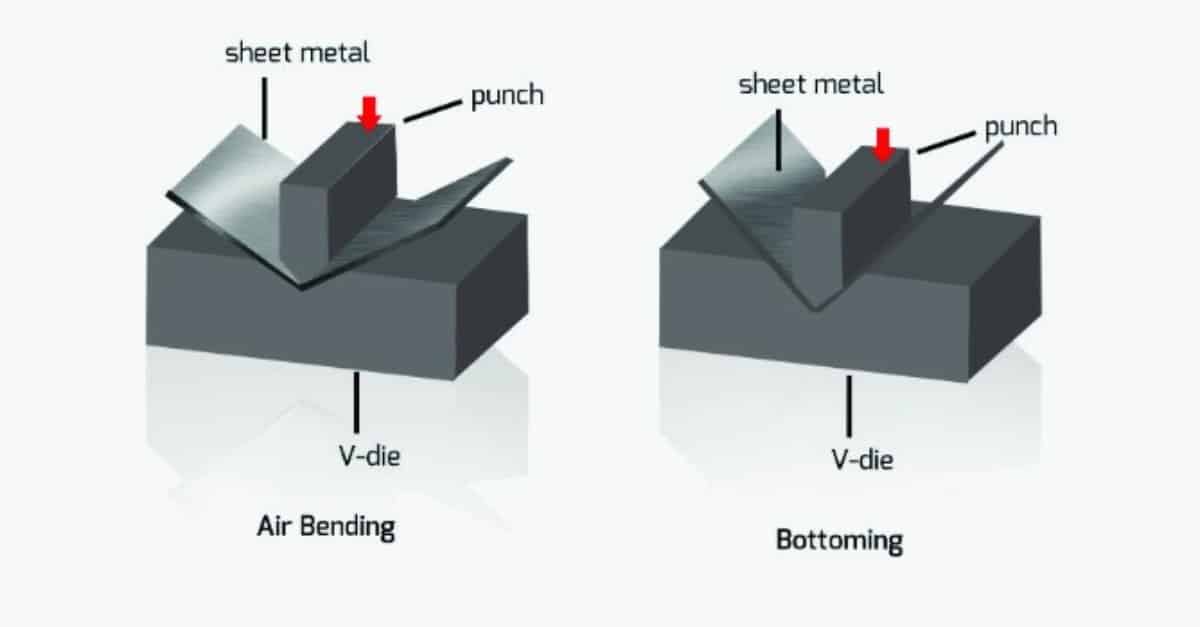
In air bending, the punch presses the workpiece into a V-die but never touches the bottom. The bend angle is controlled by how far the punch descends.
The big advantage is flexibility. One set of tooling can produce a wide range of angles just by changing the punch depth. You also need less tonnage than other methods.
The trade-off is springback. Because the metal isn’t fully formed against the die, it relaxes more after the punch lifts. You’ll compensate by over-bending, which takes a little experience to dial in.
Bottoming
With bottoming, the punch presses the metal all the way into the bottom of the V-die. The material gets fully seated against the die walls.
This gives you better accuracy and far less springback than air bending. The angle is locked in by the die geometry, improving repeatability.
The catch: you need a specific die for every angle you want to produce. That means more tooling on the shelf and more setup changes between jobs. Bottoming makes sense when you’re running higher volumes of the same angle.
Coining
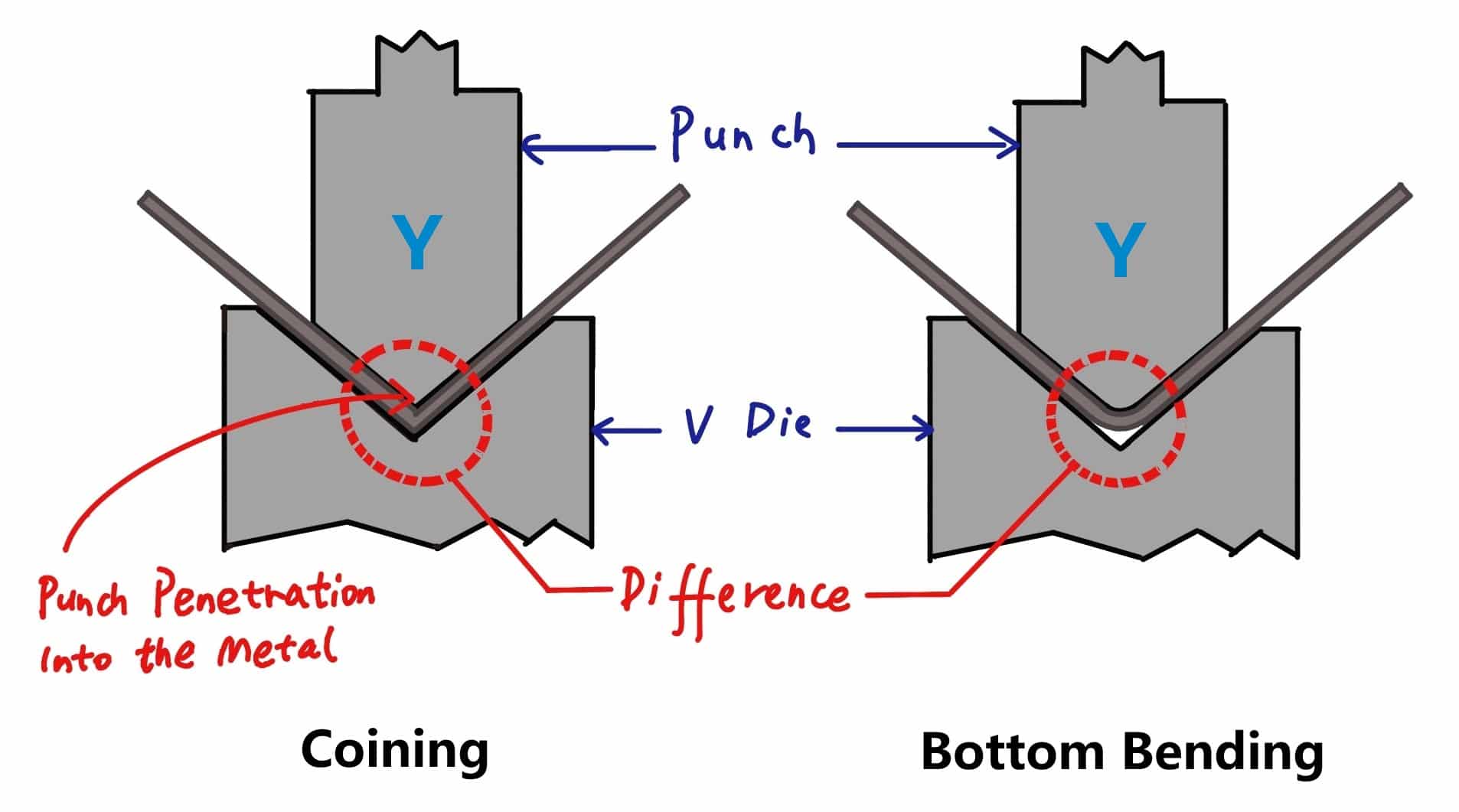
Coining is the high-pressure method. The punch stamps the metal so hard that it actually flows into the die, eliminating springback almost entirely.
Precision is excellent—this is what you reach for on critical, tight-tolerance parts. But it comes at a cost. Coining requires extreme force, often five to ten times that required by air bending. That kind of pressure wears on tooling and the press brake itself, so reserve it for parts that truly demand it.
Roll Bending and Folding
Not every bend happens in a V-die.
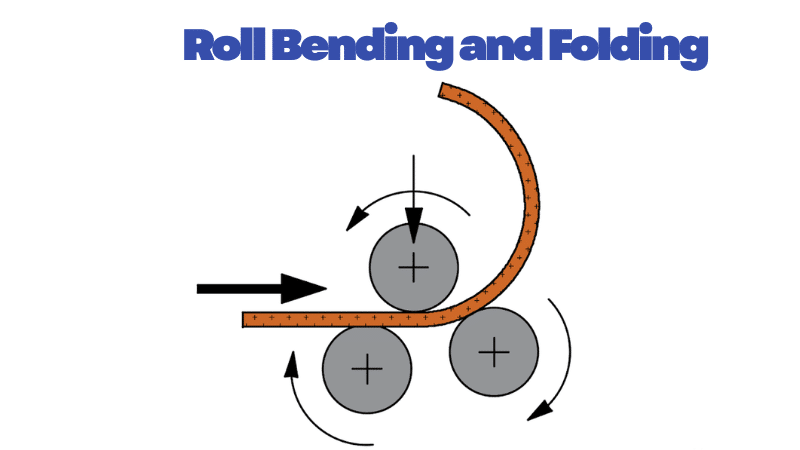
Roll bending uses three rollers to gradually curve large plates or sheets into cylinders and cones. Think tanks, pipes, and structural sections. You feed the material through, adjust the roller position, and build the curve in passes.
Folding works differently. A clamping beam holds the sheet flat while a folding beam swings up to create the bend. It’s gentle on the surface finish, which makes it a good choice for prepainted or delicate material and large sheet sizes.
Essential Tools and Equipment
Good results depend on the machine and tooling behind the bend. Here’s what runs the shop.
The Press Brake
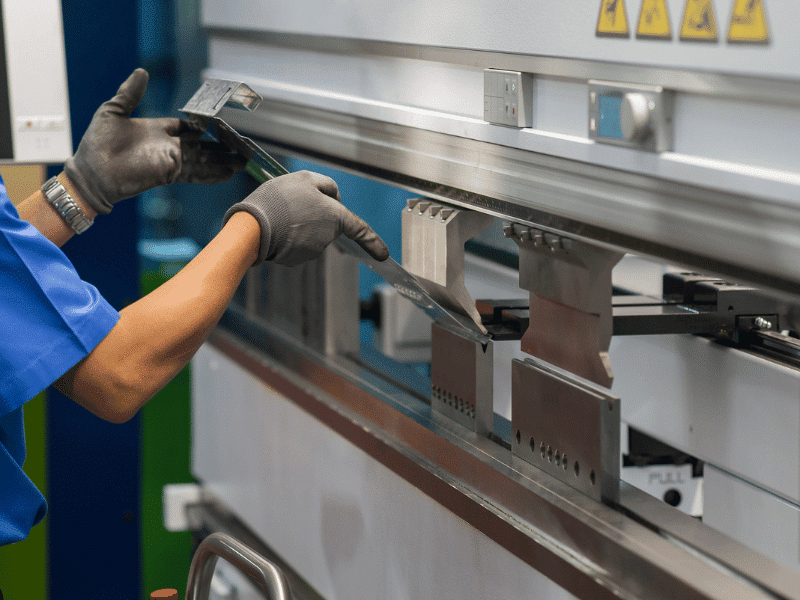
The press brake is the primary machine for industrial sheet metal bending. It clamps a punch above and a die below, then forces them together with the workpiece in between.
You’ll find three main types:
- Hydraulic — strong and reliable, great for thick material and high tonnage. Slightly slower but very consistent.
- Mechanical — fast and powerful through a flywheel, though less flexible on stroke control. Older technology is still around.
- Electric (servo) — fast, energy-efficient, and extremely precise. Best for thinner material and high-repeat work.
Most modern brakes run CNC controllers. These automate the bend sequence, position the back gauge, and store programs so the next run matches the last one exactly. CNC control turns a skilled job into a repeatable one, and it’s a big reason angle variation drops in high-volume work.
Punch and Die Sets
Different geometries call for different tooling:
- V-dies — the standard for most angle bends. Matching the die opening to material thickness is critical for clean results.
- U-dies — for forming channels in a single stroke.
- Gooseneck punches — curved to clear tall flanges and return bends without collision.
All of it should be made from hardened tool steel. Bending puts heavy, repeated stress on tooling, and soft steel wears out fast. Worn tooling shows up as drifting angles, so hardened tooling that holds its edge through thousands of cycles keeps your angles consistent and your costs down.
Measurement and Support Tools
Accuracy starts with positioning. The back gauge sets how far the material sits in the machine, controlling where the bend lands. On a CNC brake, the back gauge moves automatically between bends, so every part repeats the same setup.
For quality control, keep protractors on hand for quick angle checks. For tighter work, laser angle measuring systems read the bend angle in real time and let the machine correct itself mid-stroke. That kind of feedback is a big help when you’re chasing tight tolerances.
Design Tips for Successful Bends
The best bends start at the design stage. A few rules will save you headaches downstream.
Calculating Bend Allowance and Deduction
Because metal stretches during a bend, your flat pattern can’t just be the sum of the finished dimensions. You need to account for that stretch, and that’s where bend allowance comes in.
The key variable is the K-factor. It tells you where the neutral axis lies within the material thickness, usually between 0.3 and 0.5. A lower K-factor means the neutral axis is closer to the bend’s interior. Plug the right K-factor into your bend calculation, and your flat blank will come out the correct size after forming. Get it wrong, and every part will be off.
Minimum Bend Radius
Bend a part too tightly, and the outside surface stretches past its limit, causing cracks. The harder and thicker the material, the worse this gets.
A safe general rule is to keep your inside bend radius at least equal to the material thickness. So for 0.125-inch steel, aim for a bend radius of at least 0.125 inch. Softer materials can sometimes go tighter; hard or thick stock needs more.
One more tip: keep the bend radius consistent across a single part. Using the same radius lets you run the entire part with one punch, reducing tool changes and setup time.
Hole and Slot Placement
Holes placed too close to a bend line get pulled out of round. As the metal stretches through the bend, a nearby hole deforms into an oval.
The fix is simple spacing. Keep holes and slots at least three times the material thickness away from the bend line, measured from the edge of the hole to the start of the bend. Follow this and your holes stay round and your part stays usable.
Common Bending Defects and Solutions
Even a clean setup can throw defects. Here’s how to spot and fix the common ones.
Managing Springback
Springback is the metal’s tendency to return to its original shape after the punch lifts. The harder the material, the more it springs.
The simplest fix is over-bending. Bend a few degrees past your target so that when the metal relaxes, it settles right where you want it. With CNC controls, you can program this compensation and apply it consistently across the run.
Surface Cracking and Orange Peel
Cracking occurs when low-ductility metals or thick plates are bent too tightly. The surface can’t stretch far enough, so it splits. “Orange peel” is a rough, pebbled texture that appears on the outside of a tight bend.
Grain direction is your friend here. Rolled metal has a grain, and bending it parallel to the grain invites cracks. Whenever possible, orient your bend across the grain. The metal forms more cleanly and holds together better.
Bulging and Warping
On the inside of a bend, material crowds together and can bulge outward. Nearby features can warp as the stress travels through the part.
Relief notches solve this. By cutting a small notch at the edge of the bend, you give the crowded material somewhere to go. The stress releases at the notch instead of distorting the rest of the part, keeping your flanges and edges clean.
Common Applications of Sheet Metal Bending
Bending shows up in almost every product that uses formed metal. A few of the most common applications you’ll run across:
- Brackets and mounts — simple, high-volume parts where a bent flange replaces the need for extra hardware.
- Enclosures and housings — boxes and covers that protect electronics and equipment while holding tight tolerances.
- Panels and covers — flat sheets with formed edges for stiffness and clean assembly.
- Chassis and frames — structural parts that need strength without unnecessary weight.
- HVAC ductwork — channels and transitions formed efficiently in high volumes.
- Architectural components — facade panels, trim, and supports that balance function with appearance.
Across all of these, the goal remains the same: accurate, repeatable bends that fit, perform, and minimize scrap.
Frequently Asked Questions
What is the difference between air bending and bottoming?
In air bending, the punch stops short of the die bottom, and the bend angle depends on punch depth. It’s flexible but springs back more. In bottoming, the punch presses the metal fully into the die, giving better accuracy and less springback—but you need a dedicated die for each angle.
What is the minimum bend radius for sheet metal?
A safe starting point is an inside bend radius equal to the material thickness. So for 0.125-inch stock, aim for at least a 0.125-inch radius. Softer materials can sometimes go tighter, while hard or thick stock needs more. Always confirm against the specific alloy and temper before committing.
What is the K-factor in sheet metal bending?
The K-factor indicates where the neutral axis lies within the material thickness, typically between 0.3 and 0.5. It’s the core variable in any bend allowance calculation. Get the K-factor right for your material, and your flat blank comes out the correct size after forming.
How do I prevent cracks when bending aluminum?
Aluminum cracks easily on tight bends, so be generous with the radius. Start with an inside radius equal to or greater than the material thickness, and increase it for harder tempers, such as 6061-T6. Bend across the grain whenever you can, and test a sample before running the full job.
How much springback should I expect with stainless steel?
Stainless springs back noticeably more than mild steel because of its higher yield strength, and it work-hardens fast. Plan to over-bend further than you would for carbon steel, and dial in the compensation on a test piece. CNC controls make it easy to apply that adjustment consistently across the run.
How do I choose the right bend radius for aluminum?
Aluminum cracks easily on tight bends, so be generous. Start with an inside radius equal to or greater than the material thickness, and increase it for harder tempers, such as 6061-T6. When in doubt, bend across the grain and test a sample first.
Why does the grain direction matter when bending steel?
Rolled steel has a grain running in the direction it was processed. Bending parallel to the grain makes cracking more likely. Bending across the grain spreads the stress more evenly, so the bend holds up better and looks cleaner.
What causes a press brake to produce inconsistent angles?
Common culprits include worn tooling, inconsistent material thickness, springback variation, and back gauge positioning errors. Variations in material hardness from batch to batch also show up as angle drift. Real-time angle measurement and well-maintained tooling reduce these problems.
How can I calculate the flat length of a part before bending?
Add up the flat sections, then add the bend allowance for each bend. The bend allowance uses your material thickness, bend angle, inside radius, and K-factor. Getting the K-factor right for your material is the key to an accurate flat length.
What are the safety risks associated with industrial bending machines?
Press brakes carry serious pinch-point hazards—fingers and hands near the punch and die are at risk. Heavy material can cause back and crush injuries, and flying debris is a concern on coining operations. Always use guarding, light curtains, proper lifting practices, and follow lockout procedures during setup.
Mastering the Bending Process
Good sheet metal bending comes down to three things working together: knowing your material, using the right tooling, and getting the design math right. Skip any one of them, and you’ll see it in the finished part.
Choose your method based on what the job demands. Air bending gives you flexibility for varied work, while bottoming and coining give you precision for high-volume or tight-tolerance parts. Match the method to your accuracy needs and your production volume, not the other way around.
Two habits will save you the most grief. First, bring your manufacturer into the conversation early—a quick design review catches cracking, oval holes, and warping before they cost you material. Second, keep your press brakes and dies maintained. Sharp, true tooling and a well-calibrated machine are what deliver consistent quality run after run.
Start with these fundamentals, and your bends will come off the brake right the first time.
Planning a part that involves sheet metal bending? Bring us your drawings early. Our team can review your design for manufacturable bend radii, hole spacing, and tooling strategy, build a prototype to prove out the part, and move it into production once it’s dialed in. Reach out for a design review or a fabrication quote, and let’s get your bends right the first time.