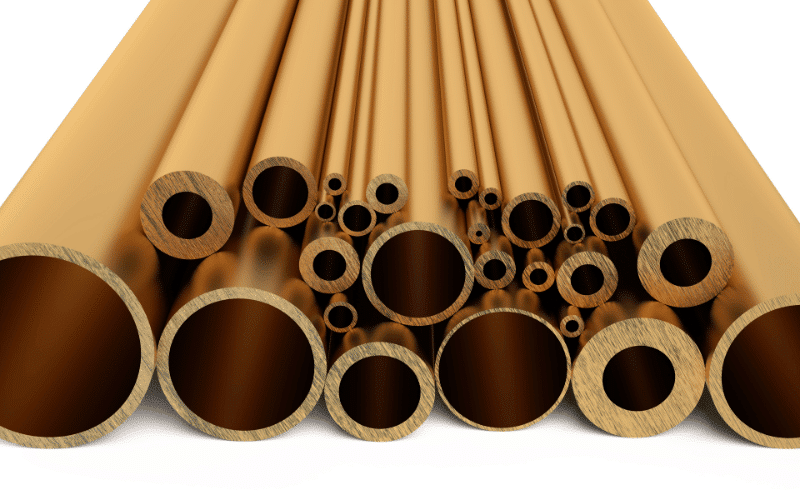
Copper has shaped manufacturing for thousands of years — and it continues to earn its place in modern precision components because no other affordable metal matches what it delivers.
When a design calls for efficient electrical conductivity, fast heat dissipation, or corrosion resistance without a protective coating, copper is typically the first material on the list. It’s also one of the more demanding metals to machine well — something buyers and engineers often discover later in production than they’d like.
This guide covers what you need to know about copper as an engineering material: its core properties, the grades and alloys most relevant to manufacturing, where it outperforms alternatives, and what to plan for when it goes on a CNC machine.
What Is Copper?
Copper (symbol: Cu, atomic number: 29) is a naturally occurring reddish-orange metal known for exceptional electrical and thermal conductivity. It’s one of the few metals found in usable metallic form in nature — a characteristic that made it one of the earliest metals worked by humans.
In modern manufacturing, pure copper is rarely used alone. More often, you’ll work with copper alloys — brass, bronze, beryllium copper — each engineered to balance conductivity, strength, machinability, and cost for a specific application. Choosing the right form is the first real engineering decision in any copper project.
Copper is ductile, non-magnetic, and naturally corrosion-resistant. When exposed to air and moisture, it develops a stable oxide layer — the familiar green patina — that protects the base metal rather than degrading it. That self-protecting behavior makes it a reliable long-term material in plumbing systems, marine environments, and electrical infrastructure.
Physical and Chemical Properties
Copper’s material data tells a clear story about why it holds its position in competitive materials selection.
Physical Properties
| Property | Value |
|---|---|
| Density | 8.96 g/cm³ |
| Melting Point | 1,085°C (1,984°F) |
| Boiling Point | 2,562°C (4,644°F) |
| Electrical Conductivity | ~59.6 × 10⁶ S/m |
| Thermal Conductivity | 401 W/m·K |
| Color | Reddish-orange |
| Hardness (Brinell, pure) | ~35 HB |
Copper ranks second only to silver in electrical conductivity — and silver costs roughly 80 times more per kilogram. Its thermal conductivity of 401 W/m·K places it among the best heat-transfer materials available at an industrial scale.
Density is worth factoring into your design early. At 8.96 g/cm³, copper is approximately 3.3 times denser than aluminum. That difference affects part weight, assembly load, and material cost per component — particularly for high-volume applications.
Chemical Properties
Copper is mildly reactive but does not rust. Rusting is an iron-specific oxidation process. Copper instead forms a reddish-brown copper oxide layer, which over time converts to green copper carbonate — the familiar patina seen on aged copper roofing and architectural elements. This patina is chemically stable and slows further oxidation.
Copper reacts with nitric acid and hot concentrated sulfuric acid but resists most organic acids and mild alkaline environments. Its naturally antimicrobial behavior — copper ions are toxic to a wide range of bacteria and viruses — makes it genuinely functional in medical equipment, food-contact surfaces, and healthcare environments.
Mechanical Properties
Pure copper is softer and more ductile than most structural metals. That ductility is valuable in forming and drawing operations, but it creates real process challenges during machining that are worth understanding before committing to a design.
| Property | Value |
|---|---|
| Tensile Strength | 200–250 MPa (annealed) |
| Yield Strength | ~70 MPa (annealed) |
| Elongation | 35–50% |
| Modulus of Elasticity | ~120 GPa |
| Shear Modulus | ~48 GPa |
The high elongation (35–50%) means that copper deforms significantly before fracturing — useful in wire drawing and tube forming, but challenging in machining. It contributes to long, stringy chips that can wrap around tooling and damage surfaces if not managed.
Copper also work hardens under deformation. Improper feeds and speeds or dull tooling can progressively alter the material’s behavior mid-cut, affecting dimensional accuracy and surface quality. Understanding this behavior up front is key to a reliable machining process.
Copper Grades and Alloys
Specifying “copper” without a grade leaves critical performance variables undefined. The grade determines machinability, conductivity, strength, and cost, and the differences are significant.
Pure Copper Grades
- C110 (Electrolytic Tough Pitch): The most common commercially pure copper grade, at approximately 99.9% copper with a small oxygen content. Widely used in busbars, electrical terminals, and conductors. Offers strong conductivity but requires careful machining technique.
- C101 (Oxygen-Free Copper): High-purity grade at 99.99% Cu with minimal oxygen content. Preferred for vacuum equipment, high-frequency electronics, and semiconductor components where trace oxygen creates performance issues. Excellent electrically, challenging to machine.
- C102 (Oxygen-Free Electronic): Similar to C101 with tighter purity control. Specified for applications where outgassing is unacceptable, such as electron-beam equipment and precision vacuum assemblies.
Common Copper Alloys in Manufacturing
| Alloy | Main Additive | Key Strength | Typical Applications |
|---|---|---|---|
| Brass (C360) | Zinc | Machinability | Fittings, valves, connectors |
| Bronze | Tin | Wear resistance | Bearings, bushings, gears |
| Beryllium Copper | Beryllium | High strength + conductivity | Springs, precision connectors |
| Copper-Nickel | Nickel | Corrosion resistance | Marine components, heat exchangers |
- Brass (C360) is the practical choice when machinability matters. Free-machining brass carries a machinability rating of 100 — the industry benchmark — compared to roughly 20–25 for pure copper. When a design tolerates a modest reduction in conductivity, switching to C360 can dramatically cut cycle times and improve surface finish.
- Beryllium copper delivers a combination that’s hard to find elsewhere: near-copper conductivity alongside tensile strength approaching high-strength steel. It’s the go-to alloy for precision springs, connectors, and instruments where both properties are non-negotiable. Note that beryllium particulate is a serious inhalation hazard — machining beryllium copper demands proper ventilation and PPE compliance.
- Copper-nickel alloys are built for seawater exposure. The nickel content significantly improves resistance to biofouling and saltwater corrosion, which is why they’re standard in shipbuilding, offshore platforms, and marine heat exchangers.
What Copper Is Used For
Electrical and Electronics
No other affordable metal moves electricity as efficiently as copper. It’s used in power cables, motor windings, transformer coils, PCB traces, busbars, and connector pins. The combination of conductivity, ductility, and solderability makes it the default choice wherever reliable current flow is required. For sensitive electronics, oxygen-free grades (C101, C102) are specified where even trace contamination degrades performance.
Plumbing and HVAC
Copper’s pressure tolerance, broad temperature range (−200°C to +250°C for most grades), and antimicrobial properties have made it the standard for potable water pipes, refrigerant lines, and HVAC heat exchangers. Its compatibility with soldering and brazing simplifies both installation and field repair.
Industrial Machinery and Precision Components
This is where copper’s properties intersect most directly with CNC machining. Heat exchanger components, hydraulic fittings, bearing housings, induction coils, and EDM electrodes regularly call for copper or copper alloys. The right alloy holds tight tolerances while delivering the thermal or electrical performance the application requires.
Aerospace, Defense, and Medical
Beryllium copper is the material of choice for precision aerospace instruments, RF connectors, and sensor housings where strength, conductivity, and dimensional stability under thermal cycling all need to coexist. In medical settings, copper’s antimicrobial properties make it practical for high-touch surfaces, surgical instruments, and certain implant components.
Copper Machinability — What Engineers Should Know
This is where copper surprises buyers more familiar with aluminum or stainless steel. On paper, a soft, ductile metal should be straightforward to machine. In practice, pure copper is among the more demanding materials to process cleanly.
The two core challenges are work hardening and chip behavior.
Pure copper work hardens as it’s cut. If a tool rubs rather than shears cleanly — from a worn edge, insufficient feed rate, or inadequate rake angle — the surface progressively hardens and each subsequent pass becomes harder. The result is degraded surface finish, tighter tolerances, slipping, and faster tool wear.
Copper’s high ductility also produces long, continuous chips that don’t break cleanly. These chips can wrap around tooling, re-cut the part surface, and cause scratching or smearing that ruins finish. Chip control isn’t a theoretical concern — it’s an active process management task with copper.
Practical guidance that works:
- Use sharp, high-positive-rake tooling — carbide or polished HSS
- Maintain consistent, adequate feed rates — dwelling or rubbing triggers work hardening
- Run higher cutting speeds than you might expect for a soft metal
- Apply cutting fluid generously throughout the operation
- Avoid interrupted cuts where possible; re-entering a work-hardened surface accelerates edge wear
Machinability by grade:
Pure copper (C110) has a machinability rating of approximately 20–25 on the standard brass-referenced scale, where free-machining brass (C360) sits at 100. That four-to-five-times difference directly affects cycle time, tooling costs, and the surface quality you can realistically achieve.
If your application allows substitution, switching from C110 to C360 brass typically reduces machining time by 60–70% while having minimal impact on most mechanical or electrical performance requirements. Where conductivity is non-negotiable, plan feeds, speeds, and tooling selection accordingly — and involve your machining team early in the design process.
Copper vs. Other Metals
| Property | Copper | Aluminum | Stainless Steel | Brass (C360) |
|---|---|---|---|---|
| Electrical Conductivity | Excellent | Good | Poor | Good |
| Thermal Conductivity | Excellent | Good | Low | Good |
| Tensile Strength | Moderate | Moderate | High | Moderate–High |
| Machinability | Moderate | Good | Moderate | Excellent |
| Corrosion Resistance | Good | Good | Excellent | Good |
| Density | 8.96 g/cm³ | 2.70 g/cm³ | 7.90 g/cm³ | 8.50 g/cm³ |
| Relative Cost | High | Moderate | High | Moderate |
- Copper vs. aluminum: Choose copper when electrical conductivity is the primary driver. Aluminum conducts at roughly 61% of copper’s rate — workable in large-format power lines where cross-section can compensate, but not in compact connectors, coils, or terminals where space is fixed. Choose aluminum when weight and machinability take priority; at one-third the density, it’s dramatically easier to machine and produces lighter parts.
- Copper vs. brass: When a design can accommodate a modest reduction in conductivity, brass offers far superior machinability. It’s the practical choice for precision fittings, valve bodies, and connectors with complex geometries.
- Copper vs. stainless steel: When the environment is aggressively corrosive — chloride-rich media, strong acids, elevated temperatures — stainless steel outperforms copper. Where conductivity matters more than chemical resistance, copper remains the better choice.
Advantages and Limitations
Advantages
- Best-in-class electrical conductivity among affordable industrial metals
- Outstanding thermal performance for heat sinks, exchangers, and cooling systems
- Natural antimicrobial properties — no coatings or additives required
- Highly ductile; can be formed, drawn, and shaped into complex geometries
- Self-protecting corrosion resistance through stable oxide formation
- Fully recyclable with no loss of material properties
Limitations
- Significantly heavier than aluminum — not suitable for weight-sensitive designs
- Work hardens during machining, requiring careful process planning
- Higher material cost than aluminum and most carbon steels
- Lower structural strength than steel or titanium
- Not recommended for load-bearing applications above approximately 200°C
- Beryllium copper alloys require specialized safety measures during machining
Frequently Asked Questions About Copper
Is copper magnetic?
No. Copper contains no iron and does not respond to magnets. This makes it useful in environments where magnetic interference is a problem, such as near sensitive instrumentation or MRI-adjacent equipment.
Does copper rust?
No. Rust is an iron oxide process that doesn’t apply to copper. Copper oxidizes to form a reddish-brown copper oxide, then develops a green copper carbonate patina over time. This patina is chemically stable and protects the underlying metal from further corrosion.
Is copper a good conductor of electricity?
Yes — copper is the industry benchmark for electrical conductivity. At approximately 59.6 × 10⁶ S/m, it’s second only to silver among practical industrial metals. This is why it dominates applications in wiring, busbars, motor windings, and connectors globally.
What is the melting point of copper?
Copper melts at 1,085°C (1,984°F) — well above aluminum’s melting point (660°C) but below most steels. For precision machining, the concern isn’t approaching the melting point; it’s managing localized heat at the cutting zone to protect tool life and surface integrity.
Is copper ductile or brittle?
Copper is highly ductile. It draws into a wire, rolls into a thin sheet, and forms into complex shapes without fracturing. That ductility is a forming asset but a machining complication — it produces long chips and increases the risk of surface smearing.
What is the difference between copper and brass?
Brass is a copper-zinc alloy, typically 60–90% copper. It’s harder, significantly more machinable, and less expensive per finished part than pure copper. Pure copper offers higher electrical and thermal conductivity. The right choice depends on whether conductivity or machinability drives the application requirement.
Can copper be CNC machined?
Yes, but it requires proper process setup. Work hardening and long chip formation are the main challenges with pure copper. Sharp tooling with positive rake angles, consistent feed rates, and adequate cutting fluid are essential. For complex precision geometries where maximum conductivity isn’t required, C360 brass is often the more practical material choice.
Is copper corrosion-resistant?
Yes, in most common environments. Copper resists moisture, organic acids, and mild alkaline conditions through its stable oxide layer. It’s less suitable for chloride-rich or strongly acidic environments — copper-nickel alloys are the preferred choice for exposure to seawater or other aggressive media.
What is oxygen-free copper used for?
Oxygen-free grades (C101, C102) are specified where trace oxygen causes performance issues: vacuum equipment, semiconductor processing, RF shielding, and precision electronics. Removing oxygen prevents hydrogen embrittlement at elevated temperatures and reduces outgassing in vacuum environments.
Is copper heavier than aluminum?
Yes. Copper’s density of 8.96 g/cm³ is approximately 3.3 times that of aluminum (2.70 g/cm³). For weight-sensitive applications, this difference is often significant enough to influence material selection even when copper’s conductivity is preferred.
What color does copper turn over time?
Freshly machined copper is bright reddish-orange. Air exposure darkens it to a reddish-brown oxide within hours or days. Over months or years outdoors, it develops the well-known green copper carbonate patina — the same finish seen on aged copper roofing and historical statues.
How do you join copper parts?
Copper is commonly soldered (in electrical and plumbing applications), brazed (for higher-strength structural joints), or welded using TIG or MIG processes. Adhesive bonding is used in some electronics assemblies. Copper’s high thermal conductivity rapidly draws heat away from the joint, so preheating is typically needed for thicker sections to achieve a sound bond.
Key Takeaways
- Copper’s electrical and thermal conductivity remains unmatched at an industrial scale — that’s the core reason it stays in specifications where alternatives fall short
- Pure copper is harder to machine than it looks; work hardening, chip formation, and tooling selection all require active planning
- Alloy selection has a major impact on process efficiency: C360 brass delivers four to five times the machinability of pure copper with acceptable conductivity for most non-critical electrical applications
- Weight is a real constraint — factor in copper’s density early when comparing it to aluminum-based alternatives
- Beryllium copper is the high-performance option when both strength and conductivity are required, but it demands proper safety practices during machining
If you’re sourcing copper or copper alloy components and want guidance on grade selection before committing to production, our engineering team can review your drawings and help you choose the most practical material and process for your requirements.